
6061 vs 7075 Aluminum: Differences, Properties, and Applications
When evaluating aluminum alloys for structural and precision-machined components, 6061 and 7075 are the two most frequently specified grades. As an application engineer at PartsMake, I evaluate these alloys daily during design reviews. Here is an honest, data-driven comparison covering mechanical strength, machinability, corrosion behavior, and cost to help you choose the right material for production.
Engineering Summary
Choose 6061-T6 when your part requires welding, complex sheet bending, high atmospheric corrosion resistance, or cost-effective volume machining. Reserve 7075-T6 for load-critical structural components where extreme yield strength, fatigue endurance, and rigidity outweigh the penalties of raw material cost and weldability limitations.
What Is 6061 Aluminum Alloy?
Alloy 6061 belongs to the 6000 series of wrought aluminum alloys, meaning its primary alloying constituents are magnesium (Mg) and silicon (Si). Together, these form magnesium silicide (Mg2Si), enabling precipitation hardening via solution heat treatment and artificial aging (most commonly into the T6 condition).
In our CNC machine shop, 6061 is the single most common aluminum grade on our pallets. It functions as the universal baseline for mechanical components, structural weldments, fixtures, and consumer electronic enclosures. It balances clean chip formation, solid corrosion behavior, smooth surface finish capabilities, and widespread commercial availability across extruded bars, plates, and tubes.
What Is 7075 Aluminum Alloy?
Introduced by the Sumitomo Metal company in the 1930s and standardized for aircraft airframes during World War II, 7075 is the flagship of the 7000 series. Its primary alloying element is zinc (5.1% to 6.1%), stabilized with significant additions of magnesium and copper.
Heat-treated to the T6 temper, 7075 delivers yield strengths exceeding 500 MPa, rivaling several structural steels while maintaining one-third of the density. We machine 7075 primarily for clients in aerospace, high-performance defense systems, competitive motorsport suspensions, and downhole robotics where every gram matters and elastic deflection under peak load must be strictly controlled.
Chemical Composition of 6061 vs 7075 Aluminum
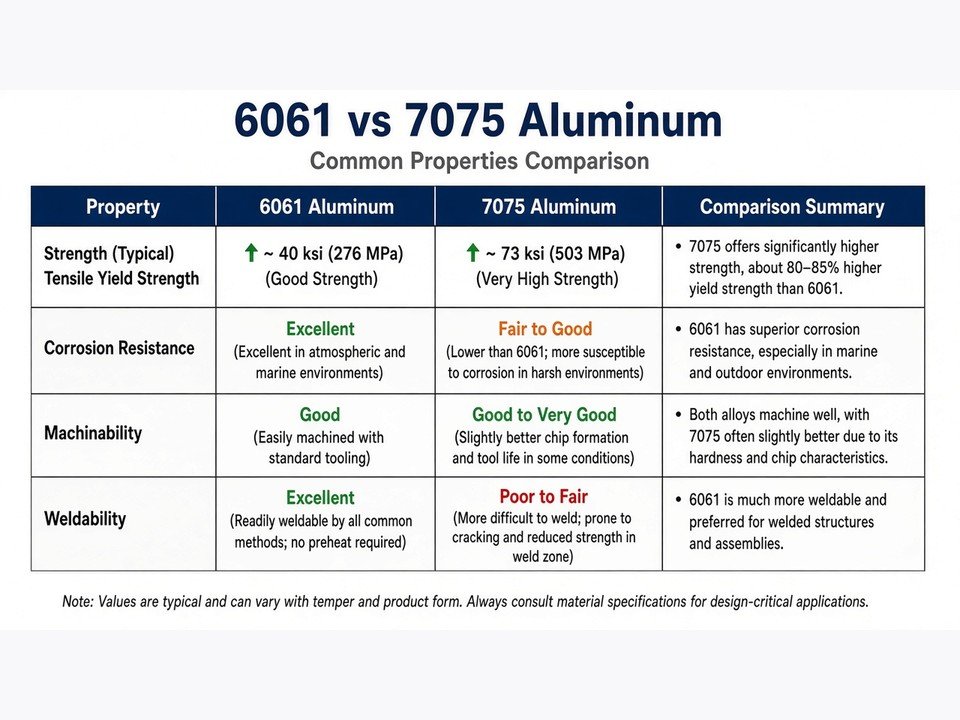
The mechanical divergence between these two alloys stems directly from their alloying matrix. While 6061 leans on magnesium and silicon to retain ductility and resist environment-driven oxidation, 7075 relies on a zinc-copper-magnesium matrix engineered specifically for extreme static strength.
| Element | 6061 Composition (wt%) | 7075 Composition (wt%) | Influence on Metallurgy |
|---|---|---|---|
| Aluminum (Al) | 95.8 – 98.6% | 87.1 – 91.4% | Base matrix |
| Zinc (Zn) | 0.00 – 0.25% | 5.10 – 6.10% | Primary driver of high static and yield strength |
| Magnesium (Mg) | 0.80 – 1.20% | 2.10 – 2.90% | Forms strengthening precipitates with Zn and Si |
| Copper (Cu) | 0.15 – 0.40% | 1.20 – 2.00% | Increases strength; diminishes weldability & corrosion barrier |
| Silicon (Si) | 0.40 – 0.80% | Max 0.40% | Forms Mg₂Si precipitates in 6061 |
| Chromium (Cr) | 0.04 – 0.35% | 0.18 – 0.28% | Controls grain size and stress corrosion cracking susceptibility |
Mechanical Properties Comparison
When our engineers review FEA simulations or stress-concentration points on custom brackets, we rely on the mechanical data summarized below. Unless otherwise noted, values reflect standard T6 temper (solution heat-treated and artificially aged).
| Property (Temper: T6) | 6061-T6 | 7075-T6 | Engineering Difference |
|---|---|---|---|
| Yield Strength (0.2% offset) | 276 MPa (40.0 ksi) | 503 MPa (73.0 ksi) | 7075 offers ~82% higher plastic deformation threshold |
| Ultimate Tensile Strength (UTS) | 310 MPa (45.0 ksi) | 572 MPa (83.0 ksi) | 7075 handles ~84% greater ultimate rupture load |
| Brinell Hardness (HB500) | 95 HB | 150 HB | 7075 shows significantly higher scratch and indentation resistance |
| Elongation at Break | 12 – 17% | 9 – 11% | 6061 is noticeably more ductile before fracture |
| Modulus of Elasticity | 68.9 GPa | 71.7 GPa | Nearly identical stiffness under pure elastic loading |
| Fatigue Strength (500M cycles) | 96 MPa | 159 MPa | 7075 resists cyclic stress failure ~65% better |
| Shear Strength | 207 MPa | 331 MPa | Critical for pins, shear keys, and fasteners |
Strength and Hardness: Is 7075 the Strongest Aluminum?
7075 is often referred to in engineering literature as "aircraft-grade" or the "strongest aluminum commercially available." While specialized aerospace alloys like 7068 or metal-matrix aluminum composites can produce slightly higher raw numbers, 7075-T6 is by far the strongest standard, production-ready aluminum grade widely stocked across mills worldwide.
With a yield strength over 500 MPa, 7075-T6 surpasses standard A36 structural mild steel (approx. 250 MPa) and approaches structural grades like 4130 chromoly in non-heat-treated conditions, all while weighing 65% less.
Strength does not come free. The high zinc and copper concentrations that give 7075 its extreme strength simultaneously make it brittle under tight radius bending, virtually unweldable using standard fusion methods, and susceptible to stress-corrosion cracking (SCC) if continuously exposed to moisture and high tensile preload.
Machinability of 6061 vs 7075
From our perspective on the CNC machine shop floor at PartsMake, both alloys offer excellent machinability, but their cutting dynamics diverge noticeably during 3-axis, 5-axis, and mill-turn operations.
Machining 6061-T6
6061 is softer and slightly gummier than 7075. While it cuts quickly and cleanly, chips can occasionally pack tool flutes if coolant pressure or chip evacuation is inadequate.
- Cutting Tool Life: Low tool wear on uncoated and polished carbide cutters.
- Burr Formation: Slight edge burrs may occur on fine slots; deburring cycles are standard.
- Feeds & Speeds: Very high spindle RPM and feed rates achievable without excessive thermal buildup.
Machining 7075-T6
Due to its superior hardness (150 HB vs 95 HB), 7075 shears cleanly. Chips break crisply and eject reliably, allowing mirror-grade Ra surface finishes directly off the cutter.
- Chip Evacuation: Crisp, segmented chips that do not wrap or stick to flutes.
- Dimensional Control: Outstanding stability on thin-walled aerospace pockets.
- Tool Wear: Higher cutter flank wear over time compared to 6061; requires periodic tool compensation monitoring.
Weldability and Formability
If your product assembly includes welded joints or tight sheet metal bends, this property alone will determine your alloy selection.
Fusion Welding Performance
6061 is readily weldable via Gas Tungsten Arc Welding (TIG) and Gas Metal Arc Welding (MIG), typically using 4043 or 5356 filler wire. Note that welding anneals the heat-affected zone (HAZ), reducing local yield strength by roughly 30–50% unless post-weld solution heat treatment and re-aging are performed.
7075 is generally classified as unweldable by conventional fusion welding. The wide solidus-to-liquidus freezing range coupled with high zinc and copper contents causes severe micro-cracking and hot tearing along the solidification boundary. While friction stir welding (FSW) is possible in aerospace labs, conventional TIG/MIG welding on 7075 parts is strictly avoided in production.
Bending and Sheet Metal Forming
In the T6 temper, 6061 can accommodate moderate brake-press bends with an inside bend radius of roughly 1.5x to 3x sheet thickness (depending on gauge). 7075-T6, however, possesses low ductility (9–11% elongation) and will frequently craze or crack along the outer bend radius. If 7075 must be formed, it must be ordered in the annealed (O) temper, bent, and then solution heat-treated and aged—a costly and distortion-prone procedure.
Corrosion Resistance
Natural corrosion resistance in aluminum relies on the spontaneous formation of a thin, protective surface oxide film (Al2O3). The chemistry of the alloy dictates the stability of this passive layer.
- 6061: Excellent natural corrosion resistance in marine, atmospheric, and industrial conditions. The low copper level (under 0.4%) maintains passive oxide stability.
- 7075: Moderate to poor natural resistance. The high copper content (1.2–2.0%) forms micro-galvanic cells within the grain matrix, making raw 7075 susceptible to exfoliation and stress corrosion cracking when exposed to saltwater or chemical washdown environments.
In outdoor or marine applications, bare 7075 is never recommended. It requires protective coatings, such as Type II or Type III hardcoat anodizing, chemical conversion film (chromate/alodine), or specialized aircraft primer systems.
Anodizing Performance
Anodizing is an electrochemical process that converts the surface layer into an exceptionally hard, uniform oxide coating. Both 6061 and 7075 accept anodizing, but their visual and functional outcomes differ:
6061 Anodizing Results
Produces consistent, uniform color absorption across all standard dye pigments (black, clear, red, blue, gold).
Best choice for visible cosmetic housings, front panels, and consumer handheld hardware.
7075 Anodizing Results
Due to zinc and copper content, the anodic coating naturally develops a slightly yellowish or bronze-gray tint. Clear anodize will not look purely silver.
Excels under Type III Hardcoat anodizing for wear, abrasion, and dielectric surface resistance.
Physical Properties: Density, Thermal Conductivity, and More
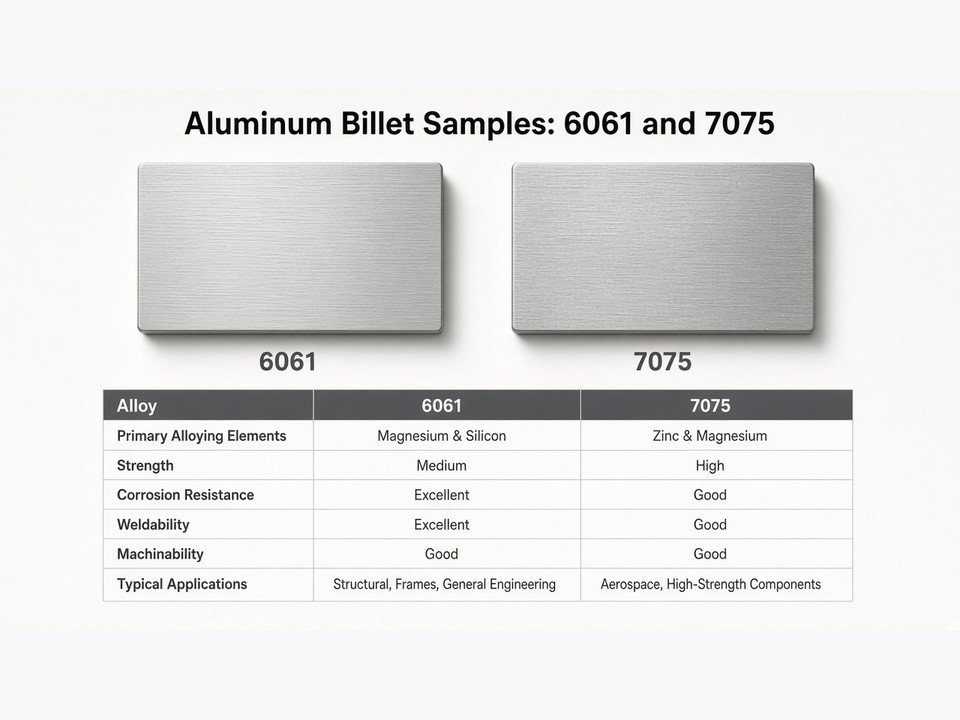
For thermal dissipation components, heatsinks, and lightweight assemblies, secondary physical properties become deciding criteria.
| Physical Property | 6061-T6 | 7075-T6 | Practical Design Impact |
|---|---|---|---|
| Density | 2.70 g/cm³ (0.0975 lb/in³) | 2.81 g/cm³ (0.102 lb/in³) | 7075 is approx. 4% heavier due to zinc content |
| Thermal Conductivity | 167 W/m·K | 130 W/m·K | 6061 dissipates heat ~28% faster; better for thermal management |
| Electrical Conductivity | 43% IACS | 33% IACS | 6061 is preferred for grounding bars and bus brackets |
| Melting Range | 582 – 652 °C | 477 – 635 °C | 7075 starts melting earlier, narrowing its welding window |
Common Applications of 6061 vs 7075 Aluminum
At PartsMake, we manufacture precision components for robotics, automotive, aerospace, and semiconductor clients. Below is how we typically see parts split between these two materials:
When We Machine 6061-T6
When We Machine 7075-T6
Cost Considerations
Total part cost is not solely determined by raw material price per kilogram; machine cycle times, deburring, scrap rates, and surface treatments all contribute.
7075 raw bar and plate stock generally commands a 25% to 50% price premium over 6061 due to alloying elements (zinc, copper) and tighter mill certifications.
7075 allows faster feed rates and produces cleaner finishes with less manual deburring, but cutter wear is higher. On complex parts requiring extensive hogging, machining cycle costs are comparable.
7075 almost always mandates protective anodizing or chemical conversion to prevent environmental oxidation, adding a mandatory secondary process to your unit cost.
How to Tell if Aluminum Is 6061 or 7075
If you have unmarked bar stock in your shop or an unlabelled prototype part on your desk, visual inspection alone cannot distinguish between 6061 and 7075. Here are the practical shop-floor and laboratory testing methods we use at PartsMake:
Hardness Indentation Testing (Fastest Shop Method)
Using a portable Webster hardness tester or benchtop Rockwell/Brinell tester: 6061-T6 typically reads ~95 HB (approx. 60 HRB), while 7075-T6 reads ~150 HB (approx. 87 HRB). A 50-point Brinell gap provides unambiguous differentiation within seconds.
Handheld XRF Analyzer (Positive Material Identification - PMI)
During PartsMake quality intake inspections, we verify raw material lots with an X-ray fluorescence (XRF) gun. Within 5 seconds, an XRF gun detects the 5–6% zinc content of 7075 versus the near-absence of zinc in 6061.
Caustic Etch Spot Test (Chemical Indicator)
Applying a drop of 10% sodium hydroxide (NaOH) solution causes a chemical reaction. On 6061, the solution reacts slowly leaving a faint grayish residue. On 7075, due to its copper and zinc content, the etched drop turns dark brown to black almost immediately.
6061 vs 7075 Aluminum FAQ
Is 7075 better than 6061?
"Better" depends entirely on your design constraints. 7075 offers nearly double the yield and tensile strength of 6061, making it superior for aerospace structural brackets and high-stress mechanical components. However, 6061 is significantly better for welding, tight bending, cosmetic color anodizing, and cost-constrained production runs.
Why is 7075 not weldable?
7075 contains high concentrations of zinc (5–6%) and copper (1.2–2%). During fusion welding (TIG/MIG), these elements cause extreme solidification shrinkage and grain boundary segregation, resulting in micro-fissuring and catastrophic hot cracking within the heat-affected zone.
Is 7075 the strongest aluminum?
7075-T6 is the strongest among standard, commercially stocked aluminum alloys. Specialized aerospace grades such as 7068-T6511 provide even higher tensile strengths (up to 710 MPa), but they are far more expensive, difficult to source in low quantities, and limited to specialized military or Formula 1 applications.
How to tell if aluminum is 6061 or 7075?
The most reliable non-destructive shop method is a Brinell hardness test: 6061-T6 measures ~95 HB, whereas 7075-T6 measures ~150 HB. For certified validation, use a handheld XRF spectrometer to detect the 5.1–6.1% zinc content exclusive to 7075.
Which Aluminum Alloy Should You Choose?
When reviewing customer CAD models at PartsMake, we apply the following decision framework to avoid over-engineering or premature field failures:
- ✓ The assembly requires TIG or MIG welding.
- ✓ The part is exposed to marine or outdoor humidity without heavy protective paint.
- ✓ Vibrant decorative anodizing (clear, red, black, blue) is required.
- ✓ You need to keep unit material costs low for consumer products or high-volume production.
- ✓ The design serves as a thermal heatsink or electronic cold plate.
- ✓ Yield strength above 400 MPa is mandatory to avoid structural deflection under high loads.
- ✓ Weight reduction in aerospace, drone, or race vehicle assemblies justifies higher raw stock cost.
- ✓ The component experiences severe cyclic fatigue or high contact pressure (gears, shafts).
- ✓ The assembly uses bolted, pinned, or clamped joints rather than welded seams.
- ✓ Type III Hardcoat anodizing can be applied to handle wear and environmental exposure.
Still uncertain which alloy best balances your tolerances, thermal requirements, and unit budget? Our engineering team reviews technical drawings, CAD files, and operating environments to recommend the most manufacturable and cost-effective grade before machining begins.
Ready to Machine Your 6061 or 7075 Aluminum Parts?
Upload your CAD files and technical drawings. Our application engineers will conduct a full DFM review, verify alloy suitability, and provide a detailed quote with production lead times.