
Engineering Materials Guide
Acetal vs. Delrin: Key Differences & How to Choose the Right Material
Confused by Acetal vs. Delrin? We explain the practical differences between POM-H and POM-C, compare their mechanical and environmental performance, and show how to choose the right material for a machined or molded part.
Introduction: Are Delrin and Acetal the Same?
When engineers search for acetal vs Delrin, they are usually comparing two names that appear interchangeable on drawings, supplier quotes, and material datasheets. They are closely related, but they are not always identical.
Delrin is a trade name commonly associated with acetal homopolymer, or POM-H. Acetal is the generic name for the polyoxymethylene material family and often refers in manufacturing discussions to acetal copolymer, or POM-C. Both provide low friction, good stiffness, and excellent dimensional stability, but their molecular structures create different performance trade-offs.
The short version: choose POM-H when maximum strength and hardness are the priority; choose POM-C when chemical resistance, moisture tolerance, and long-term environmental stability matter more.
What is Acetal (POM)?
Polyoxymethylene, abbreviated POM, is a high-performance engineering thermoplastic used for precision components that need a combination of stiffness, low friction, wear resistance, and dimensional control. It is available in homopolymer and copolymer grades, with Delrin generally referring to the homopolymer side of that family.
POM is valued because it behaves more like a precision engineering material than a commodity plastic. It can be machined into gears, bushings, rollers, guides, spacers, housings, and other functional parts. Its low moisture absorption helps parts retain their dimensions, while its naturally low coefficient of friction supports sliding and rotating interfaces.
Why engineers use POM
POM combines high stiffness with a smooth, wear-resistant surface. That makes it useful where a component must guide, locate, support, or transmit motion without the weight or corrosion concerns of a metal part.
Where material choice matters
The resin family alone does not determine performance. Section thickness, temperature, moisture, chemical exposure, load, surface finish, and the required manufacturing process all influence whether POM-H or POM-C is the safer choice.
The Core Distinction: Homopolymer (Delrin) vs. Copolymer (POM-C)
The difference begins at the polymer structure level. Acetal homopolymer has a more uniform chain structure and typically higher crystallinity. This supports higher tensile strength, hardness, and rigidity. Acetal copolymer modifies the structure to improve resistance to chemical attack, hot water, and certain processing-related issues.
Neither material is universally better. We select between them by looking at the part's failure modes. A gear that needs high tooth strength may benefit from POM-H, while a fluid-handling component exposed to hot water or fuel may be better served by POM-C.
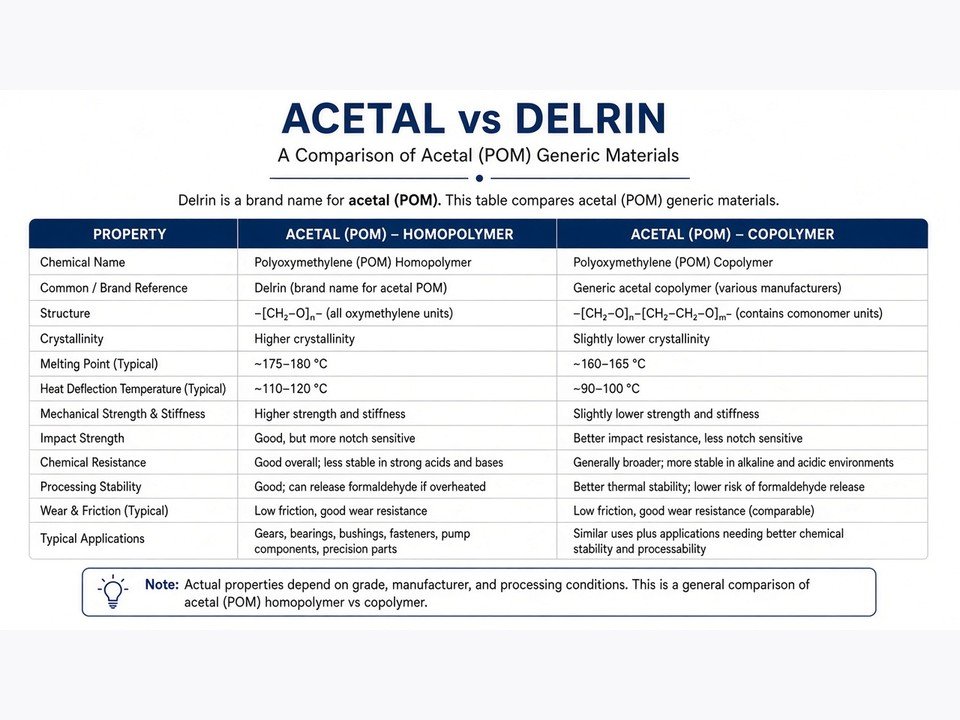
| Property or consideration | Acetal homopolymer (POM-H / Delrin) | Acetal copolymer (POM-C) |
|---|---|---|
| Strength and hardness | Typically higher tensile strength, stiffness, and hardness. | Strong and rigid, though typically below POM-H in peak mechanical values. |
| Wear and friction | Excellent for many gears, bushings, bearings, and sliding interfaces. | Also offers low friction and good wear performance for general engineering use. |
| Chemical resistance | Good, but more vulnerable to some aggressive environments than POM-C. | Generally improved resistance to chemicals, fuels, solvents, and hot water. |
| Moisture and dimensional behavior | Low moisture absorption and good dimensional stability. | Very good dimensional stability, particularly when environmental exposure varies. |
| Thick-section concern | Greater attention may be needed for centerline porosity in thick sections. | Reduced centerline porosity risk compared with homopolymer grades. |
| Typical selection logic | Prioritize maximum mechanical performance and hardness. | Prioritize chemical durability and environmental stability. |
The exact performance depends on the grade, supplier datasheet, geometry, processing method, and operating conditions. For a critical component, we review the specified grade rather than treating “acetal” as a complete material definition.
When to Choose Delrin (Homopolymer)
We generally consider POM-H when a component needs the highest practical combination of strength, rigidity, hardness, and wear performance within the acetal family. This is especially relevant for parts that carry concentrated loads or transfer motion through small contact areas.
Strength, rigidity, and wear
POM-H is a strong candidate for gears, bearings, bushings, rollers, wear pads, and precision locating components. Its high crystallinity supports a hard, stiff material that can maintain useful contact geometry under mechanical loading.
Low-friction motion
For sliding or rotating parts, POM-H can help reduce friction and wear without requiring a metal component. The design still needs appropriate clearances, surface conditions, loading, and lubrication assumptions.
Manufacturing warning
Address centerline porosity in thick sections
A known consideration with acetal homopolymer is centerline porosity in thicker stock or molded sections. The center of a section may not have the same integrity as the outer material, which can matter for pressure-containing parts, deep machining, tapped holes, or highly loaded features. We review section thickness, critical features, machining depth, and the intended load path before approving POM-H for a thick component.
When to Choose Acetal Copolymer (POM-C)
POM-C is often the more conservative choice when the part must remain stable in a chemically active or wet environment. Compared with POM-H, copolymer grades generally provide improved resistance to hot water, fuels, and a broader range of chemicals.
That makes POM-C suitable for many fluid-handling components, fuel-exposed parts, machine elements near cleaning agents, and assemblies operating across changing temperatures. It also has reduced centerline porosity compared with homopolymer, which can be important when the part geometry includes thicker sections.
-
1
Start with the exposure
List every fluid, cleaning agent, fuel, humidity condition, and temperature cycle the part will encounter—not only the nominal operating environment.
-
2
Check the load after exposure
A material that performs well dry may behave differently after prolonged contact with hot water or chemicals. Evaluate strength retention and dimensional requirements together.
-
3
Confirm the exact grade
“POM-C” identifies a material family, not every detail of a supplier's formulation. We verify the required grade against the drawing and application before production.
Performance Comparison: Key Engineering Factors
The best answer to acetal vs Delrin depends on how the finished part will be used. We normally evaluate the following factors together rather than selecting a resin from a single tensile-strength value.
Dimensional Stability
Both POM-H and POM-C absorb relatively little moisture compared with many other engineering plastics, which supports good dimensional stability. However, “low absorption” does not mean “dimensionally unchanged.” Temperature changes can cause thermal expansion, and moisture, stress relief, machining history, and geometry can all influence final dimensions.
For a close-tolerance bushing or mating guide, we consider the actual operating temperature and fit—not only the room-temperature measurement. Where the environment varies significantly, POM-C may offer a useful stability advantage because of its broader environmental resistance.
Chemical and Thermal Resistance
POM-C often outperforms POM-H in aggressive environments, particularly where hot water, fuels, or chemicals are present. The correct choice still depends on concentration, contact time, temperature, and mechanical stress. A material may resist a chemical in an unloaded test but fail when the same exposure occurs under constant force or repeated motion.
Design review note
For fluid-exposed parts, send us the chemical name, concentration if known, temperature range, exposure duration, and whether the component is loaded. Those details are more useful than a generic material label.
Machinability
Both homopolymer and copolymer acetal are generally well suited to CNC machining and prototyping. Their stiffness, low friction, and ability to produce clean functional features make them practical for turned bushings, milled brackets, precision spacers, gears, and test components.
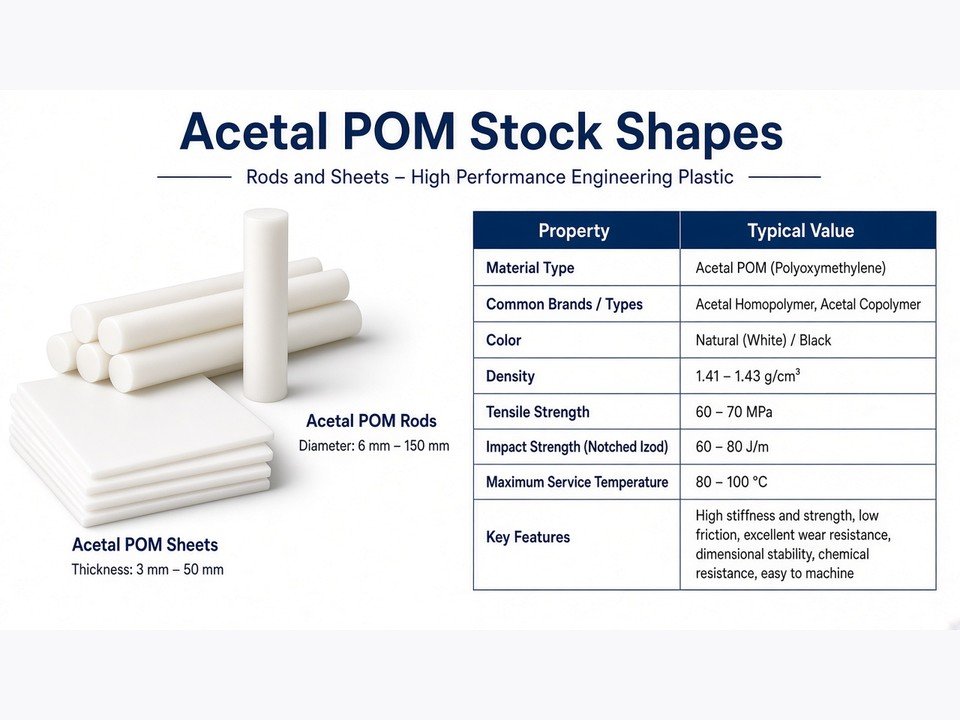
The main manufacturing risks are usually part-specific: thin walls can deflect, deep bores can accumulate heat, and released machining stress can affect close-tolerance dimensions. We review the CAD model, tolerances, critical dimensions, surface requirements, and production quantity before manufacturing. For larger production quantities, injection molding may also be considered when the geometry and tooling economics support it.
Frequently Asked Questions (FAQ)
Is acetal cheaper than Delrin?
Generic acetal, particularly POM-C, may cost less than a branded Delrin grade because Delrin carries a brand premium and may be specified for its particular performance profile. Actual part cost also includes stock availability, material certification or verification needs, machining time, scrap risk, and quantity. We compare the full manufacturing requirement rather than choosing on resin price alone.
Which plastic is stronger than Delrin?
For extreme high-stress, temperature, or chemical requirements, engineering plastics such as PEEK may offer higher performance in selected conditions. Nylon can also be a useful alternative where toughness or other application-specific characteristics are more important than the stiffness and low moisture response of acetal. The strongest material is not automatically the best material: cost, machinability, moisture behavior, friction, and operating environment must be considered together.
What are the main disadvantages of Delrin?
Delrin can be difficult to bond or glue reliably because acetal has low surface energy. Mechanical fastening, press fits, snap features, or a design-specific joining method may be preferable. POM-H is also sensitive to ultraviolet radiation, so outdoor exposure may require a suitable grade, protection, or a different material. Thick sections require attention to centerline porosity, and chemical exposure should be checked rather than assumed safe.
Can you use acetal and Delrin interchangeably?
They can sometimes be substituted for non-critical prototypes or lightly loaded parts when the dimensions, temperature, chemical exposure, and wear requirements are comparable. We would not make an automatic substitution for a safety-relevant part, a pressure-related component, a highly loaded gear, a thick-section part, or any drawing that specifies a named grade. In those situations, confirm the replacement with the design authority and compare the relevant datasheets before production.
Conclusion: Making the Right Selection for Your Project
The decision between acetal and Delrin is ultimately a decision between different priorities within the POM family. If your part needs maximum mechanical strength, rigidity, hardness, and strong wear performance, POM-H or Delrin is often the logical starting point. If the part will face hot water, fuels, chemicals, changing temperatures, or a thick-section integrity concern, POM-C may be the more durable choice.
A practical selection sequence
-
1
Define the environment. Record temperature, moisture, chemicals, fuels, UV exposure, and cleaning conditions.
-
2
Define the mechanical duty. Identify load, impact, friction, wear, stiffness, and fatigue concerns.
-
3
Review the geometry. Pay particular attention to thick sections, deep features, thin walls, and close-tolerance interfaces.
-
4
Confirm the grade and process. Match the selected material to the drawing, supplier datasheet, machining or molding process, and inspection plan.
At PartsMake, we begin with the part rather than simply starting the machine. Our engineering team reviews CAD files, drawings, materials, tolerances, critical dimensions, surface requirements, quantities, and intended applications before production. Whether you need a CNC-machined prototype, engineering sample, molded component, or repeat-production part, we can help evaluate the material choice and manufacturing risks.
Discuss Your Acetal PartPartsMake Engineering Support
Need help choosing between POM-H and POM-C?
Share your drawing, CAD file, operating environment, tolerances, and production quantity. We will review the material and manufacturing requirements and help you move from prototype to production with fewer avoidable risks.