
Materials engineering guide
Alloy Steel vs Carbon Steel: Differences, Properties & Best Uses
We compare alloy steel and carbon steel by composition, strength, corrosion resistance, fabrication, cost, and application. Use this practical guide to select a material that supports both part performance and manufacturability.
The right answer in alloy steel vs carbon steel is not simply “stronger” or “cheaper.” It depends on the loads, environment, heat exposure, manufacturing process, and service life expected from the part.
What Is Alloy Steel?
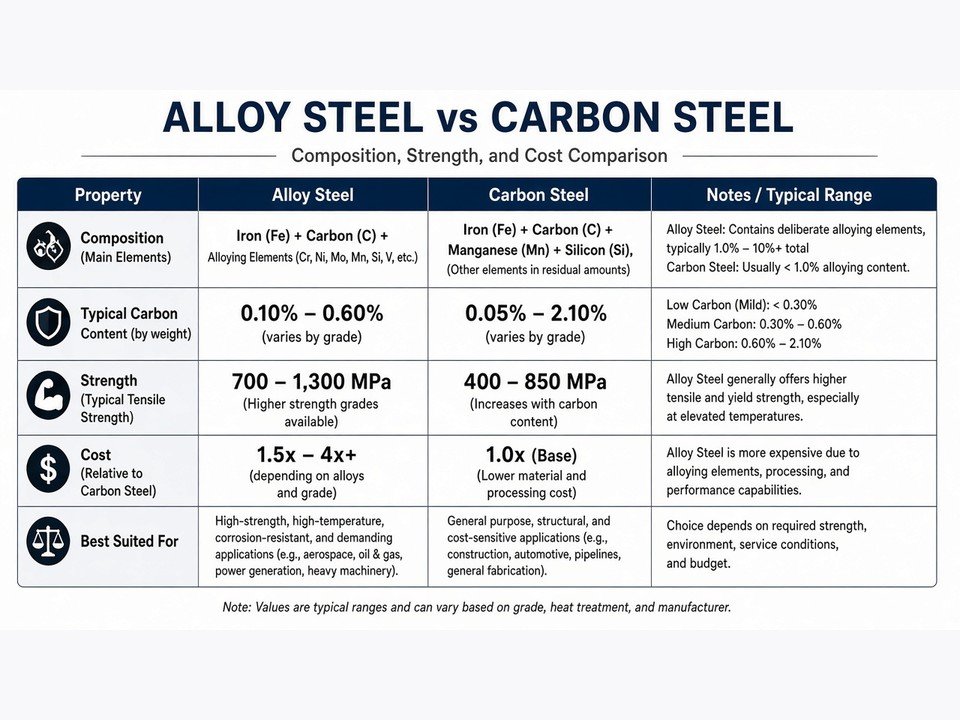
Alloy steel is steel in which elements beyond iron and carbon are intentionally added to change performance. Common additions include chromium, nickel, molybdenum, manganese, silicon, and vanadium. The exact grade and treatment determine how those additions affect the finished material.
Chromium can improve hardenability and corrosion performance, nickel can support toughness, and molybdenum can improve hardenability and performance under demanding service conditions. These elements do not automatically make every alloy steel corrosion-proof or stronger in every condition; grade selection and heat treatment remain important.
Engineering perspective
We usually evaluate alloy steel as a performance-focused material family. It is useful when a component needs a controlled combination of strength, toughness, wear resistance, hardenability, or elevated-temperature capability.
What Is Carbon Steel?
Carbon steel is primarily an iron-carbon material in which carbon is the main alloying element and other elements are present in comparatively limited amounts. Its carbon content is commonly discussed in three broad ranges:
| Category | Typical carbon range | General characteristics |
|---|---|---|
| Low carbon | Approximately 0.05–0.25% | Ductile, formable, and generally easier to weld |
| Medium carbon | Approximately 0.25–0.60% | A balance of strength, hardness, and ductility |
| High carbon | Approximately 0.60–1.00% or more | Higher hardness and wear potential, with reduced ductility |
Carbon steel remains a foundational industrial material because it is widely available, versatile, familiar to fabricators, and often economical. With suitable surface protection and grade selection, it can support everything from structural fabrication to machined components and tools.
Alloy Steel vs Carbon Steel: Chemical Composition
Both materials are iron-based, and both rely on carbon to influence hardness and strength. The key difference is the deliberate use of additional alloying elements and the amount of control required to achieve the target properties.
Carbon steel composition
Carbon is the principal property-changing addition. Manganese, silicon, sulfur, phosphorus, and residual elements may also be present within the grade specification, but the material is not primarily engineered around a broad alloying package.
Alloy steel composition
Chromium, nickel, molybdenum, vanadium, manganese, or silicon may be added to tune hardenability, toughness, strength, wear behavior, or corrosion performance. The result is a wider range of engineered property combinations.
Important qualification
“Alloy steel” is a broad category, not one single performance level. A specific grade, condition, heat treatment, and surface finish must be reviewed before making a material decision.
Mechanical Properties Comparison
Mechanical performance depends on grade, section size, processing, and heat treatment. The comparison below describes general tendencies rather than replacing a material certificate or grade-specific datasheet.
Strength and Hardness
Many alloy steels can achieve higher tensile strength, yield strength, and through-section hardness than plain carbon steels when the grade and heat treatment are properly selected. Alloying elements can improve hardenability, allowing more consistent properties in thicker or more heavily loaded sections.
In practice, this can mean a smaller or lighter component, better resistance to permanent deformation, or improved performance in a shaft, gear, pin, fastener, or load-bearing mechanism. A medium- or high-carbon steel may still provide sufficient strength for a less demanding design.
Corrosion Resistance
Alloy steel generally offers better corrosion performance than plain carbon steel when the alloying package is designed for that purpose, particularly where chromium contributes to surface protection. However, not every alloy steel grade is corrosion-resistant in the way stainless steel is.
Carbon steel readily oxidizes when exposed to moisture, salts, chemicals, or poorly controlled storage conditions. Paint, plating, conversion coatings, oil, powder coating, or other surface treatments can reduce the risk, but they introduce their own preparation, inspection, and maintenance requirements.
Ductility and Toughness
Ductility describes how much a material can deform before breaking, while toughness describes its ability to absorb energy without fracturing. Low-carbon steel is often easy to form and weld because its relatively low carbon content supports ductility.
Alloy steel can deliver excellent toughness when the grade and heat treatment are chosen correctly, but higher strength or hardness may make forming and welding more demanding. For parts exposed to impact, cyclic loading, or low temperatures, we recommend evaluating the specific toughness requirements rather than relying on a material family label.
Wear Resistance and Heat Resistance
Hardened alloy steels are often selected for abrasion, sliding contact, repeated impact, or heavy loads. Their alloying and heat-treatment response can help maintain useful hardness and dimensional stability in demanding mechanisms.
Carbon steel can perform well in moderate service conditions, particularly when wear is limited or a replaceable surface treatment is practical. For elevated-temperature service, the relevant alloy grade, temperature range, exposure time, and required strength must be checked together; neither material category should be selected solely by name.
| Property | Typical alloy steel advantage | Where carbon steel may be sufficient |
|---|---|---|
| Strength | Higher achievable strength in many grades and treatments | Moderate loads and conventional structural parts |
| Hardness | Better hardenability and wear-focused options | General tools, brackets, fixtures, and low-wear parts |
| Corrosion | Some grades improve resistance in harsh conditions | Indoor use or parts with an effective protective finish |
| Fabrication | Performance can justify additional process control | Forming, welding, and machining priorities favor simplicity |
Production and Fabrication Differences
The material choice affects more than the purchase order. It changes cutting, machining, forming, welding, heat treatment, finishing, inspection, and sometimes the sequence in which those operations should occur.
Machinability
Many carbon steels are straightforward to machine, especially in lower-carbon conditions. Alloying and increased hardness can raise cutting forces, accelerate tool wear, and make stable fixturing and cutting parameters more important.
Weldability and forming
Low-carbon steel is commonly favored for forming and welding. Higher carbon content and certain alloying additions can increase cracking or distortion risk, so preheating, interpass control, filler selection, and post-weld requirements may need engineering review.
Heat treatment
Alloy steels often gain much of their value through normalizing, quenching, tempering, carburizing, or other controlled treatments. Carbon steels can also be heat-treated, but the achievable result depends strongly on composition, section thickness, and the required property profile.
Dimensional control
Heat treatment can change dimensions and introduce distortion in either material family. We review critical dimensions, tolerances, surface requirements, and inspection points before production so the process plan accounts for those risks.
At PartsMake, that review can include CNC milling, CNC turning, 5-axis machining, mill-turn machining, Swiss machining, precision grinding, EDM, sheet metal fabrication, and surface finishing, depending on the part and its production stage.
Cost Comparison
Carbon steel is often less expensive as a raw material and may reduce processing complexity. It is a strong candidate when the part operates in a controlled environment, loads are moderate, and protective finishing is practical.
Alloy steel can cost more because of its composition, availability, heat treatment, machining demands, and inspection requirements. That higher initial cost can be justified when the material extends service life, reduces mass, avoids premature wear, supports a smaller design, or reduces maintenance and replacement work.
Total-cost check
Compare the complete part cost—not only the material price. Include machining time, tooling, heat treatment, finishing, inspection, corrosion protection, expected replacement frequency, and the consequence of failure.
Applications of Alloy Steel
Alloy steel is often selected when a component must combine strength, toughness, wear resistance, hardenability, or controlled performance under demanding conditions.
Automotive: shafts, gears, axles, pins, fasteners, and other drivetrain or load-bearing components.
Aerospace and drones: precision components where strength-to-weight considerations and dependable mechanical performance matter.
Heavy machinery: wear-prone pins, bushings, gears, drive components, and heavily loaded mechanisms.
Industrial equipment: fixtures, shafts, tooling components, and parts subject to repeated loads or abrasion.
Energy and process equipment: selected components exposed to elevated loads, temperature, or demanding operating conditions.
Robotics and automation: compact precision parts that need repeatable strength and wear performance.
Applications of Carbon Steel
Carbon steel is a practical default for many parts because it combines useful mechanical performance with broad availability and familiar fabrication methods.
Construction and structural fabrication
Beams, plates, frames, brackets, supports, and general structural components commonly use carbon steel where strength and economical fabrication are priorities.
Pipelines and industrial assemblies
Carbon steel can serve in piping and assemblies when the operating environment, pressure, temperature, corrosion allowance, and protective system are appropriate.
Tools and fixtures
Selected carbon steel grades are used for hand tools, jigs, fixtures, plates, and low- to moderate-wear components that do not require a more specialized alloy.
General machined parts
Pins, spacers, brackets, housings, sleeves, and other custom parts can often be produced efficiently from carbon steel when the design and environment permit.
How to Choose Between Alloy Steel and Carbon Steel
We recommend making the decision in the following order. This prevents a material label from being chosen before the actual service requirements are understood.
-
1
Define the environment
Identify moisture, salt, chemicals, outdoor exposure, temperature, abrasion, and contact with other materials. Corrosion and heat exposure may justify an alloy or a protective finish.
-
2
Quantify the mechanical requirement
Review static loads, impact, fatigue, wear, required hardness, deflection limits, and failure consequences. Do not use tensile strength alone to represent the whole design requirement.
-
3
Check manufacturing constraints
Consider machining, turning, forming, welding, heat treatment, grinding, finishing, tolerances, and inspection. A material that meets the design target but creates unacceptable process risk is not an efficient choice.
-
4
Compare lifecycle value
Balance raw material and production cost against finishing, maintenance, replacement, downtime, and service life. Carbon steel is not automatically the lowest-cost option if corrosion or wear causes early replacement.
Practical review checklist
Before releasing a drawing, confirm the material grade, material condition, heat-treatment requirement, surface finish, critical dimensions, tolerances, inspection method, and intended service environment.
Frequently Asked Questions
Which Is Better for Outdoor Use?
Alloy steel generally offers better performance than plain carbon steel when its alloying additions are suitable for the environment, but the specific grade still matters. For outdoor carbon steel, plan a protective system such as paint, plating, coating, or corrosion-control treatment, and consider how damage and maintenance will be handled over time.
Can Carbon Steel Replace Alloy Steel?
Sometimes. Substitution may be reasonable for moderate loads, controlled indoor environments, simple geometry, and applications where carbon steel can meet the required strength, wear, and corrosion targets after finishing. It is risky when the original alloy was selected for through-hardening, impact toughness, fatigue performance, elevated-temperature service, corrosion exposure, or a critical safety function. We recommend rechecking the design and process requirements rather than making a direct material swap.
Discuss your part with PartsMake
Need help choosing a steel material?
Share your drawing, CAD file, material preference, tolerances, quantity, and intended application. Our engineering team can review manufacturing risks before production and help coordinate machining, heat treatment, finishing, and inspection from prototype through repeat production.