
Materials guide
Copper vs. Brass vs. Bronze: A Complete Guide to Metal Differences
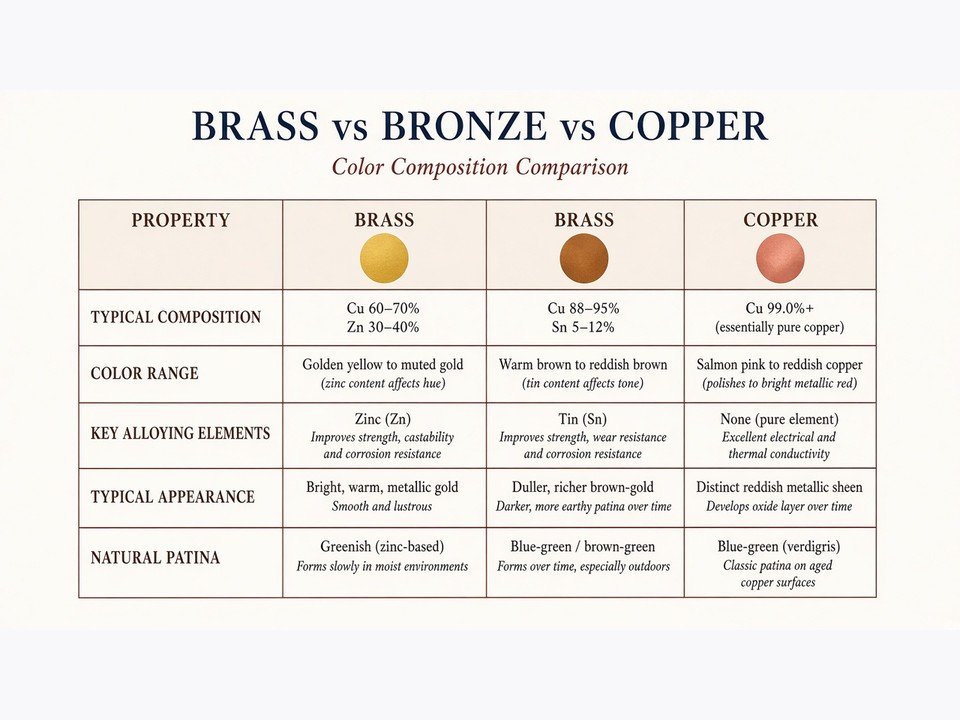
Confused by copper, brass, and bronze? We compare their composition, durability, appearance, conductivity, corrosion behavior, and applications so you can identify the right material for your part or product.
Introduction
Copper, brass, and bronze are closely related materials, which is why they are frequently confused. All three can display warm reddish, golden, or brown tones, and all are widely used in manufactured products, architecture, electrical systems, and mechanical components.
The important distinction is that copper is an elemental metal, while brass and bronze are copper-based alloys. Their different compositions affect conductivity, hardness, machinability, corrosion resistance, appearance, and cost. In this guide, we will help you identify the differences and select the most appropriate material for a practical application.
The best material is not the one with the most attractive color; it is the one whose properties match the part's operating environment and performance requirements.
Understanding the Fundamentals: What Are They?
What is Copper?
Copper is a pure, elemental metal identified by the chemical symbol Cu. It is known for excellent electrical and thermal conductivity, along with high ductility and malleability. These properties allow copper to carry current efficiently and to be drawn, bent, rolled, or formed without easily fracturing.
What is Brass?
Brass is an alloy made primarily from copper and zinc. The zinc content can be adjusted to change the alloy's color, hardness, strength, ductility, and machinability. This flexibility makes brass useful for both precision components and visible decorative hardware.
What is Bronze?
Bronze traditionally refers to a copper and tin alloy. In modern engineering, the term also covers several copper-based alloy families that may include elements such as aluminum or phosphorus. Bronze is generally selected when hardness, wear resistance, and corrosion performance are more important than maximum electrical conductivity.
Quick Comparison: Key Differences at a Glance
When comparing brass vs bronze vs copper, start with composition and then consider the service environment. The table below provides a practical first pass before a specific grade is selected.
| Material | Primary composition | Typical appearance | General strength and resistance |
|---|---|---|---|
| Copper | Elemental copper | Salmon-pink to reddish orange | Highly conductive and malleable; develops a protective patina |
| Brass | Copper and zinc | Muted yellow or golden tone | Good machinability, useful hardness, and attractive finish |
| Bronze | Copper and tin, sometimes with other elements | Dull gold, brown, or reddish brown | Hard, wear-resistant, and particularly suitable for many marine environments |
Visual identification
Fresh copper usually has the most obvious salmon-pink or reddish color. Brass is commonly brighter and more yellow, although its tone depends on zinc content and surface finish. Bronze often appears darker, duller, or browner than brass.
Durability and corrosion resistance
Copper resists atmospheric corrosion and forms a patina. Brass can perform well in many indoor and general-purpose environments, while bronze is often preferred for wear, outdoor exposure, and saltwater service. Exact performance depends on the grade and environment.
Deep Dive: Copper
Copper remains the reference material when a design depends on electrical or thermal performance. Its combination of conductivity and formability is difficult to match with brass or bronze.
Properties that define copper
Electrical conductivity: Copper carries electrical current efficiently, which is why it is widely used in conductors, terminals, busbars, and grounding systems.
Thermal conductivity: Heat moves through copper effectively, supporting heat-transfer components and thermal management applications.
Malleability: Copper can be formed and worked into wire, tubing, sheet, and detailed components with comparatively low risk of cracking.
Common applications
Typical uses include electrical wiring, plumbing tubing, connectors, heat-transfer components, and architectural roofing. Copper is also selected when its recognizable appearance and natural aging are part of the design intent.
The patina factor
When exposed to air and moisture over time, copper gradually oxidizes. Its surface may darken and eventually develop a green layer commonly called verdigris. This patina is different from iron rust and can help protect the underlying metal, although the appearance and rate of change depend on the environment.
Design note
If the finished part must retain a consistent appearance, define the required surface finish and inspection standard rather than relying only on the base material name.
Deep Dive: Brass
Brass occupies a useful middle ground between copper's conductivity and bronze's mechanical performance. It is valued for its visual warmth, ease of machining, and ability to provide a clean, precise surface.
Properties and applications
Brass has useful acoustic properties, which help it produce a clear, resonant tone in musical instruments. Its relatively low friction behavior makes suitable grades useful for moving interfaces, and its golden appearance supports decorative hardware, visible fittings, and architectural details.
Common applications include musical instruments, gears, valves, fittings, fasteners, handles, locks, and decorative hardware. In precision manufacturing, brass can also be selected for small turned or milled components where machinability and appearance both matter.
How brass variations change performance
Changing the copper-to-zinc ratio changes the balance of color, strength, ductility, and forming behavior. Additional alloying elements can further adjust performance. For example, leaded brass is designed to improve machinability, but the selected grade must still be checked against the part's service, joining, and compliance requirements.
Engineering check
Do not specify only “brass” on a production drawing when strength, corrosion exposure, machining behavior, or surface appearance is critical. A defined grade prevents substitutions that may look similar but perform differently.
Deep Dive: Bronze
Bronze has a long history as an engineering and artistic material. Compared with pure copper, it is generally harder and better suited to wear and load-bearing applications. Many bronze families also provide strong corrosion resistance, including useful performance in saltwater environments.
Properties and applications
Bronze is commonly selected for hardness, wear resistance, dimensional stability, and resistance to corrosion. These characteristics have made it important in ship propellers, marine hardware, statues, medals, bushings, bearings, and other high-stress mechanical parts.
Its historical significance is equally notable: bronze enabled durable tools, weapons, sculptures, and ceremonial objects long before modern industrial alloys were available. Today, its continued use is based on measurable performance rather than tradition alone.
High-performance bronze types
Phosphor bronze uses phosphorus to improve properties such as wear behavior and spring performance. Aluminum bronze uses aluminum as an important alloying element and is known for high strength and strong corrosion resistance in demanding environments. The appropriate choice depends on loading, motion, exposure, manufacturing process, and finish requirements.
How to Tell Them Apart: Practical Tips
A quick visual inspection can suggest whether a sample is copper, brass, or bronze, but it should not replace material verification for a critical production part. Use several observations together.
Start with color
Copper tends toward salmon-pink or red-orange, brass toward muted gold, and bronze toward dull gold or brown. Oxidation, plating, polishing, and lighting can change the apparent color.
Use the sound test carefully
When safely tapped, brass and bronze can produce a clearer ring, while copper often gives a duller thud. Part geometry, thickness, mounting, and surface condition strongly influence the result.
Check magnetism
Copper, brass, and bronze are not magnetic in the way steel is. A strong magnetic response can indicate steel contamination, a steel core, or a plated or assembled construction.
Inspect surface wear
Look at scratches, drilled edges, threads, corners, and other wear points. A different color beneath the outer layer may indicate plating or coating rather than solid brass, bronze, or copper.
Verification warning
For safety-critical, electrical, marine, or tightly controlled assemblies, confirm the material through supplier documentation or an appropriate material-identification method instead of relying on appearance alone.
Frequently Asked Questions
Which is better, copper, brass, or bronze?
There is no universal winner. Copper is usually the better choice for electrical and thermal conductivity, brass is often preferred for decorative, acoustic, and machinable components, and bronze is a strong candidate for wear, high-stress, and marine applications. The correct grade depends on the complete operating requirement.
What is more valuable, brass or bronze?
Value is usually influenced by copper content, alloying elements, availability, part geometry, machining time, finishing, and inspection requirements. A bronze part is not automatically more valuable than a brass part, and material price alone does not determine finished-part cost.
Why do we not use bronze anymore?
We still use bronze extensively. Modern steel, stainless alloys, engineering plastics, and other materials have replaced bronze in some structural roles, but bronze remains valuable for bearings, marine components, statues, medals, and demanding wear applications.
Do brass and bronze rust?
Rust specifically refers to the iron-oxide corrosion associated with iron and steel. Brass and bronze do not rust in that sense, but they do oxidize and may develop tarnish or patina. Their corrosion behavior still depends on the alloy, moisture, chemicals, salt exposure, and surface condition.
Choosing the Right Metal for Your Project
We recommend choosing in a defined sequence: identify the main performance requirement, map the environment, confirm manufacturability, and then specify the alloy and finish. This prevents a visually similar substitute from creating problems during production or use.
For electrical and thermal needs: choose copper
Copper is the clear starting point when conductivity is the primary requirement. Consider geometry, joining method, mechanical load, surface treatment, and the need for a defined copper grade before finalizing the drawing.
For decorative and acoustic needs: choose brass
Brass is well suited to visible hardware, musical instruments, fittings, and components where machinability and a warm golden appearance are valuable. Select the grade based on forming, machining, corrosion, and finishing requirements.
For high-stress and marine environments: choose bronze
Bronze is often the better starting point for wear, load, saltwater exposure, and demanding mechanical service. Phosphor bronze and aluminum bronze may provide more targeted performance than a general bronze specification.
Material selection checklist
Before releasing a design for production, record the required alloy or grade, dimensions and tolerances, surface finish, operating temperature, contact media, expected loads, quantity, and inspection requirements. These details give a manufacturer enough information to review risks before material is committed.
Conclusion
Understanding brass vs bronze vs copper starts with composition but should end with application. Copper delivers outstanding electrical and thermal conductivity, brass balances appearance, acoustic behavior, and machinability, and bronze provides hardness, wear resistance, and strong corrosion performance for demanding environments.
Selecting the right alloy improves part longevity, manufacturing consistency, and in-service performance. We recommend consulting a qualified metal supplier or manufacturing partner when a project requires a specific grade, surface condition, inspection plan, or material documentation.
Need help selecting or manufacturing the right alloy?
At PartsMake, we review the material, CAD files, tolerances, surface requirements, quantities, and intended application before production. Contact us to discuss a copper, brass, or bronze component from prototype through repeat production.