
Materials Engineering Guide
Cast Iron vs Steel: A Comprehensive Comparison for Manufacturing and Engineering
Two iron-carbon alloys, two very different sets of trade-offs. Here is how we evaluate carbon content, strength, castability, vibration behavior, and cost before we commit a single toolpath or pattern.
Introduction
Cast iron and steel are both iron-carbon alloys. That single sentence is where most material conversations start, and it is also where most of them go wrong. The two families share a base element, but the amount of carbon dissolved in that iron, plus the alloying and cooling history, produces materials that behave nothing alike on the shop floor.
In our daily work at PartsMake, this decision shows up early: a customer sends a drawing for a machine base, a bracket, a bushing, or a housing, and the material callout is the first thing our engineering team reviews. Choose cast iron where it does not belong and you get a cracked part in service. Choose steel where cast iron would have been cheaper and stiffer and you pay more for machining than the part is worth.
This guide walks through chemical composition, mechanical properties, and application-based selection so that the choice becomes an engineering decision rather than a habit.
Carbon content is the hinge. Below roughly 2% you are working with steel; above it, you are working with cast iron — and almost every downstream property difference follows from that line.
Understanding the Fundamentals
Before comparing properties, it helps to be precise about what each material actually is. The names are old and loosely used in industry, so we keep definitions tight when reviewing a drawing.
What is Cast Iron?
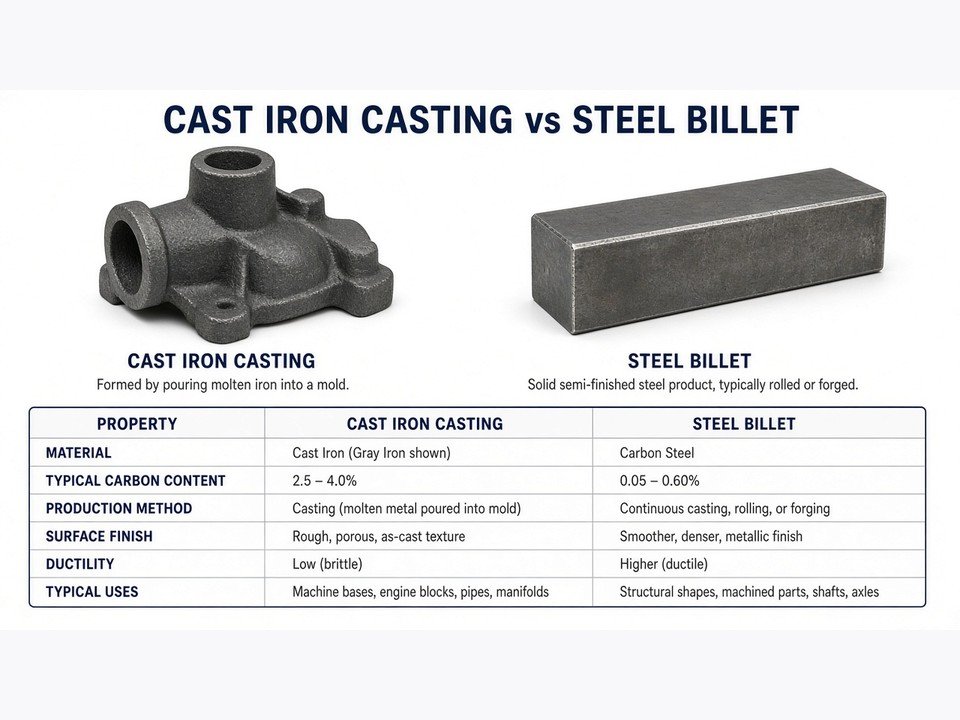
Cast iron is an iron-carbon alloy with a high carbon content, typically in the 2% to 4% range, along with silicon. That silicon content is not incidental — it promotes graphite formation during solidification, which is what gives cast iron its excellent casting behavior. The molten metal flows well, fills thin and complex mold cavities, and the resulting part machines cleanly with a characteristic short, broken chip.
The graphite flakes or nodules also explain the material's signature behavior: strong in compression, weak in tension, and very good at absorbing vibration.
What is Steel?
Steel is an iron-carbon alloy with a lower carbon content, generally under 2%. Within that band, the carbon level is a tuning knob: low-carbon steels are soft, ductile, and highly weldable, while medium- and high-carbon steels trade some of that ductility for hardness and strength.
Steel's reputation — versatile, ductile, strong — comes from this combination of a lower carbon ceiling and the ability to tailor properties through alloying and heat treatment.
The Primary Difference
At the simplest level, the distinction is the carbon-to-iron ratio. Cast iron sits above roughly 2% carbon; steel sits below it. Everything else — ductility, weldability, tensile strength, vibration damping, casting behavior — is downstream of that single number and how the material is cooled and processed.
Comparison Table: Cast Iron vs Steel at a Glance
This is the snapshot we keep in mind when a drawing lands on the desk. It is a general comparison across common grades, not a substitute for the specific alloy callout on your part.
| Property | Cast Iron | Steel |
|---|---|---|
| Carbon Content | Roughly 2%–4% | Under 2% |
| Tensile Strength | Lower; graphite limits tension | Higher; excellent in tension |
| Ductility | Low; brittle under impact | High; deforms before fracture |
| Corrosion Resistance | Moderate; varies by grade | Varies widely; alloy steels perform best |
| Melting Point | Lower; easier to pour | Higher; more demanding to melt |
| Cost | Often lower for complex cast shapes at volume | Higher machining burden; competitive for simple parts |
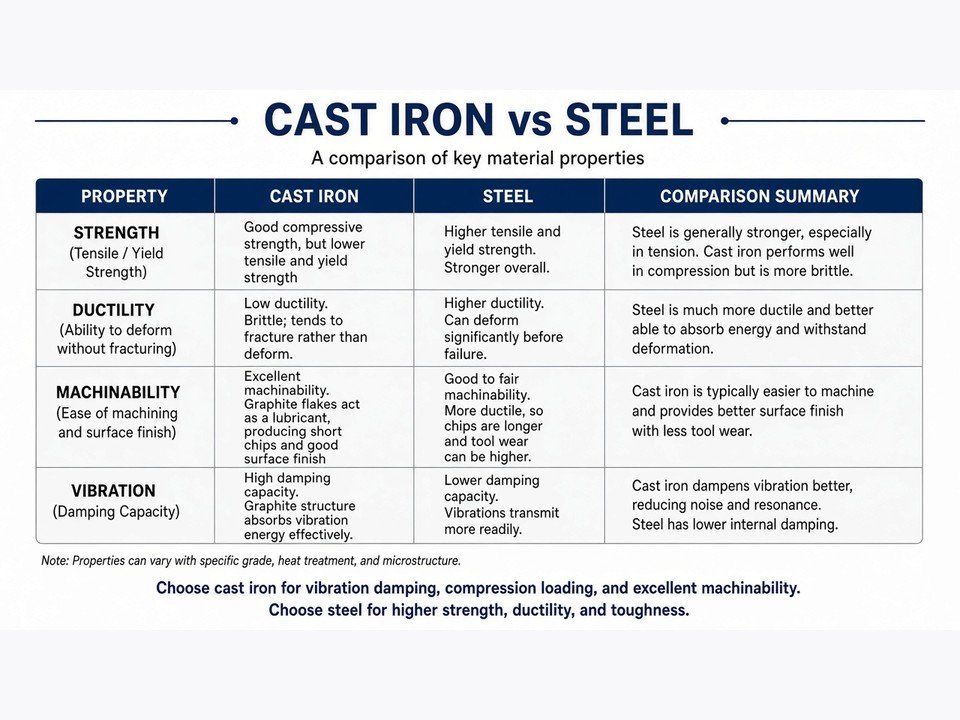
Key Mechanical and Physical Property Differences
The comparison table tells you what to expect. The sections below explain why those differences exist and how they shape the manufacturing route we recommend.
Strength & Durability
Steel wins on tensile strength. It resists being pulled apart, which is why it dominates structural beams, tie rods, and any part that carries load in tension. Cast iron wins on compressive strength. It resists being crushed, which is exactly what you want in a machine base, a column, or a heavy frame sitting under a load.
This is the single most misunderstood point in the comparison. "Stronger" is not a property — it depends on the direction of the load. A part loaded in compression may perform perfectly well in cast iron at a fraction of the cost of steel.
Why It Matters
Before specifying a material, define the load path. If the primary stress is tension or bending, steel is usually the safer call. If it is compression and stiffness, cast iron often outperforms its price.
Hardness & Wear Resistance
Cast iron's graphite structure gives it natural resistance to abrasion, which is why it shows up in brake rotors, cylinder liners, and machine tool beds. The graphite acts as a built-in lubricant and helps the material handle sliding contact.
Steel takes a different route: it can be surface hardened through carburizing, nitriding, or induction hardening, producing a hard, wear-resistant skin over a tough, ductile core. For parts that need both a hard working surface and impact tolerance, hardened steel is usually the better answer.
Machinability & Castability
Cast iron is easier to pour into complex shapes because of its lower melting point and excellent flow in the mold. Intricate internal passages, cooling channels, and thin walls are all realistic in a casting. It also machines cleanly, producing short chips rather than long, stringy ones.
Steel is more demanding. It requires more intensive machining, generates longer chips, and typically needs more passes and more tooling attention. That is a real cost, and it is why simple steel parts are often best produced as bar stock on a CNC lathe or mill rather than as castings.
Vibration & Heat
Cast iron is the industry standard for dampening vibration. The graphite flakes absorb mechanical energy, which is why machine tool bases, surface plates, and engine blocks are traditionally cast iron. If your part sits under a spindle or near a motor, this property alone can decide the material.
Cast iron also retains heat well, which matters in applications like cookware and thermal fixtures. Steel conducts heat differently and responds faster to temperature changes, which is an advantage in some contexts and a liability in others.
Weldability & Corrosion
Steel is far more weldable. Low-carbon steels join cleanly with common processes, and the resulting joints are reliable. Cast iron can be welded, but the process is slow, requires preheating and careful cooling, and the result is rarely as strong as the parent material.
Corrosion resistance varies by grade in both families. Neither is naturally corrosion-proof. Alloy steels and specific cast iron grades offer better performance, but for aggressive environments, both materials usually need a coating, plating, or surface treatment.
Practical Note
If the assembly will be welded after casting, plan the joint design around steel. Welding cast iron is possible but rarely the economical path.
When to Use Which: Application-Based Selection
Property tables are useful, but the decision usually comes down to the application. Here is how we frame it when reviewing a project.
Industrial Applications
Cast iron and steel each have a natural home in industrial equipment. The split tends to follow the load path and the required geometry.
Choose Cast Iron
Machine bases, engine blocks, cylinder heads, pump housings, and heavy frames. These parts carry compressive loads, benefit from vibration damping, and often have complex internal geometry that is far cheaper to cast than to machine.
Choose Steel
Structural beams, automotive chassis and suspension components, shafts, fasteners, and any part that carries tensile or bending loads. Steel's ductility and weldability make it the default for assemblies that must flex without fracturing.
Cookware Context
The same physics shows up in the kitchen. Cast iron pans are heavy, retain heat for a long time, and are excellent for searing and even heat distribution. Carbon steel pans are lighter, heat up faster, and respond more quickly to temperature changes, which many cooks prefer for stir-frying and precise control. Both develop a seasoning layer; the choice is about weight, responsiveness, and how the pan will be used.
Cost Efficiency
Cost is not just the price of the metal. It is the total cost of getting a finished part: material, tooling, machining time, scrap rate, and finishing. Cast iron usually wins on complex shapes at production volume, because the mold does the forming work and machining is limited to critical surfaces.
Steel often wins for simple geometries and low volumes, where bar stock and CNC machining avoid the tooling investment entirely. Waste matters too: a machined-from-solid steel part may remove a large fraction of the stock as chips, while a casting starts close to net shape.
-
1
Define the load path
Tension and bending point to steel; compression and stiffness favor cast iron.
-
2
Check the geometry
Complex internal features and thin walls favor casting; simple profiles favor machining from stock.
-
3
Estimate the volume
Tooling amortizes at higher quantities; low volumes usually favor CNC from bar or plate.
-
4
Confirm the environment
Corrosion, temperature cycling, and impact exposure may override the default choice.
Frequently Asked Questions
Is cast iron stronger than steel?
It depends on the direction of the load. Cast iron is typically stronger in compression, which is why it is used for machine bases and heavy frames. Steel is stronger in tension and bending. If someone asks this question without specifying the load, the honest answer is that the question is incomplete.
How can I tell the difference between cast steel and cast iron?
A few practical cues help. Cast iron parts usually show a slightly rougher, grayer surface finish and produce a duller, shorter ringing sound when struck. A spark test on a grinder shows short, reddish sparks for cast iron versus longer, brighter spark streams for steel. Cast steel parts also tend to show more ductile deformation at fracture, while cast iron breaks with a cleaner, more brittle edge.
What is the main disadvantage of cast iron?
Brittleness. Cast iron has low impact resistance and can crack rather than deform under sudden loads or thermal shock. That limits its use in parts that experience shock, vibration with high amplitude, or rapid temperature swings.
Why did we stop using cast iron for some applications?
For high-stress structural requirements, steel simply performs better. As engineering demands increased — lighter structures, higher tensile loads, weldable assemblies, better impact tolerance — steel replaced cast iron in many applications. Cast iron did not become a bad material; the requirements moved past what it could safely deliver.
Making the Right Choice
The cast iron vs steel decision is not about which material is better. It is about matching the material to the load, the geometry, the production volume, and the environment the part will live in.
Analyze the specific load first. Then look at the budget and the production quantity. Then check the environmental conditions — corrosion, impact, temperature cycling. In most projects, those three questions resolve the material call before any machining decision is made.
At PartsMake, every project starts with that review. Our engineering team looks at drawings, CAD files, material callouts, tolerances, critical dimensions, surface requirements, quantities, and the intended application before production begins. If a material choice looks risky for the load case, we raise it before the first part is made — not after.
Whether the part ends up in cast iron or steel, we support the full path from prototype through repeat production across CNC machining, turning, 5-axis, mill-turn, Swiss machining, sheet metal fabrication, 3D printing, grinding, EDM, finishing, and inspection.
Start Your Project
Not sure whether your part should be cast iron or steel?
Send us the drawing, the load case, and the production quantity. Our engineering team will review the material callout, flag any manufacturing risks, and recommend the process route that gets you a part ready for assembly — from prototype through repeat production.