
Manufacturing guide
CNC Meaning: Definitions, Manufacturing Uses & Slang Explained
Learn the full CNC meaning across manufacturing, machining, texting slang, and TikTok trends, plus how the technology works and where it delivers the most value.
In engineering, CNC usually means Computer Numerical Control: the automated control of machine tools using digital instructions. The same three letters can mean something entirely different online, so context matters.
What Does CNC Stand For?
CNC stands for Computer Numerical Control. It describes a manufacturing method in which a computer interprets programmed instructions and controls the movement of a machine tool. CNC equipment can cut, drill, turn, mill, grind, or otherwise process a workpiece with a high degree of consistency.
Manufacturing is the primary technical meaning, but searches for “CNC meaning” may also refer to online slang or social-media usage. We explain those interpretations later so readers can distinguish the industrial term from unrelated contexts.
CNC Definition and Acronym Explained
“Numerical control” means that machine actions are represented by numbers and commands: positions, feed rates, spindle speeds, tool changes, coolant actions, and other operating instructions. Adding “computer” reflects the modern controller that stores, interprets, and executes those instructions.
CNC in Manufacturing Context
A CNC machine does not independently decide what shape to make. An engineer or programmer prepares a digital model and manufacturing instructions; the controller then coordinates the machine’s axes, cutting tool, spindle, workholding, and auxiliary functions. The result is a repeatable process for producing a defined part geometry.
The programmed process
CAD geometry and manufacturing decisions are translated into toolpaths and machine code.
The controlled result
Motors and feedback systems move the tool or workpiece to create the intended features consistently.
How Does a CNC Machine Work?
The workflow begins with a digital design and ends with inspection of the finished component. At PartsMake, we review the drawing or CAD model, material, tolerances, critical dimensions, surface requirements, and quantity before production begins.
-
1
Create the design
A CAD model and technical drawing define geometry, dimensions, tolerances, material, and finish.
-
2
Plan the machining
The process is selected, stock and workholding are considered, and tools and cutting conditions are planned.
-
3
Generate and verify code
CAM software generates toolpaths, which are reviewed and translated into controller-ready instructions.
-
4
Machine the part
The controller coordinates axes, spindle, tooling, and auxiliary functions while the operator monitors the process.
-
5
Inspect and finish
The component is inspected against project requirements and may receive secondary processing or surface finishing.
The Language of CNC: G-Code and M-Code
G-code generally describes geometric and motion-related commands. It can define movements, positioning modes, feed rates, and cutting paths. M-code generally controls machine functions such as spindle operation, coolant, stops, and tool changes.
Why it matters
Code is only one part of a successful result. Workholding, tool selection, machine condition, material behavior, and inspection all influence whether the finished part meets its drawing.
Drive Systems: Precision and Control
CNC axes are moved by motors through mechanical drive systems such as ballscrews or other transmission arrangements. The controller commands a target position, while encoders or other feedback devices can report actual movement. This closed-loop or monitored control helps the machine maintain coordinated, accurate motion.
Accuracy also depends on calibration, thermal behavior, machine rigidity, tool condition, fixturing, and the cutting strategy. For that reason, we treat machine programming and engineering review as connected activities rather than isolated steps.
Types of CNC Machines and Their Capabilities
Different CNC platforms are optimized for different part shapes. Choosing the right process can reduce setups, improve access to features, and control cost.
| Machine type | Typical capabilities | Common applications |
|---|---|---|
| CNC milling | 3-axis, 4-axis, and 5-axis cutting | Housings, brackets, plates, fixtures, and structural components |
| CNC turning | Rotary workpiece machining and precision turning | Shafts, pins, bushings, sleeves, and threaded parts |
| Mill-turn | Turning and milling in one machine setup | Complex cylindrical components with cross features |
| Swiss machining | Precision machining for small parts up to Ø32 mm | Miniature shafts, pins, and precision components |
| EDM | Wire and sinker electrical discharge machining | Hardened materials and complex profiles |
What Materials Can CNC Machines Handle?
CNC machining is used for many metals, including aluminum, steel, stainless steel, brass, copper, titanium, and other engineering alloys. It also supports plastics such as ABS, nylon, POM, PEEK, acrylic, and similar technical materials, provided the process is matched to the material’s strength, heat sensitivity, and dimensional behavior.
Modern manufacturing increasingly combines machining with other processes rather than forcing every feature into one method. Depending on the part, a project may combine CNC machining, injection molding, sheet metal fabrication, 3D printing, grinding, EDM, and surface finishing. We select the process around the part’s function, quantity, and requirements.
Key Advantages of CNC Manufacturing
CNC manufacturing converts a controlled digital process into physical parts. Its value is especially clear when a design includes multiple features, tight relationships between dimensions, or repeated production requirements.
Precision: programmed movements and controlled setups support accurate feature placement.
Repeatability: the same validated program can be used to produce consistent parts across a batch.
Speed: automated movements can reduce manual handling and make complex operations more efficient.
Reduced manual variation: operators still oversee the process, but the programmed motion is less dependent on hand control.
CNC Machining vs. Manual Machining
| Factor | CNC machining | Manual machining |
|---|---|---|
| Accuracy and repeatability | Programmed motion supports consistent results | More dependent on operator technique |
| Initial cost | Higher equipment, programming, and setup investment | Often lower equipment complexity for simple work |
| Scalability | Well suited to repeat and multi-feature production | Useful for one-off work and straightforward adjustments |
| Skill profile | Requires programming, setup, tooling, and inspection knowledge | Requires strong hands-on machine and measurement skills |
Historical Development of CNC
CNC developed from the need to produce complex shapes more consistently than manual methods allowed. Early numerical-control systems used punched tape and hard-coded instructions to control machine movement. As electronics and computing advanced, those systems became more flexible, programmable, and accessible.
Today’s CNC environment connects CAD, CAM, simulation, digital inspection, and production planning. More recent systems can use machine data, automated verification, and AI-assisted programming or optimization, while still relying on engineering judgment for material behavior, tolerances, tooling, and quality decisions.
Key Milestones in CNC Technology
Early numerical control: machine movement was directed by numerical instructions, often stored on punched media.
Computer control: integrated controllers made programs easier to store, edit, and reuse.
CAD/CAM integration: digital design and toolpath generation became connected parts of the manufacturing workflow.
Multiaxis machining: 4-axis, 5-axis, mill-turn, and Swiss platforms expanded access to complex geometries.
Connected manufacturing: simulation, inspection data, automation, and AI-assisted tools now support more informed production decisions.
Applications of CNC Across Industries
CNC machining is used wherever engineers need controlled geometry, functional interfaces, and dependable repeatability. Typical applications include aerospace and drone components, automotive and EV parts, robotics hardware, semiconductor equipment, electronics housings, medical and laboratory equipment, and industrial machinery.
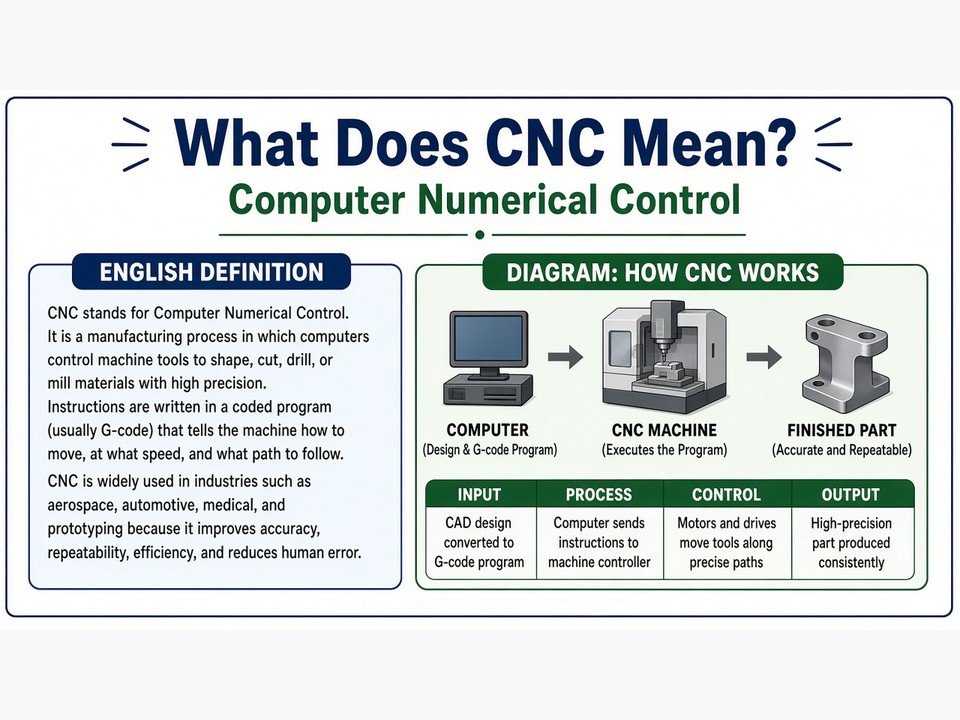
A CNC process links digital part definition, controlled machine motion, and inspection of the finished component.
CNC in Prototyping and Production
CNC is valuable for prototypes because it can produce functional parts directly from engineering data without creating a dedicated mold. This helps teams evaluate fit, assembly, strength, thermal behavior, and usability before committing to higher-volume tooling.
The same process can support engineering samples, pilot production, low-volume manufacturing, and repeat production. However, a prototype process may not be the most economical production process at larger quantities. We help evaluate whether to continue machining or combine it with injection molding, sheet metal, additive manufacturing, finishing, assembly, and inspection.
Other Meanings of CNC
Outside manufacturing, CNC can refer to different phrases. Search results and conversations should be interpreted by context, especially when the acronym appears in texting, online communities, or short-form video captions.
What Does CNC Mean in Texting Slang?
In texting and online relationship or adult-community contexts, CNC commonly means consensual non-consent. It describes a negotiated role-play or dynamic in which participants agree in advance to act as though consent is absent or withdrawn, while actual consent, boundaries, safewords, and aftercare remain essential.
Context and safety
This slang meaning is unrelated to Computer Numerical Control. It should never be assumed from an acronym alone, and any real-world activity involving it requires explicit, informed, ongoing agreement among participants.
What Is CNC in TikTok?
On TikTok, CNC may appear in videos, comments, hashtags, or coded discussions using the consensual-non-consent meaning. It can also appear in manufacturing, maker, woodworking, routing, engraving, or machining content where it retains the technical meaning of Computer Numerical Control.
There is no single TikTok definition that overrides context. Look at the surrounding words, visuals, hashtags, and audience. A video showing a router cutting a sign is likely using the manufacturing meaning; a relationship-focused post may be using the slang meaning.
Advantages and Limitations of CNC Technology
Advantages
- Consistent programmed motion
- Efficient production of complex geometries
- Repeatable results across batches
- Digital design-to-part workflow
- Compatibility with many metals and plastics
Limitations
- Equipment, tooling, programming, and setup require investment
- Operators and engineers need specialized knowledge
- Poorly designed parts can create unnecessary machining cost
- Some geometries may require multiple setups or another process
- Inspection remains necessary; automation does not remove quality responsibility
Is CNC Expensive to Start?
Starting a CNC operation can be expensive because the total investment extends beyond the machine. It may include programming or CAM software, tooling, workholding, measurement equipment, material, maintenance, operator training, facility requirements, and process development.
The practical cost of a machined part also depends on material, geometry, tolerances, surface finish, number of setups, quantity, inspection requirements, and secondary operations. For many teams, working with a manufacturing partner avoids purchasing equipment before demand and process requirements are understood.
CNC Design Guidelines and Cost Drivers
Design for manufacturing does not mean removing useful features. It means identifying which requirements are functionally necessary and making the rest practical to produce, inspect, and repeat.
Use tolerances where they matter
Reserve tight tolerances for mating, sealing, locating, or performance-critical features. Broad, workable tolerances are usually less costly to machine and inspect.
Avoid unnecessary deep and narrow features
Deep pockets, thin walls, and narrow slots can require specialized tools, slower cutting, additional setups, or careful deformation control.
Choose material with the application in mind
Strength, wear, corrosion, weight, thermal behavior, machinability, and finishing needs should all be considered before specifying a material.
Reduce setups when possible
A geometry that can be accessed efficiently in fewer setups may reduce handling, alignment risk, and machining time. Complex parts may benefit from 4-axis, 5-axis, or mill-turn strategies.
Define inspection requirements clearly
Identify critical dimensions, datums, surface requirements, material expectations, and any functional test needs on the drawing or in the project documentation.
Practical review
At PartsMake, manufacturing starts with understanding the part rather than simply starting the machine. We review CAD files, drawings, materials, tolerances, quantities, surface requirements, and intended applications before production.
FAQ
What is meant by CNC?
In manufacturing, CNC means Computer Numerical Control. It is the automated control of machine tools through programmed digital commands that direct movements and operations.
What is the other meaning of CNC?
In online and texting contexts, CNC may mean consensual non-consent, a term for a negotiated role-play or dynamic. It is unrelated to CNC machining, so the surrounding context is important.
What does CNC stand for in texting slang?
CNC commonly stands for consensual non-consent in texting slang. The term refers to an arrangement involving explicit boundaries, prior agreement, and ongoing consent, even when the role-play depicts non-consent.
What is CNC in TikTok?
TikTok uses CNC in more than one way. It may refer to Computer Numerical Control in maker and machining videos, or consensual non-consent in relationship-focused content. Hashtags and surrounding visuals usually clarify the meaning.
Plan your next part
Need CNC parts from prototype to production?
Share your CAD files, drawings, material requirements, quantities, and quality expectations with PartsMake. Our engineering team can review the manufacturing approach and help identify risks before production.