
Engineering Cost Guide
CNC Milling Cost Guide: Factors, Hourly Rates & Price Reduction Tips
Learn how much CNC milling can cost in 2024–2025. We explain machine rates, materials, setup time, tolerances, finishing, and practical design decisions that help control your manufacturing budget.
The most useful CNC milling cost estimate is not a single hourly number. It is a project-specific calculation that connects geometry, material, production volume, quality requirements, and finishing.
Understanding CNC Milling Costs: The “Quick Answer”
When people ask about CNC milling cost, they may be asking two different questions: how much it costs to own a machine, or how much it costs to have a part manufactured. These are fundamentally different spending models.
Buying a machine: CAPEX
Purchasing a CNC mill is a capital expenditure. The investment extends beyond the machine itself to include tooling, workholding, programming, inspection, maintenance, operator time, floor space, and training.
Outsourcing a part: OPEX
A supplier quote is an operating expense for a specific project. It normally combines material, programming, setup, machining, inspection, finishing, packaging, and other agreed services into a part or batch price.
As a broad planning reference, CNC machine-shop rates commonly fall between $50 and $200 or more per hour. The actual rate depends on machine complexity, capability, labor, inspection requirements, and the supplier’s operating model. A 3-axis mill and a complex 5-axis machining center should not be evaluated using the same hourly assumption.
Practical answer
There is no universal price for a CNC-machined part. Geometry, quantity, material, tolerances, surface requirements, and delivery expectations determine the quote. A simple aluminum bracket may be inexpensive per piece, while a low-volume multi-sided alloy component can require substantially more programming, setup, and inspection.
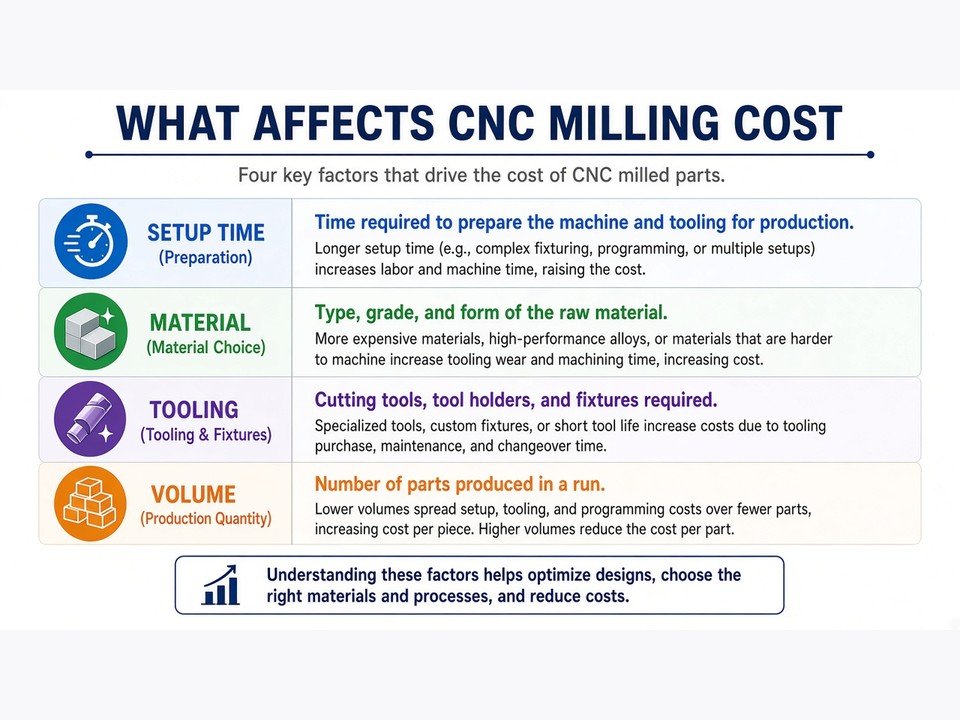
The right cost discussion begins with the part and its manufacturing requirements, not with an hourly rate alone.
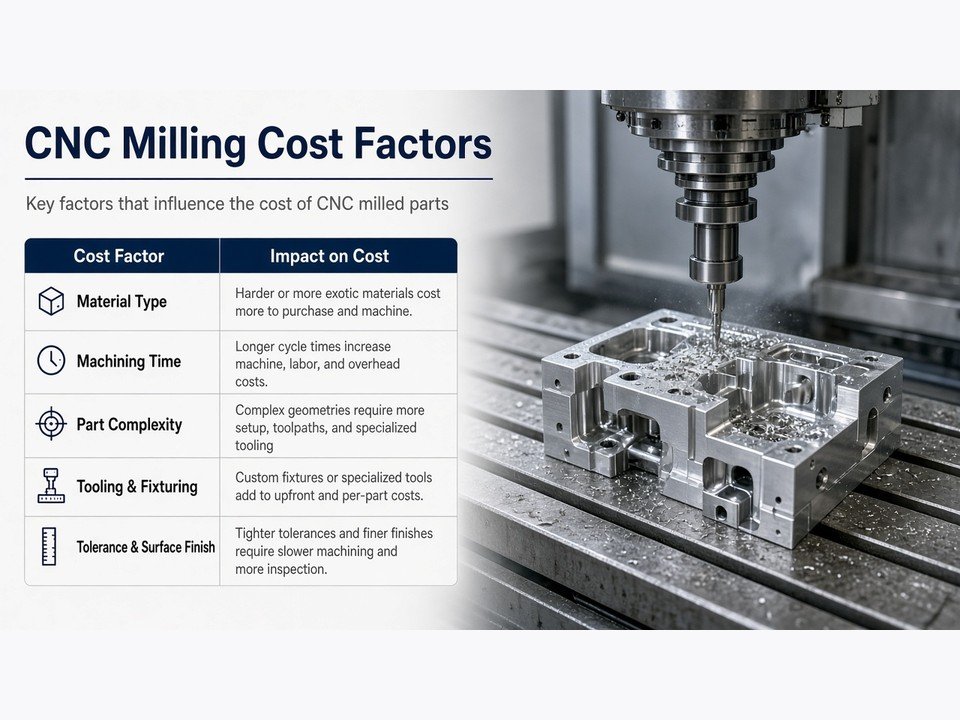
The 5 Key Drivers of CNC Milling Costs
At PartsMake, we review the drawing, CAD model, material, tolerances, quantities, and intended application before production. This engineering review helps identify which variables are truly driving the price.
Material Selection
Material affects both the raw stock price and the time required to machine it. Standard 6061 aluminum is generally easier to source and machine than exotic alloys, hardened materials, or less common engineering grades. Plastics can also vary widely: a common machinable plastic and a high-performance material may have very different raw material costs and cutting behavior.
Machine Time & Complexity
Machine time includes cutting, tool changes, probing, repositioning, and other cycle activities. A 3-axis part with accessible features may be completed efficiently, while a 4-axis or 5-axis part can require more advanced programming and workholding. Complex surfaces, deep pockets, thin walls, and multiple orientations can increase both cycle time and setup requirements.
Setup & Programming
Before the first part is cut, the supplier may need to program toolpaths, prepare workholding, load tools, establish offsets, and verify the process. These activities create a setup cost that is spread across the order quantity. Consequently, a one-piece prototype often has a higher unit price than the same part produced in a larger batch.
Tolerances & Precision
Tight tolerances are a cost-of-quality decision. They may require slower feeds, additional finishing passes, controlled measurement, specialized tooling, and more inspection time. Applying a tight tolerance to every dimension can raise cost without improving the part’s function. It is usually more efficient to identify critical dimensions and allow practical general tolerances elsewhere.
Post-Processing & Finishing
The machined part may need manual deburring, anodizing, powder coating, heat treatment, surface preparation, or another finish. Each additional operation adds handling, coordination, and inspection requirements. Finishing can be essential for corrosion resistance, wear, appearance, or fit, but it should be specified according to the application rather than added by default.
How to Calculate Your Project Costs
A useful early-stage model separates one-time work from recurring per-part work. The basic formula is:
(Setup Cost + (Material Cost + Machine Time) × Quantity) + Finishing = Total Price
This is a planning framework rather than a replacement for a supplier quote. It helps show why two visually similar parts can have different prices, and why changing quantity or tolerance can affect the result.
Define the setup
Account for programming, fixtures, workholding, tool preparation, and first-article verification.
Estimate recurring work
Combine raw material consumption with cutting, tool changes, handling, and inspection time per part.
Add required finishing
Include deburring, coating, heat treatment, marking, packaging, and any required secondary operations.
Where DFM helps
Design for Manufacturing, or DFM, reduces unnecessary cost by addressing these variables before production. We can review whether features are accessible, whether standard tools can be used, and whether tolerances and finishes match the part’s actual function.
Batch volume creates economies of scale because programming and setup costs are distributed across more pieces. Larger orders can reduce unit cost, but the best quantity depends on demand, inventory risk, cash flow, and design stability. A pilot batch may be the right choice when a product is still being validated.
Strategies to Reduce Your CNC Machining Costs
Cost reduction is most effective when it protects the function of the part rather than simply asking a supplier to lower the price. The following decisions are practical starting points.
Simplify Geometry
Use standard hole sizes, practical internal radii, and accessible features where possible. Unusually small radii, deep narrow pockets, and difficult-to-reach surfaces may require specialty tooling, extra setups, or slower machining.
Standardize Materials
Common grades such as 6061 aluminum are often easier to source and schedule than unusual materials. Standardizing material choices across related parts can simplify purchasing and reduce material surcharges.
Optimize Tolerances
Reserve tight tolerances for interfaces, bearing locations, sealing surfaces, and other genuinely critical dimensions. Use clearly defined general tolerances for non-critical features instead of tightening the entire drawing.
Plan Volume Carefully
If demand is predictable and the design is stable, a larger batch can amortize setup and programming costs. If the design is changing, a smaller engineering or pilot batch may avoid excess inventory and rework.
Use Instant Quoting Strategically
AI-driven and automated quoting platforms are making it faster to compare options and identify cost drivers. They are useful for early screening, while an engineering review remains important for complex tolerances, finishes, inspection, and production risk.
Design review checkpoint
Before requesting a final price, check that the CAD model, drawing, material callout, quantity, critical dimensions, surface requirements, and inspection expectations all describe the same part.
Outsourcing vs. In-House: Making the Right Choice
The right choice depends on more than the apparent per-part price. We recommend comparing the complete manufacturing responsibility, including programming, maintenance, quality control, scheduling, and production risk.
| Consideration | In-house may fit when | Outsourcing may fit when |
|---|---|---|
| Demand | Long-term, repeat production can support equipment utilization. | Prototypes, variable demand, or limited production do not justify ownership. |
| Part complexity | The required process is already within your team’s capability. | Complex multi-axis parts need specialized equipment or experience. |
| Business constraints | Proprietary IP or immediate internal access is a priority. | Shop space, staffing, maintenance, or capital are constrained. |
Domestic and international manufacturing also require a complete comparison. A lower quoted piece price may be offset by shipping, customs coordination, longer lead times, communication overhead, or additional quality-control work. On the other hand, an experienced international partner can coordinate machining, finishing, inspection, packaging, and repeat production through one project team.
PartsMake supports engineers, product developers, startups, OEMs, and procurement teams from prototype through repeat production. Our manufacturing scope includes CNC milling, 5-axis machining, turning, mill-turn, Swiss machining, injection molding, sheet metal fabrication, 3D printing, finishing, and inspection, allowing us to assess the most appropriate process for the part rather than forcing every project into one method.
Frequently Asked Questions (FAQ)
How much does it cost to have something CNC machined?
A simple, low-complexity part may be relatively inexpensive, while complex, tight-tolerance, multi-axis parts can cost considerably more. For planning, shop rates often range from $50 to $200 or more per hour, but the final price depends on material, geometry, quantity, setup, finishing, inspection, and delivery requirements.
What does a CNC mill cost?
A hobbyist or desktop unit and an industrial machining center serve very different purposes, so their purchase prices and ownership costs are not directly comparable. The total investment should include tooling, workholding, software, installation, maintenance, operator capability, inspection, and available floor space—not only the machine purchase price.
How much does CNC cutting cost?
“CNC cutting” can mean different processes. CNC milling removes material with rotating tools and is suited to 3D features, pockets, holes, and contoured surfaces. Laser or waterjet cutting is typically used to cut profiles from sheet or plate. The better process depends on thickness, material, geometry, edge requirements, quantity, and secondary operations.
How can I get an accurate quote for my part?
Upload clean CAD or STEP files and provide a drawing when tolerances, surface finish, material condition, inspection, or other requirements matter. Include quantity, target application, finishing needs, and delivery expectations. Complete information allows the manufacturing team to evaluate risk instead of pricing from assumptions.
Conclusion: Optimizing Your Manufacturing Budget
The best time to manage CNC milling cost is before the design is released for production. Material selection, feature accessibility, tolerance strategy, batch planning, finishing, and inspection requirements all influence the final price. Early decisions are usually less expensive to change than production tooling, rework, or a delayed launch.
We encourage engineers and purchasing teams to involve a machinist during the design phase. A practical DFM review can reveal hidden cost drivers, clarify which dimensions are critical, and identify whether another process or production volume would better support the application.
At PartsMake, manufacturing starts with understanding the part—not simply starting the machine. Our team reviews CAD files, drawings, materials, tolerances, critical dimensions, surface requirements, quantities, and intended use before production begins. Upload your design for a custom quote, or contact us to discuss a DFM review and manufacturing plan.
Ready to evaluate your CNC milling cost?
Send us your CAD files and project requirements. We will help identify the major cost variables and determine a practical path from prototype to production.
Request a Custom Quote