
Composite Materials: A Complete Guide to Properties, Types, and Uses
From aerospace primary structures to ultra-light EV battery enclosures, composite materials allow engineers to tailor mechanical behavior along directional load paths. Here is how reinforcements, matrices, and sandwich cores combine to outshine monolithic alloys.
"Unlike isotropic metals that possess uniform properties in every direction, composite materials allow us to architect strength exactly along the lines of principal stress—delivering high structural stiffness without dead weight."
What Are Composite Materials? (Definition & Basics)
In mechanical and manufacturing engineering, a composite material is formed by combining two or more physically and chemically distinct constituent materials that remain separated by a macroscopic interface within the finished component. Instead of dissolving into each other like a metallic solid-solution alloy, the constituents cooperate synergistically.
The fundamental premise behind composites is synergy: the combined assembly exhibits engineering performance—such as specific modulus, fatigue resistance, and thermal stability—that neither constituent could achieve on its own. While the primary reinforcement bears tensile and compressive stress, the surrounding binder holds the fibers in geometric alignment and isolates surface microcracks from propagating unchecked.
Addressing the PAA: What are composite materials?
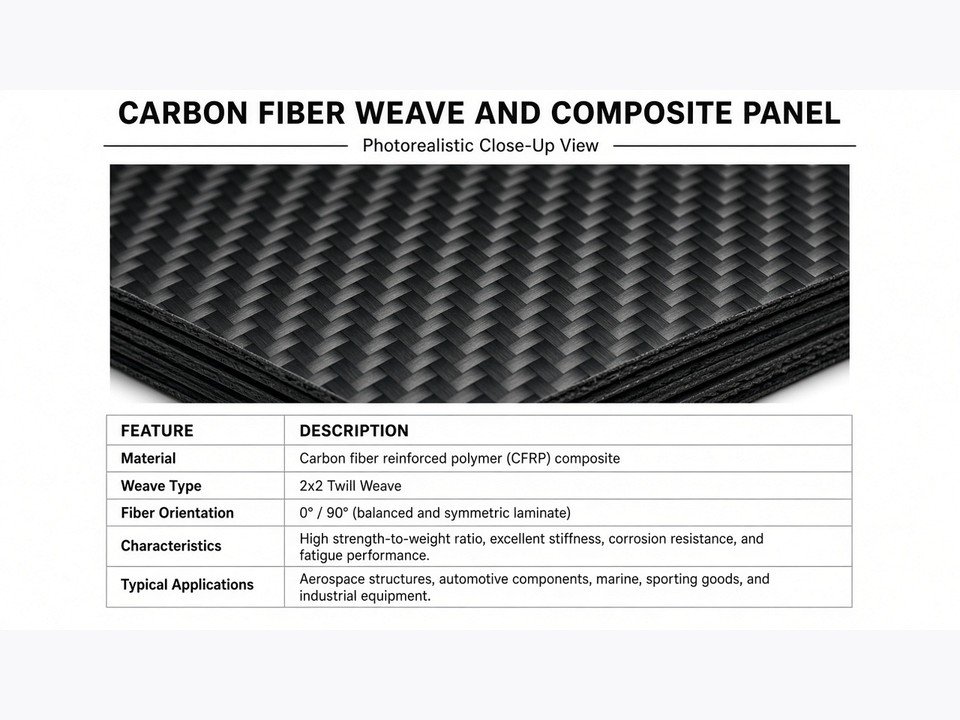
Practically speaking, composite materials are engineered multi-phase systems comprising a reinforcing element (continuous fiber, short chop, or particulate) embedded inside a continuous binding matrix (polymer, metal, or ceramic). Common everyday examples include carbon fiber reinforced polymer (CFRP), fiberglass (GFRP), and structural concrete reinforced with steel rebar.
Core Components: How Composites Are Made
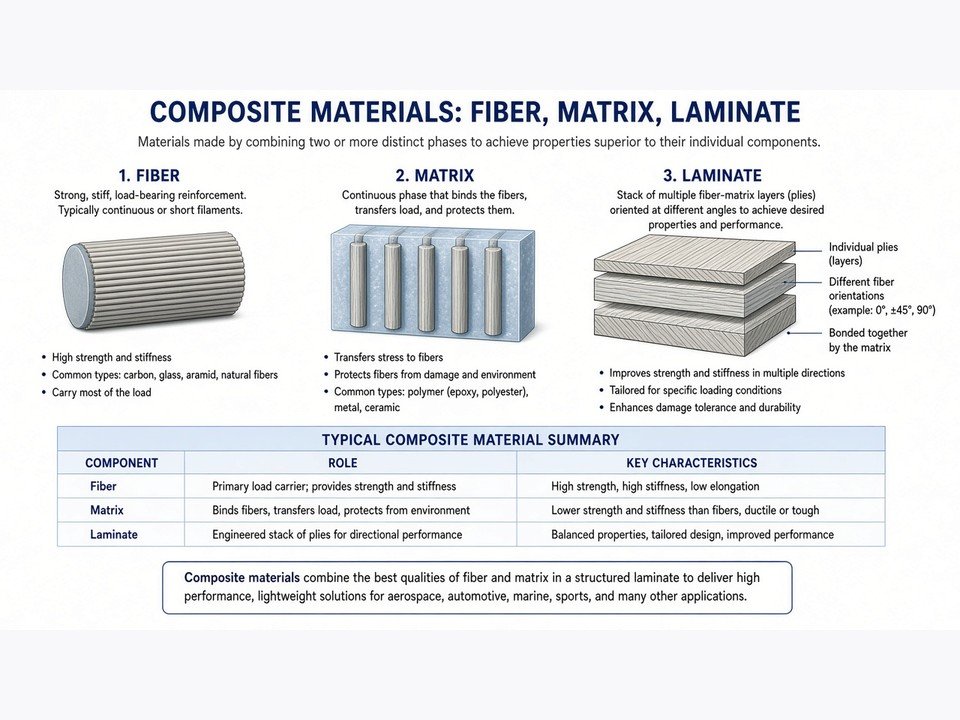
When we evaluate composite component designs at PartsMake, we break the laminate architecture down into three functional constituents: the reinforcement, the matrix, and optional low-density core media.
1. Reinforcement Fibers
Fibers represent the principal load-bearing element, contributing up to 60–70% of the composite's total volume in high-performance structural laminates. The three dominant reinforcement classes are:
2. Matrix and Resin Systems
The continuous phase serves four pivotal mechanical duties: distributing applied shear stresses across individual filaments, maintaining fiber spacing and orientation, preventing moisture ingress or galvanic oxidation, and providing interlaminar shear strength. In Polymer Matrix Composites (PMCs), matrices fall into thermosetting resins (epoxy, vinyl ester, bismaleimide) which cure irreversibly, or high-temperature engineering thermoplastics (PEEK, PEKK, PPS) that allow rapid stamping and post-form thermoforming.
3. Core Materials for Sandwich Structures
When an application requires maximum flexural stiffness with strict weight limits, single solid laminates are replaced by sandwich panel constructions. By separating two thin, high-modulus composite skins with a lightweight, shear-resistant core, the section moment of inertia increases dramatically with negligible added mass:
The Different Types of Composite Materials
Composite classifications are conventionally grouped according to matrix chemistry or reinforcement morphology. In industrial manufacturing, categorizing by the matrix phase dictates the tooling, thermal processing limits, and secondary machining methods required.
Polymer Matrix Composites (PMCs)
Accounting for over 90% of global industrial output, PMCs utilize either thermoset or thermoplastic resins reinforced with glass, carbon, or aramid. Within PMCs, Carbon Fiber Reinforced Polymers (CFRPs) and Glass Fiber Reinforced Polymers (GFRPs) dominate due to straightforward molding chemistry and predictable room-temperature mechanical behavior.
Metal Matrix Composites (MMCs)
MMCs utilize a lightweight metallic binder—primarily aluminum, titanium, or magnesium alloys—reinforced with refractory ceramic particles or whiskers such as silicon carbide (SiC) or aluminum oxide (Al2O3). MMCs bridge the gap between traditional casting metals and pure ceramics, offering superior wear resistance, high thermal conductivity, and elevated-temperature creep stability for automotive brake rotors, drive shafts, and electronic thermal spreaders.
Ceramic Matrix Composites (CMCs)
CMCs overcome the brittle fracture limitations of pure monolithic ceramics. By distributing continuous ceramic fibers (such as silicon carbide fibers) within a ceramic matrix, microcracks bridge across fibers rather than propagating catastrophically. Operating above 1,100°C without external active cooling, CMCs have become mandatory for modern jet engine hot-section turbine shrouds and hypersonic thermal protection surfaces.
Hybrid Composites
Engineering designs often balance competing constraints that a single reinforcement cannot solve alone. Hybrid composites combine two distinct fiber systems within the same resin system—such as alternating carbon and glass plies. This architecture leverages carbon for high tensile modulus and structural rigidity, while interleaved glass or aramid plies mitigate catastrophic impact brittleness and lower raw raw-material procurement costs.
Addressing PAA: What are the main types of composite materials?
Depending on the engineering taxonomy used, composites are classified either into the 3 fundamental matrix groups or the 9 structural configurations:
Why Choose Composites? Key Advantages and Properties
When our engineering team at PartsMake works with designers deciding between 6061-T6 aluminum, 316 stainless steel, and carbon laminates, we benchmark functional performance against specific mechanical criteria:
High Strength-to-Weight Ratio
CFRP delivers specific tensile strengths exceeding structural steel by up to 5 times at one-fifth the density (1.55 g/cm³ vs 7.85 g/cm³). This reduction in rotating mass directly reduces mechanical inertia in high-frequency automated systems.
Corrosion and Chemical Immunity
Unlike ferrous alloys vulnerable to galvanic corrosion or aluminum subject to pitting in saline atmospheric environments, polymer-based composites resist moisture, harsh salts, and hydrocarbon solvents without sacrificial coatings.
Unmatched Geometric Freedom
Liquid infusion, compression molding, and prepreg bladder molding allow monolithic consolidation of complex compound curvatures, integrated stiffening ribs, and structural bosses that would require multi-piece CNC assemblies in metal.
Thermal & Dielectric Customization
Composites can be formulated with near-zero Coefficient of Thermal Expansion (CTE) across satellite thermal ranges, or engineered with glass/cyanate-ester matrices to provide high-voltage dielectric isolation for power hardware.
| Material Class | Density (g/cm³) | Tensile Modulus (GPa) | Corrosion Vulnerability | Primary Failure Mode |
|---|---|---|---|---|
| Carbon Epoxy Prepreg (UD) | 1.50 - 1.60 | 130 - 230 | Immune (Resin-protected) | Delamination / Fiber micro-buckling |
| Structural Steel (AISI 1045) | 7.85 | 205 | High (Oxidation/Rust) | Ductile yield / Plastic slip |
| Aluminum Alloy (6061-T6) | 2.70 | 69 | Moderate (Pitting / Intergranular) | Cyclic fatigue cracking |
| E-Glass Vinyl Ester | 1.80 - 2.00 | 20 - 40 | Immune | Matrix shear microcracking |
Real-World Applications Across Industries
Composite utilization is no longer isolated to boutique aerospace programs. Across modern industrial product development, composites routinely displace standard extrusions and cast housings:
Aerospace & Defense
Modern airliners like the Boeing 787 and Airbus A350 exceed 50% composite content by structural weight. Monolithic wing skins, stringers, and pressurized fuselage barrels decrease structural mass, yielding lower burn rates and extended fatigue service lifetimes without risk of metallic skin corrosion.
Automotive & Electric Vehicles
In addition to monocoque chassis tubs in motorsport, production electric vehicles rely on compression-molded Sheet Molding Compound (SMC) and high-stiffness carbon composites for structural battery carrier trays. This preserves torsional rigidity while shielding passenger cabins during side-pole impact events.
Renewable Energy Infrastructure
Modern offshore wind blades spanning over 100 meters rely on carbon-fiber spar caps paired with resin-infused multiaxial glass fabrics and balsa sandwich cores. This combination maintains structural aerodynamic pitch under heavy cyclic wind gusts without structural deflection into turbine towers.
Infrastructure & Civil Retrofits
Civil contractors wrap external carbon fiber reinforced polymer jackets around aging municipal bridge piers and concrete support pillars. This non-invasive retrofitting restores structural seismic load ratings without demolishing foundation elements.
Engineering Considerations: Selecting the Right Composite
Specifying a composite material involves balancing production volume against mechanical demands and tooling investment. At PartsMake, our engineering review evaluates manufacturing trade-offs before committing material or tooling:
Process Selection & Consolidation Method
Autoclave curing of aerospace-grade prepregs delivers void contents below 1%, providing maximum inter-ply shear strength, but incurs high recurring processing costs and strict autoclave cycle limits. Conversely, Resin Transfer Molding (RTM) or high-volume Sheet Molding Compound (SMC) compression delivers cycle times under 5 minutes for automotive runs, but requires matched metal tooling with substantial upfront NRE.
Secondary Post-Machining & Tolerancing
Molded composite panels cannot hold precision bearing bores or tapped threads straight out of the tool. Machining cured composites demands polycrystalline diamond (PCD) end mills, optimized chip loads, and specialized vacuum dust extraction to prevent abrasive dust ignition and edge breakout. Where precision fasteners are required, engineers should specify bonded metallic inserts (aluminum or stainless bushings) rather than direct-tapped composite plies.
Recyclability & Circularity Pressures
Thermoset epoxies form irreversibly cross-linked molecular chains that cannot be remelted, traditionally relegating spent components to landfills or energy recovery plants. The modern materials sector is transitioning toward recyclable epoxy systems with cleavable crosslinkers, recyclable high-temperature thermoplastics (such as PEEK and PPS), and bio-derived natural fibers (flax, hemp) for non-critical interior enclosures.
When transitioning parts from machined 6061 billet to continuous carbon composites, never duplicate the metal geometry directly. Remove redundant internal pockets, implement large transition radii to prevent resin-rich stress concentrations, and review fastener bearing stresses early in CAD.
Frequently Asked Questions (FAQs)
What is the difference between carbon fiber and fiberglass?
Carbon fiber is significantly stiffer, stronger in tension, and roughly 30% lighter than standard E-glass, but it is electrically conductive and considerably more expensive. Fiberglass is less brittle, acts as an electrical and thermal insulator, exhibits higher elongation before rupture, and provides a much more economical solution for structural marine, consumer, and enclosure applications.
How are composite materials manufactured?
Fabrication strategies range based on production volumes. For prototypes and low volumes, manual wet lay-up or vacuum bagging with oven cures is standard. Medium volumes benefit from Vacuum-Assisted Resin Transfer Molding (VARTM). High-volume industrial output relies on heated matched-metal compression molding, automated fiber placement (AFP), pultrusion for continuous profiles, or thermoplastic stamping.
Are composite materials sustainable?
Historically, thermoset composites posed end-of-life recycling challenges because the matrix cannot be remelted. However, modern composite manufacturing is adopting pyrolytic fiber recovery (reclaiming virgin-grade carbon fibers), recyclable dynamic-covalent-network epoxies, and structural thermoplastic matrices (PEEK/PEKK) that can be re-melted, granulated, and repurposed into injection molding pellets.
What are the main limitations of using composite materials?
The primary disadvantages include high raw material and tooling costs, extended cure cycle durations, poor resistance to through-thickness shear loads (delamination risk), sensitivity to localized impact damage that may remain invisible from the surface, and complex non-destructive testing (NDT) requirements compared to homogeneous isotropic metals.
Conclusion: Designing for Advanced Performance
Composite materials have altered how modern mechanical assemblies achieve high performance. By decoupling structural rigidity from dead weight, composites allow hardware teams to construct stiffer, longer-lasting, and aerodynamically optimized components.
Success with composites begins with matching mechanical requirements to process physics. Whether you require precision CNC-machined metal tooling for composite compression molding, precision-trimmed composite prototype plates, or hybrid metal-composite assemblies, a collaborative engineering review is essential.
Ready to Review Your Next Project?
At PartsMake, our engineers evaluate your CAD models, materials, tolerances, and production goals before machining or molding begins. Upload your files today to receive an actionable manufacturing and DFM review.