
Materials & Cost Engineering
Cost-Effective Metals for CNC Machining: Top Choices & Cost-Saving Tips
Raw material price is only one line on a machining quote. In this guide, we break down which metals actually deliver the best performance-to-cost ratio, how machinability drives cycle time and tool wear, and how to choose a material that keeps your total part cost low without compromising the function of the part.
A part that machines in 30 minutes on one alloy can take 90 minutes on another. Material choice is a machining-time decision as much as a purchasing decision.
What Makes a Metal Cost-Effective for CNC Machining
When a customer asks us for "the cheapest metal," we usually reframe the question. The number that matters is not the price per kilogram of stock — it is the total cost of ownership of the finished part. That number is built from several moving pieces, and the raw material line is often a smaller share of the invoice than people expect.
Here is how we think about it when we review a drawing before quoting.
Raw material cost
Stock price per kilogram, plus the buy-to-fly ratio — how much material is removed as chips versus what remains in the part.
Machinability and cycle time
Softer, free-cutting alloys run at higher feeds and speeds. Harder, gummier, or work-hardening alloys force slower passes and more setups.
Tooling wear
Abrasive or hard alloys dull cutters faster, which means more tool changes, more inserts, and more downtime per part.
Post-processing and finishing
Some alloys come off the machine looking acceptable; others require deburring, anodizing, passivation, or polishing to meet the drawing.
Scrap, rework, and yield
Difficult materials increase the risk of a scrapped part. On a tight tolerance feature, one scrapped part can erase the savings from a cheaper alloy.
Why it matters
A material that costs 20% more per kilogram but machines 40% faster often produces a cheaper part. We see this repeatedly on aluminum versus mild steel housings.
Top Cost-Effective Metals for CNC Machining
Ranked by performance-to-cost ratio — not by stock price alone — these are the metals we recommend most often to customers who want a good part at a fair total cost. The ranking below reflects how these materials behave on our machines and in our quotes, not a universally fixed order.
Aluminum Alloys
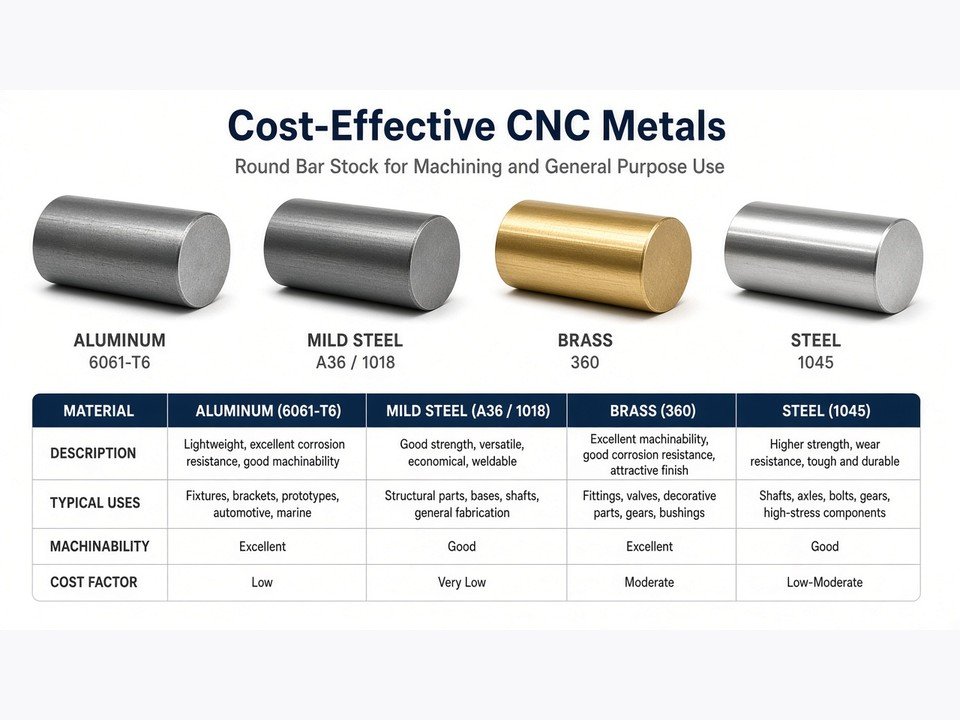
Aluminum is the default answer for most cost-sensitive CNC work, and for good reason. It is light, cuts fast, produces clean chips, and holds tight tolerances without fighting the tool. Grades like 6061 and 5052 dominate our shop floor because they balance strength, corrosion resistance, and price better than almost anything else.
6061 is the general-purpose workhorse: weldable, heat-treatable, and easy to anodize. 5052 is a little softer and more corrosion-resistant, which makes it a strong pick for sheet-metal-adjacent parts, brackets, and enclosures that will see moisture or marine conditions. Both grades let us run aggressive parameters, which shortens cycle time and lowers the per-part cost.
6061 Aluminum
The most common CNC aluminum. Good strength-to-weight ratio, excellent machinability, and reliable anodizing. Ideal for housings, brackets, plates, and structural components.
5052 Aluminum
Higher corrosion resistance and better formability than 6061. Suited to panels, enclosures, and parts exposed to moisture. Slightly softer, so we adjust feeds accordingly.
Carbon Steel and Mild Steel
Carbon and mild steels are the affordability champions when strength matters more than weight. The stock is inexpensive, widely available, and strong — which makes these steels a natural fit for high-volume parts where the material cost per unit compounds quickly. The trade-off is tool wear: steel is harder on cutters than aluminum, so cycle times and insert consumption climb.
For parts that will not see aggressive corrosion, mild steel is often the most economical strong option. We typically recommend it for fixtures, shafts, structural brackets, and machined components where a protective finish — plating, coating, or painting — is already planned.
Tip
If a steel part is not exposed to weather or chemicals, skipping a corrosion-resistant alloy in favor of mild steel plus a finish often lowers total cost without hurting performance.
Brass
Brass is one of the most machinable metals we run. Free-cutting brass produces short, clean chips, machines at high speeds, and leaves an excellent surface finish straight off the tool — which means minimal deburring and finishing costs. It also resists corrosion and looks good without extra work.
That combination makes brass a strong economic choice for fittings, connectors, threaded parts, and decorative components. The stock price is higher than aluminum or mild steel, but the reduced machining and finishing time frequently offsets it on small, detailed, or high-feature-count parts.
Stainless Steel
Stainless steel sits in the middle of the cost curve: more expensive than mild steel, but with corrosion resistance built in, so you often skip plating or coating entirely. Grades 304 and 316 are the ones we quote most. 304 is the general-purpose choice for food, medical, and industrial parts; 316 adds molybdenum for better resistance to chlorides and marine environments.
Stainless is tougher to machine than aluminum — it work-hardens, generates more heat, and demands sharp tooling and steady feeds. We reduce machining time by choosing the right grade for the job, keeping tools sharp, and avoiding unnecessary tight tolerances that force slow finishing passes.
Tip
If a part does not need 316's extra corrosion resistance, 304 is usually the more economical stainless. Reserve 316 for chloride, marine, or aggressive chemical exposure.
Copper
Copper earns its place when electrical or thermal conductivity is the whole point — busbars, heat sinks, RF components, and thermal management parts. It is not a cheap stock, and it is gummy and soft, which causes chip buildup, tool adhesion, and built-up edge if the tooling and parameters are not dialed in.
We manage copper economically by using sharp, polished-flute tooling, generous coolant, and conservative depths of cut that avoid rubbing. When a design allows, we also look at whether a copper alloy with improved machinability can meet the conductivity requirement without the full machining penalty of pure copper.
Titanium
Titanium has the highest upfront cost of the metals here — expensive stock, slow cutting speeds, and heavy tool wear. So when does it become cost-effective? When weight savings and longevity are the dominant requirements. In aerospace, drones, and high-performance medical or industrial parts, titanium's strength-to-weight ratio and corrosion resistance can eliminate weight, extend service life, or remove the need for coatings and maintenance.
In those cases, the higher machining cost is justified by the lifecycle value of the part. For a general-purpose bracket, it almost never is. We treat titanium as a lifecycle decision, not a line-item decision.
CNC Machining Cost Comparison by Material
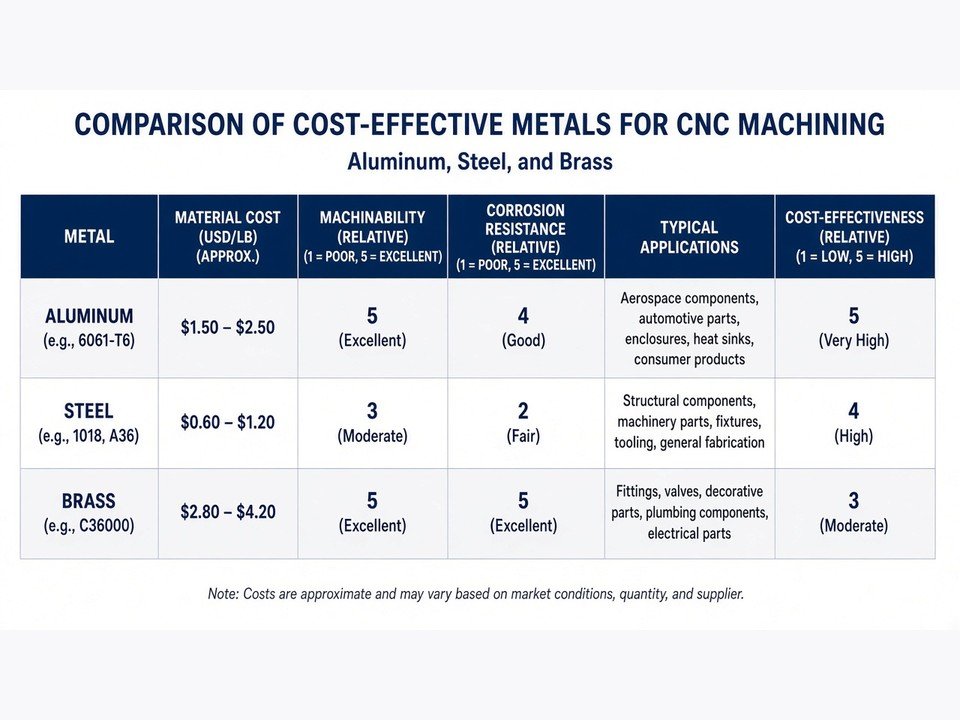
The table below compares the metals on the factors that drive total part cost. The values are relative indicators from our own quoting experience, not absolute prices — actual cost depends on geometry, tolerances, quantity, and finish. Use it to compare materials against each other, not to predict a specific quote.
| Material | Relative Stock Cost | Machinability | Relative Cycle Time | Tool Life | Finishing Needs |
|---|---|---|---|---|---|
| Aluminum (6061/5052) | Low | Excellent | Short | Long | Low |
| Carbon / Mild Steel | Low | Good | Moderate | Moderate | Often needs coating |
| Brass | Moderate | Excellent | Short | Long | Very low |
| Stainless Steel (304/316) | Moderate–High | Moderate | Longer | Moderate | Low (self-protecting) |
| Copper | High | Difficult | Longer | Shorter | Low |
| Titanium | High | Difficult | Longest | Shortest | Low |
Relative indicators reflect typical behavior on our machines. Actual values vary with part geometry, tolerances, quantity, and finish requirements.
Key Factors That Influence CNC Machining Costs
Material selection is one lever among several. Before finalizing a metal, it helps to understand the other factors that move the price of a part.
Raw material cost vs performance value
A pricier alloy that removes a coating step, a secondary operation, or a failure risk can be the cheaper decision overall.
Machinability index
Higher machinability means faster feeds, fewer tool changes, and shorter cycle times — a direct multiplier on labor and machine-hour cost.
Batch size and economies of scale
Setup and programming costs spread across more parts as quantity rises. At low volumes, machinability dominates; at high volumes, stock price and tool life matter more.
Required surface treatments
Anodizing, plating, passivation, and polishing each add cost. Choosing a material that already meets the finish requirement can eliminate an entire step.
Tolerances and feature complexity
Tight tolerances, deep pockets, and thin walls add machining time regardless of material. Over-specifying tolerances is one of the most common cost drivers we see.
How to Choose the Right Cost-Effective Metal
We walk customers through a short decision sequence before locking in a material. Answering these questions in order usually narrows the choice to one or two candidates quickly.
Define the strength requirement
Does the part carry structural load, or is it mostly a housing or cover? Structural parts lean toward steel or a stronger aluminum; covers and brackets rarely need it.
Weigh the importance of weight
If weight is critical — moving parts, drones, handheld devices — aluminum's low density is hard to beat economically. Titanium only wins when weight savings justify its cost.
Confirm the corrosion environment
Indoor and dry favors mild steel or aluminum. Moisture, chemicals, or marine conditions push toward 5052, 304/316 stainless, or brass.
Balance machinability against the other requirements
Once the functional constraints are set, choose the most machinable material that still meets them. That is where the real cost savings live.
Why it matters
Most over-budget parts we review do not fail because of the material itself — they fail because the material was chosen before the requirements were clear.
What Is the Cheapest Metal to Machine?
If the question is purely about machining cost — not stock price — aluminum and brass come out on top. Aluminum 6061 is the most economical overall for general parts: low stock cost, fast cutting, long tool life, and easy finishing. Brass is the most machinable of the common metals and often the cheapest to machine on small, detailed, high-feature-count parts, even though its stock costs more.
In practice, this is what we tell customers: for a simple, medium-tolerance bracket, 6061 aluminum is almost always the cheapest path. For a small threaded fitting or connector with many features, brass frequently wins on total cost because it machines so cleanly and needs almost no finishing.
Takeaway
Cheapest to machine is not the same as cheapest to buy. Aluminum and brass win the machining race; the right answer still depends on the part.
What Is a Cheap but Strong Metal for CNC Parts?
When strength is the priority and budget is tight, carbon and mild steel are the obvious answer. They offer high strength at low stock cost and are widely available, which keeps lead times and pricing stable. The catch is that they need a protective finish if corrosion is a concern, and they wear tooling faster than aluminum.
On the aluminum side, 6061 is the strong-but-affordable option for weight-sensitive parts. It does not match steel's absolute strength, but its strength-to-weight ratio is excellent, and it machines far faster. For many structural parts where weight matters, 6061 delivers more than enough strength at a lower total cost than steel.
What Is the Most Affordable Metal Overall?
If we measure by total lifecycle cost rather than purchase price, aluminum — specifically 6061 — is the most affordable metal for the widest range of CNC parts. It combines low stock cost, excellent machinability, long tool life, and easy finishing, which keeps every line of the cost equation low at once.
Mild steel is the most affordable when strength is the dominant requirement. Brass is the most affordable on small, highly detailed parts where machining time and finishing dominate. There is no single universal winner — but if you had to pick one metal that is cheapest across the most applications, it is aluminum.
Common Mistakes That Increase CNC Machining Costs
After reviewing thousands of drawings, we see the same cost-driving mistakes repeatedly. Avoiding them is often easier than finding a cheaper material.
Over-specifying the material
Choosing 316 stainless or titanium "just to be safe" on a part that will never see corrosion or high load adds cost with no functional benefit.
Ignoring machinability
A slightly cheaper alloy that machines slowly or wears tooling fast can end up costing more per part than a pricier, free-cutting grade.
Choosing by stock price alone
The cheapest material per kilogram is rarely the cheapest finished part. Cycle time, tooling, and finishing usually outweigh the material line.
Over-tightening tolerances
Specifying tolerances tighter than the function requires forces slow finishing passes and drives up cost on any material.
Designing features that fight the process
Deep pockets, sharp internal corners, and thin walls add machining time regardless of the metal. A short DFM review often removes cost before the first chip is cut.
Frequently Asked Questions
Is aluminum always the cheapest metal for CNC machining?
Aluminum is the cheapest for most general-purpose parts because it combines low stock cost, fast machining, and easy finishing. But for small, highly detailed parts like fittings or connectors, brass can be cheaper on total cost because it machines so cleanly and needs minimal finishing.
Why is stainless steel more expensive to machine than mild steel?
Stainless steel work-hardens during cutting, generates more heat, and wears tooling faster, so it runs at lower feeds and speeds. That increases cycle time and tool consumption compared to mild steel, even though the stock price is also higher.
When does titanium become cost-effective?
Titanium is cost-effective when weight savings and longevity are critical — for example in aerospace, drones, or high-performance medical parts. In those cases, its strength-to-weight ratio and corrosion resistance can reduce weight, extend service life, or eliminate coatings and maintenance. For general-purpose parts, it is rarely economical.
Does a cheaper alloy always produce a cheaper part?
No. A lower stock price can be offset by slower machining, faster tool wear, and extra finishing. Total part cost depends on cycle time, tooling, and post-processing as much as on the material line.
How can I reduce CNC machining cost without changing the material?
Loosen tolerances that are tighter than the function requires, simplify deep pockets and sharp internal corners, and confirm the surface finish actually needed. These changes reduce cycle time on any metal and often save more than switching materials.
Conclusion
Choosing a cost-effective metal for CNC machining is a total-cost exercise, not a price-per-kilogram exercise. Aluminum 6061 is the most affordable choice for the widest range of parts. Mild and carbon steel win when strength matters most and a finish is acceptable. Brass is the economical pick for small, detailed components. Stainless steel, copper, and titanium each earn their cost in specific applications where corrosion resistance, conductivity, or weight savings justify the premium.
The best way to control cost is to choose the material after the requirements are clear — and to let a manufacturing engineer review the design before quoting. At PartsMake, every project starts with a manufacturing review of the drawing, material, tolerances, critical dimensions, surface requirements, and quantity, so we can flag cost drivers before material or tooling is committed.
If you are weighing materials for an upcoming part, send us the drawing and your functional requirements. We will recommend the most cost-effective metal for the job and quote it from prototype through repeat production.
Get a Quote
Talk to a PartsMake engineer about your part
Share your CAD files, material options, tolerances, and quantities. Our engineering team will review the design, recommend a cost-effective material, and support you from prototype to repeat production — CNC machining, turning, 5-axis, Swiss machining, finishing, and inspection under one roof.