
Materials engineering guide
Galvanneal vs. Galvanized Steel: Key Differences & Which to Choose
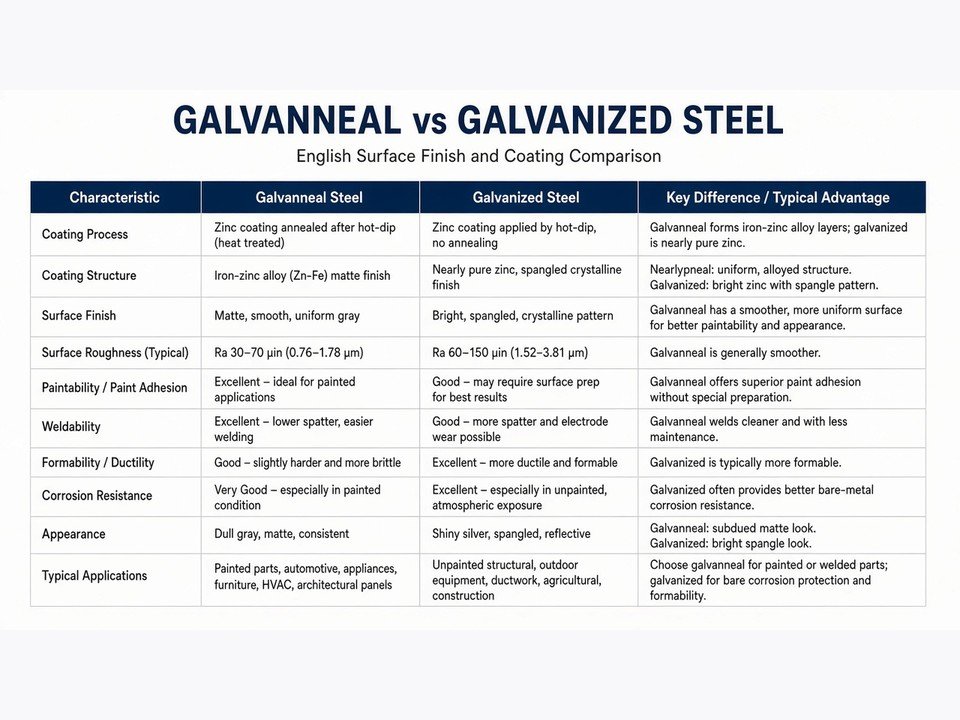
Choosing between galvanneal vs. galvanized steel affects corrosion performance, paint adhesion, welding, forming, and the appearance of the finished part. We compare both materials so engineers and fabricators can select the coating that fits the application.
Introduction
Galvanized and galvannealed steel are both steel products protected by a zinc-based coating. Their names sound similar, but the coating structure and manufacturing route create meaningful differences in corrosion behavior, surface texture, painting, welding, and forming.
At PartsMake, we review material selection alongside drawings, tolerances, surface requirements, production quantities, and intended use. That approach matters here because the “best” material depends less on the name of the coating and more on what the finished part must do.
The practical rule: choose galvanized steel when exposed-environment corrosion resistance is the priority; choose galvanneal when a durable painted finish and repeatable fabrication are central requirements.
What is Galvanized Steel?
Galvanized steel is steel coated with zinc, most commonly through a hot-dip galvanizing process. The steel passes through molten zinc, allowing the coating to bond to the substrate and create a protective barrier between the steel and the surrounding environment.
How the coating protects steel
The zinc layer provides barrier protection and also helps protect exposed steel through zinc’s sacrificial behavior. If the surface is scratched, the surrounding zinc can continue to offer protection to the nearby steel.
Where galvanized steel is strongest
Its principal advantage is long-term corrosion resistance in outdoor and exposed environments. It is widely used for structural, agricultural, construction, and industrial components where the coating may remain unpainted.
The visible surface may show a crystalline or spangled appearance, depending on the coating and production route. That appearance is not, by itself, a reliable measure of performance, but it can influence paint preparation and cosmetic expectations.
What is Galvanneal Steel?
Galvanneal steel begins with a hot-dip galvanized coating, but it then passes through an in-line heat treatment or annealing step. That controlled heating causes iron from the steel substrate to diffuse into the zinc layer.
The result is a zinc-iron alloy coating rather than a predominantly pure zinc surface. Galvanneal is typically harder and duller in appearance than standard galvanized steel, with a matte gray surface that is well suited to subsequent painting.
Coating transformation
The annealing step changes the coating’s composition and surface behavior. In practice, this supports paint adhesion and makes the material a common choice for parts that will receive a controlled finishing system.
Galvanneal vs. Galvanized Steel: Key Differences
The two materials share a steel substrate and zinc-based protection, but their surface chemistry changes how they behave after cutting, forming, welding, and painting. We evaluate the following properties when helping a customer select sheet material.
| Property | Galvanized steel | Galvanneal steel |
|---|---|---|
| Coating | Predominantly zinc | Zinc-iron alloy |
| Appearance | Often brighter or spangled | Usually matte gray and duller |
| Painting | Requires suitable preparation and paint selection | Generally more paint-friendly |
| Welding | May require more process attention because of the zinc layer | Typically easier to weld in coated applications |
| Typical priority | Unpainted outdoor corrosion resistance | Painted parts and repeatable fabrication |
Coating Composition
Standard galvanized steel has a predominantly pure zinc coating applied to the steel substrate. Galvanneal is also created from a hot-dip zinc coating, but the subsequent annealing step forms a zinc-iron alloy. This alloy distinction affects hardness, surface texture, coating adhesion, and fabrication response.
Surface Appearance
Galvanized steel commonly has a brighter, more reflective appearance and may display visible spangle patterns. Galvanneal generally has a uniform matte gray surface. For a part that will remain visible and unpainted, the expected appearance should be included in the drawing or material discussion rather than assumed.
Paintability
Galvanneal is usually the stronger choice when paint adhesion and finish consistency are important. Its matte, micro-textured surface gives a coating system a more receptive foundation than a smooth or spangled zinc surface.
Why it matters
A painted enclosure or panel can look acceptable immediately after fabrication and still fail later if surface preparation, primer compatibility, or handling is not controlled. Material selection reduces, but does not eliminate, that risk.
Weldability
The zinc-iron alloy coating on galvanneal is generally easier to weld than a pure zinc layer. Galvanized steel can still be welded, but the zinc coating may influence arc behavior, electrode wear, spatter, fumes, and the condition of the weld area.
The correct process depends on the joint design, coating thickness, sheet thickness, weld type, and production volume. We treat weld locations as part of the manufacturing review rather than as an isolated operation.
Formability
Both materials can be bent and stamped, but the coating must be considered along with the base steel grade and forming severity. Galvanneal is often less prone to the visible flaking associated with some forming operations, although its harder alloy coating can produce powdering under certain conditions.
For deep bends, tight radii, or stamped features, we recommend reviewing the bend sequence, tooling condition, grain direction where relevant, and the required cosmetic surface before production begins.
Similarities Between the Two
The comparison is not between steel and a nonmetallic alternative. Both materials are steel products designed to improve resistance to rust and oxidation through a zinc-based coating.
Steel substrate: Both use steel as the structural base, so substrate grade, thickness, and mechanical requirements remain important.
Corrosion protection: Both are intended to slow rust and oxidation compared with uncoated steel.
Manufacturing use: Both are widely used in industrial and commercial products, including fabricated panels, enclosures, brackets, frames, and formed components.
Fabrication Considerations
Coating selection does not replace a fabrication plan. Cutting, punching, bending, welding, finishing, and inspection all interact with the coated surface.
Laser cutting and punching
Cut edges expose the underlying steel regardless of whether the sheet is galvanized or galvannealed. Edge condition, part geometry, handling, and any required post-cut protection should be considered for parts exposed to moisture or corrosive conditions.
Welding techniques
Welding coated sheet requires suitable ventilation because zinc-containing coatings can generate fumes when heated. The process may also require adjustments for coating thickness, joint design, weld sequence, and the desired appearance after welding.
Material availability
Both materials are available in standard sheet gauges and thickness ranges, although exact availability depends on the supplier, coating designation, substrate grade, and order requirements. Confirming material availability early helps prevent a late substitution that changes the finish or fabrication process.
Fabrication review
When we review a sheet-metal drawing, we look beyond the material callout: bend radii, holes near bends, weld access, coating visibility, paint requirements, tolerances, and inspection points can all affect the finished result.
Typical Applications: Which One Should You Choose?
The decision becomes clearer when we start with the environment and the finished surface. The following guidelines are useful for early design decisions, but the final material callout should still reflect the complete application.
Choose galvanized steel when
Outdoor exposure is the main concern
Galvanized steel is a practical choice for outdoor structural projects, agriculture, construction framing, and components exposed to weather where long-term corrosion resistance is more important than a premium painted finish.
Choose galvanneal steel when
Painting and fabrication control are central
Galvanneal is commonly selected for automotive body panels, electrical enclosures, appliances, and other products requiring high-quality paint finishes, consistent appearance, and practical welding performance.
For a hybrid requirement, such as an outdoor enclosure that must also be painted, we would review the environment, paint system, joints, exposed edges, drainage, and maintenance expectations before recommending a coating.
Frequently Asked Questions
Is galvanneal better than galvanized?
Neither is universally better. Galvanneal is often better for painting, welding, and a controlled matte finish. Galvanized steel may be the better choice when the part will remain unpainted and requires strong long-term corrosion resistance in an outdoor or exposed environment, especially when a heavier-duty galvanized coating is specified.
Is G90 galvanized or galvannealed?
G90 refers to a coating weight class and is typically associated with galvanized steel. The designation should be confirmed against the applicable material standard and supplier documentation, because a coating designation alone does not describe every property of the steel substrate or finished part.
What is the difference between galvalume and galvanneal steel?
Galvalume uses an aluminum-zinc coating, while galvanneal uses a zinc-iron alloy coating created by annealing a hot-dip galvanized layer. They are different coating systems with different surface behavior and application priorities, so they should not be treated as interchangeable names for the same material.
Why does my paint peel on galvanized steel?
Paint can peel when the galvanized surface is too smooth, contaminated, insufficiently prepared, or incompatible with the selected primer and topcoat. The spangled zinc surface and its surface reactivity can make adhesion less forgiving than on galvanneal. Cleaning, suitable preparation, correct primer selection, and controlled handling are all important.
Conclusion
When comparing galvanneal vs. galvanized steel, start with the real operating requirement. Galvanized steel is often the stronger fit for unpainted outdoor exposure. Galvanneal is often the stronger fit for painted parts, welded assemblies, and products where a consistent matte surface supports finishing.
| At a glance | Galvanized steel | Galvanneal steel |
|---|---|---|
| Best starting point | Outdoor and exposed applications | Painted and fabricated assemblies |
| Coating type | Predominantly zinc | Zinc-iron alloy |
| Surface | Often bright or spangled | Matte gray |
| Key advantage | Long-term corrosion protection | Paintability and fabrication response |
Before releasing a drawing, confirm the coating designation, steel substrate, thickness, finish requirements, joining method, exposed edges, and inspection expectations with your material supplier and manufacturing partner. At PartsMake, we can review those requirements with your CAD files or drawings and help identify fabrication risks before production begins.
Discuss your material requirements