
Manufacturing Guide
Top Sheet Metal Fabrication Companies in the USA: Services, Costs & Trends
A practical look at how American sheet metal fabrication shops are organized, what they charge, which materials they run, and how engineers and procurement teams should evaluate them before sending a drawing out for quote.
Sheet metal work sits underneath almost everything engineered in the United States — the enclosure around a control board, the ductwork in a hospital, the bracket that holds a sensor on a robot arm. When engineers and procurement teams search for sheet metal fabrication companies, they are usually trying to answer three questions at once: can this shop hold my tolerances, what will it cost, and how fast can it ship. This guide walks through all three.
Fabrication is not a single process. It is a chain of decisions — cut, form, join, finish — and the cost of that chain is decided long before the first blank hits the shear.
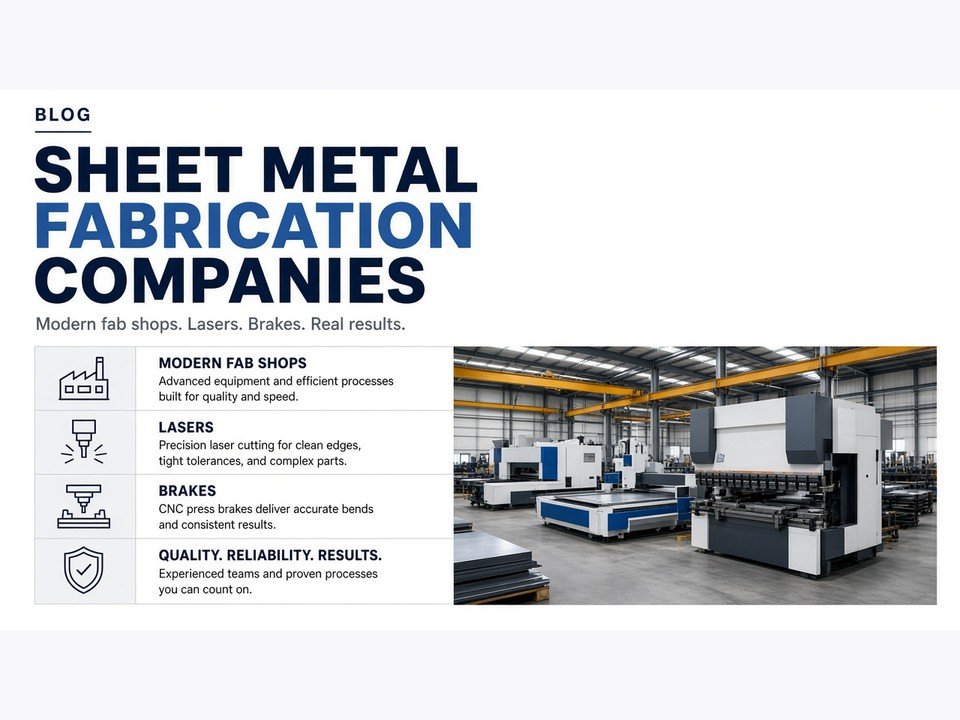
What Is Sheet Metal Fabrication and Why It Matters
Sheet metal fabrication is the set of processes that turn flat metal stock into finished parts and assemblies. The core sequence is consistent across shops: cutting (laser, plasma, waterjet, or punch), forming (press brake bending, rolling, stamping), joining (welding, riveting, hardware insertion, clinching), and finishing (deburring, powder coating, anodizing, plating, galvanizing). For thinner or higher-volume parts, a shop may skip the brake entirely and run progressive-die stamping instead.
Why it matters comes down to reach. Sheet metal parts appear in HVAC and mechanical rooms, in electrical enclosures and switchgear, in conveyor frames and structural gussets, in medical carts and lab equipment, and in the chassis of just about every robot and automation cell. It is one of the few manufacturing methods that scales from a one-off prototype panel to tens of thousands of identical brackets without changing the fundamental process.
That flexibility is also why fabrication is often the bottleneck in a product schedule. A machined part or a molded part has a long setup and a fast cycle. A fabricated assembly has many small setups — one per bend, one per weld, one per finish — and each of those steps can introduce a tolerance stack, a cosmetic defect, or a shipping delay.
Why it matters
Fabricated parts are structural, cosmetic, or both. A bracket that is 0.5 mm out of position can prevent an assembly from closing; an enclosure with a visible weld seam can fail a customer's cosmetic inspection even when it is dimensionally perfect. Both risks are controlled at the drawing stage, not at the welding table.
Key Services Offered by Sheet Metal Fabrication Companies
Most full-service fabrication shops in the USA offer a similar menu, even though the equipment behind it varies. When you request a quote, this is the list of capabilities worth confirming explicitly, because a shop that cuts and bends but outsources welding and finishing will add days to your lead time.
-
1
Custom cutting
Fiber laser for tight profiles and small holes, plasma for thick plate, waterjet when heat input must be avoided, and turret punch for repetitive hole patterns.
-
2
Forming and bending
Press brake work with tooling selected for the bend radius, plate rolling for cylinders and cones, and stamping for high-volume flat parts.
-
3
Welding and joining
MIG, TIG, spot, and robotic welding, plus riveting, clinching, and press-in hardware such as PEM nuts and standoffs.
-
4
Finishing
Deburring, grinding, powder coating, wet paint, anodizing, zinc plating, and hot-dip galvanizing for outdoor or corrosive environments.
-
5
Assembly and kitting
Sub-assembly, hardware installation, labeling, and packaging so the part arrives ready to install rather than ready to rework.
Industrial and Mechanical Fabrication
Industrial fabrication is heavy-duty work where the part carries load or moves air, fluid, or product. Typical output includes equipment skids and base frames, conveyor guards and chutes, structural gussets and platforms, and HVAC ducting, plenums, and transition pieces. Plate thicknesses here often run well above what a typical enclosure shop handles, and weld quality is usually governed by a written procedure rather than a visual standard.
For these projects, the drawing review matters more than the machine list. Weld symbols, fit-up tolerances, and the sequence of welding relative to machining determine whether a frame stays square after cooling. A frame that is welded first and machined second will hold its geometry; the reverse order usually will not.
Custom and Specialty Projects
Specialty work is where fabrication shops differentiate. This category covers architectural elements such as column covers, railings, and façade panels; signage and channel letters; stainless steel sinks and wash stations; generator stands and equipment pads; and one-off brackets or fixtures that do not justify tooling. Volumes are low, geometry is irregular, and the shop is often working from a sketch or a Revit model rather than a fully dimensioned drawing.
If your project falls here, expect a shop to spend real engineering time before quoting. That time is not overhead — it is the step that catches an impossible bend radius or a weld that cannot be reached with a torch. We see the same pattern on our own side of the business: at PartsMake, every sheet metal project starts with a manufacturing review of the drawing, material, tolerances, and critical dimensions before any material is committed, and the review usually surfaces at least one item worth changing.
Materials Commonly Used in Sheet Metal Fabrication
Material choice drives cost, lead time, and finish options more than any other single decision. Four families cover the large majority of American fabrication work.
| Material | Typical Use | Finishing Options |
|---|---|---|
| Aluminum | Enclosures, brackets, panels where weight matters | Anodizing, powder coating, conversion coating |
| Carbon steel | Frames, skids, structural parts, general fabrication | Powder coating, wet paint, zinc plating, galvanizing |
| Stainless steel | Food equipment, medical, washdown, corrosive environments | Brushed or polished finish, passivation |
| Galvanized / coated steel | HVAC ducting, outdoor enclosures, cost-sensitive frames | Usually left as-is; touch-up on cut edges |
Two finishing notes worth flagging early. First, hot-dip galvanizing requires vent and drain holes in any closed section, otherwise the part can trap molten zinc or burst during the dip. Second, powder coating adds thickness on every surface, so threaded holes and tight mating features should be masked or the threads cut after coating. Both are cheap to design in and expensive to fix later.
Leading Sheet Metal Fabrication Companies in the USA
The American market is not dominated by a handful of national names. It is a patchwork of regional shops with strong local supply chains, plus a smaller group of large contract manufacturers that serve national OEM programs. That structure matters when you are sourcing: a shop two states away may be more capable than a national brand, but freight and communication overhead change the economics.
Broadly, the market breaks into four tiers. Regional full-service fabricators handle cutting through finishing under one roof and are the default choice for most industrial buyers. Precision sheet metal specialists focus on tight-tolerance enclosures, chassis, and instrument panels, often for electronics and medical customers. Heavy steel fabricators work in structural and plate-intensive projects such as bridges, platforms, and large equipment frames. Specialty and architectural shops take on signage, railings, and custom metalwork where finish quality is the primary specification.
Rather than ranking shops by name, the more useful exercise is matching your part to a tier and then verifying that the shop actually owns the processes it claims. Ask which operations are in-house, which are subcontracted, and what the typical lead time is for a job of your size and finish. We have seen plenty of quotes where the cutting and forming were in-house but the powder coating was sent out, adding a week that was never mentioned in the original lead time.
What Are the Top 10 Steel Fabrication Companies in the USA?
Steel fabrication is a distinct segment from general sheet metal work. These firms typically handle structural steel, plate, and heavy weldments for construction, energy, infrastructure, and large industrial programs, and they are often certified under AISC, AWS, or both. The list below reflects firms with broad market presence and well-documented capabilities in structural and heavy steel fabrication.
1. Schuff Steel
One of the largest structural steel fabricators in North America, serving commercial, stadium, and infrastructure projects with heavy plate and weldment capability.
2. W S Steel
A long-established fabricator and erector known for complex structural work in the Pacific Northwest and across national projects.
3. Cives Steel Company
Multiple fabrication plants supporting bridge, industrial, and commercial structural steel across the eastern and central United States.
4. Hirschfeld Industries
Heavy fabrication for bridges, highway structures, and specialty steel projects, with a focus on large plate weldments.
5. Canam Steel Corporation
Joist, deck, and structural steel fabrication with a strong presence in commercial and industrial building programs.
6. Nucor Steel Fabricators
Part of Nucor's downstream network, producing fabricated structural steel for commercial construction and industrial facilities.
7. ADF International
A large steel fabricator in the Northeast and Canada, working on major infrastructure and architectural steel projects.
8. Banker Steel
Known for complex, fast-track structural steel packages on high-rise and commercial projects.
9. LeJeune Steel Company
AISC-certified fabricator serving commercial, education, and healthcare construction in the upper Midwest.
10. Paxton & Vierling
A diversified fabricator of heavy steel, weldments, and machined components serving construction and industrial markets.
Note on scope
These firms serve structural and heavy steel markets. If your part is a 2 mm enclosure or a formed bracket, a precision sheet metal shop will usually be a better fit — and a faster, cheaper one — than a structural fabricator.
How Much Do Metal Fabricators Charge?
There is no single rate card. Most American fabricators quote in one of three ways, and knowing which model you are being quoted under explains most of the price difference between two shops.
Hourly shop rate
Common for repair, prototype, and one-off work. You pay for machine time plus setup, and the shop absorbs the risk of how long the job actually takes.
Piece price
Standard for repeat production. The quote bundles material, setup amortization, run time, finishing, and margin into a per-part number, with setup often shown separately for first articles.
Cost-plus or time-and-material
Used for development work and jobs with undefined scope. Transparent, but it puts the schedule risk on you.
Whichever model applies, the same factors move the number. Material type and thickness set the raw cost. Part complexity — number of bends, holes, and welds — sets the labor. Tolerance and finish requirements set the inspection and rework risk. Quantity sets how much of the setup is amortized per part. And lead time sets whether the shop has to expedite material or run overtime.
| Cost driver | Effect on price |
|---|---|
| Material and thickness | Aluminum and stainless carry a premium over carbon steel; heavier gauge increases cut time and weld time |
| Part complexity | Each additional bend, hole, or weld adds setup and handling time |
| Tolerance and finish | Tight tolerances and cosmetic finishes require inspection time and raise scrap risk |
| Quantity | Higher volume spreads setup and tooling cost across more parts |
| Lead time | Rush jobs add expedited material and overtime charges |
Practical advice
We do not publish a rate table here because quoting a fabricated assembly without seeing the drawing produces a number that is either wrong or padded. The fastest way to a usable price is to send the drawing, material, quantity, and finish requirement together, and ask for the setup and run time to be broken out separately.
Where Do Sheet Metal Workers Make the Most Money?
Pay for sheet metal workers and welders tracks three things: regional cost of living, union density, and the industrial mix of the local economy. Markets with heavy aerospace, shipbuilding, energy, or semiconductor activity tend to pay above the national median because the work is more specialized and the tolerance requirements are tighter.
In practice, the highest-paying states for sheet metal workers are typically those with strong union presence and high living costs — states such as California, Washington, Illinois, New York, and Massachusetts — along with Alaska and Hawaii, where remote or island logistics push wages up. Metro areas with concentrated aerospace or defense manufacturing, including Seattle, the Bay Area, and parts of Connecticut, also sit near the top of the range. Welders certified for pipe, aerospace, or nuclear work command a further premium over general fabrication welders.
The caveat is that high wages usually come with high overhead. A shop in an expensive metro passes those costs into its hourly rate, which is one reason fabrication quotes from low-cost regions can look dramatically different for identical work. When comparing shops, compare the total landed cost — part price plus freight plus the cost of managing the relationship — rather than the hourly rate alone.
Current Trends Shaping Sheet Metal Fabrication
Four shifts are changing how American fabrication shops quote, schedule, and deliver work.
Automation and lights-out capacity
Automated laser cells, robotic bending, and robotic welding allow shops to run unattended shifts. The result is more consistent cycle times and better repeatability on high-volume parts, but also a higher capital threshold — which is gradually separating shops that can take large programs from those that cannot.
Sustainable materials and processes
Recycled-content aluminum and steel, lower-VOC coatings, and powder coating as a replacement for solvent-based paint are increasingly requested by OEM customers with their own sustainability reporting requirements.
Digital design and simulation
3D CAD, flat-pattern unfolding, and bend simulation have made it routine to catch interference and impossible bends before cutting metal. Shops that accept native CAD files and return a flat pattern for review tend to have far fewer first-article surprises.
Supply-chain resilience
Buyers are diversifying beyond a single fabricator and asking for dual sourcing on critical parts. For many teams this now includes qualifying an overseas manufacturing partner as a second source for repeat production, alongside a domestic shop for rapid turnaround.
How to Choose the Right Sheet Metal Fabrication Partner
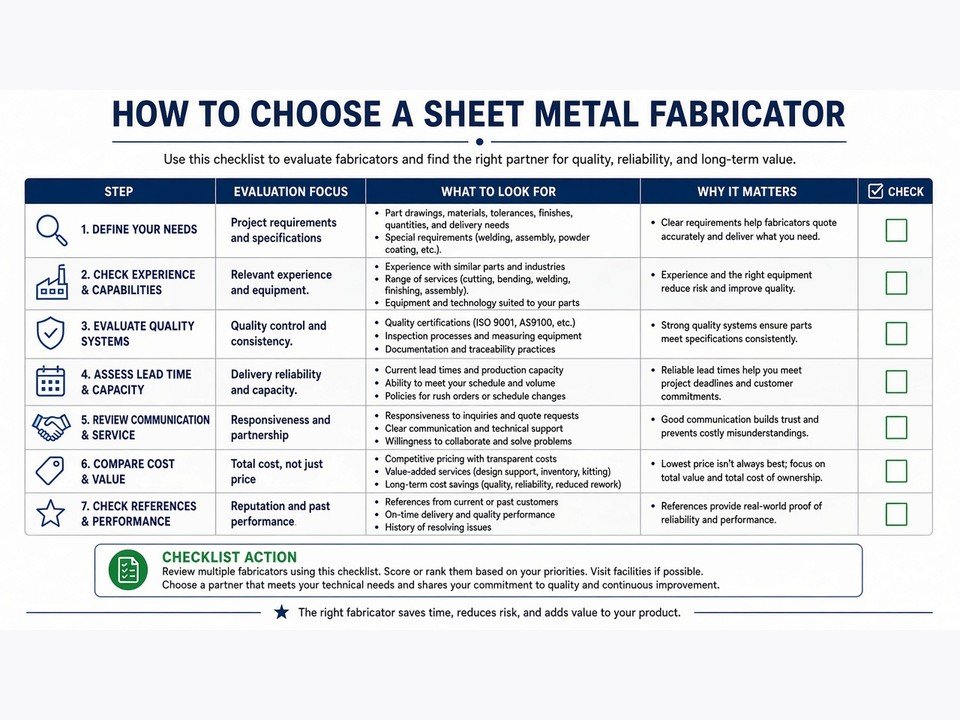
The right partner is the one whose process capability matches your drawing, whose lead time matches your schedule, and whose communication style matches your engineering team. Six checks cover most of the risk.
-
1
Verify process capability, not just process list
Confirm the thickness range, maximum part size, and tightest bend tolerance the shop can actually hold — not just which machines it owns.
-
2
Review the portfolio for parts like yours
A shop that excels at architectural railings may not be the right fit for a 0.8 mm electronics chassis. Ask for examples in your product category.
-
3
Confirm certifications and inspection practice
Ask which standards apply to your industry and how first-article and in-process inspection are documented.
-
4
Ask what is subcontracted
Finishing, heat treatment, and hardware insertion are commonly outsourced. Each handoff adds transit time and a new quality risk.
-
5
Get lead time in writing, per operation
A single lead-time number hides the real schedule. Ask for material, fabrication, finishing, and shipping separately.
-
6
Check geographic coverage against your logistics
Freight cost and transit time can outweigh a lower piece price, especially for bulky enclosures and frames.
For teams that need both domestic responsiveness and a cost-competitive second source, working with a manufacturing partner that coordinates multiple processes under one engineering team removes a layer of coordination. PartsMake supports sheet metal fabrication alongside CNC machining, injection molding, 3D printing, finishing, and inspection, from prototype through repeat production, with a manufacturing review before any material is committed.
FAQ
What are some leading sheet metal fabrication companies in the USA?
The market is regional rather than dominated by national brands. It includes regional full-service fabricators that cut, form, weld, and finish in-house; precision sheet metal specialists serving electronics and medical customers; heavy steel fabricators working in structural and plate-intensive projects; and specialty or architectural shops handling signage, railings, and custom metalwork. The best choice depends on your part size, tolerance, finish, and volume rather than on brand recognition.
How much do metal fabricators charge?
Most shops quote either an hourly shop rate, a piece price for repeat production, or a cost-plus arrangement for undefined scope. The price is driven by material type and thickness, part complexity, tolerance and finish requirements, quantity, and lead time. Because these factors vary so widely between parts, a meaningful price requires a drawing, material specification, quantity, and finish requirement.
Where do sheet metal workers make the most money?
Wages are highest in states with strong union presence and high living costs, such as California, Washington, Illinois, New York, and Massachusetts, as well as Alaska and Hawaii. Metro areas with concentrated aerospace, defense, or energy manufacturing also pay above the national median, and welders certified for pipe, aerospace, or nuclear work earn a further premium.
What are the top 10 steel fabrication companies in the USA?
Prominent structural and heavy steel fabricators include Schuff Steel, W S Steel, Cives Steel Company, Hirschfeld Industries, Canam Steel Corporation, Nucor Steel Fabricators, ADF International, Banker Steel, LeJeune Steel Company, and Paxton & Vierling. These firms focus on structural steel, plate, and heavy weldments for construction, energy, and infrastructure — a different segment from precision sheet metal work.
Start a Project
Send Us Your Sheet Metal Drawing
Share your CAD files, material, tolerances, surface requirements, and target quantity. Our engineering team reviews the design before production, flags manufacturing risks early, and coordinates cutting, forming, welding, finishing, and inspection through one partner — from prototype through repeat production.