
Engineering reference guide
Sheet Metal Gauge Chart: Thickness Guide for Steel, Aluminum & More
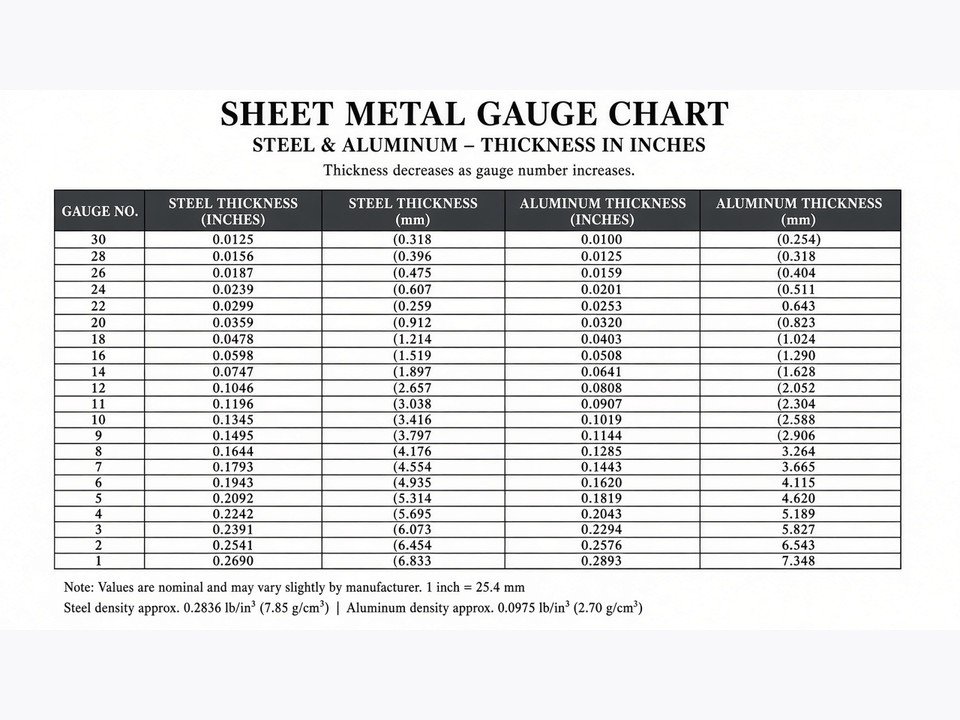
Use this sheet metal gauge chart to compare nominal thicknesses for steel, galvanized steel, stainless steel, aluminum, brass, and copper—and to choose material that fits your strength, weight, forming, corrosion, and cost requirements.
What Is a Sheet Metal Gauge Chart?
A sheet metal gauge chart converts a gauge number into an approximate material thickness. Because gauge is a legacy sizing system rather than a universal dimensional unit, the chart helps engineers, fabricators, buyers, and inspectors translate a drawing note such as “16 ga steel” into inches or millimeters.
Gauge numbers are commonly used for thin sheet and strip products. The same terminology appears in enclosures, brackets, HVAC components, automotive panels, electrical cabinets, guards, and fabricated frames. On a production drawing, however, we normally recommend specifying the material grade and nominal thickness—not gauge alone.
What the chart gives you
A practical reference between gauge, inches, and millimeters for commonly ordered sheet materials.
What it does not replace
A material specification, supplier tolerance, forming allowance, or inspection requirement on the engineering drawing.
Gauge vs. Actual Thickness: Why the System Is Confusing
Gauge numbers run in the opposite direction from thickness: a lower number generally means thicker sheet. For example, 14 gauge carbon steel is approximately 0.0747 in (1.897 mm), while 16 gauge is approximately 0.0598 in (1.519 mm). Therefore, 14 gauge is thicker.
The complication is that gauge is not one universal scale. Standard steel, galvanized steel, stainless steel, aluminum, brass, and copper may use different industry tables. Coatings, temper, product form, and supplier conventions can also change the nominal value. A “20 gauge” designation should never be transferred from one material to another without checking the relevant chart.
Engineering note
For purchasing and inspection, write the material and thickness together—for example, “CRS, 1.5 mm nominal” or “304 stainless steel, 16 gauge per supplier standard.” This removes ambiguity before fabrication begins.
History and Evolution of the Gauge System
The gauge system developed from historical wire-drawing and metalworking practices. Manufacturers used numbered references to describe material sizes before modern precision measurement and standardized digital drawings were widely available. In many systems, repeated processing steps produced thinner material as the number increased.
Gauge terminology persists because it is familiar throughout fabrication and supply chains. It is fast for shop-floor communication and remains common in catalogues and legacy designs. Modern engineering practice combines that shorthand with decimal or metric thickness, material grade, and an acceptable tolerance.
Full Sheet Metal Gauge Charts by Material
The tables below provide common nominal reference values. Actual supplied thickness can vary with the material standard, mill tolerance, coating, temper, and supplier. When a dimension is critical, we verify the applicable standard and inspect the incoming or finished part against the drawing requirement.
| Material | Typical gauge range | Common uses |
|---|---|---|
| Carbon steel | 30–10 gauge | Brackets, panels, frames, enclosures |
| Galvanized steel | 30–10 gauge | HVAC, outdoor panels, ductwork |
| Stainless steel | 30–10 gauge | Equipment covers, laboratory parts, guards |
| Aluminum | 30–8 gauge | Lightweight panels, housings, brackets |
| Brass and copper | 30–10 gauge | Decorative panels, electrical and thermal parts |
Standard Steel Gauge Chart
This common carbon or mild steel reference is useful for early design comparisons. Steel gauge values are nominal; cold-rolled and hot-rolled products may be supplied to different thickness ranges and tolerances.
| Gauge | Inches | Millimeters | Gauge | Inches | Millimeters |
|---|---|---|---|---|---|
| 30 | 0.0125 | 0.318 | 20 | 0.0359 | 0.912 |
| 29 | 0.0141 | 0.358 | 19 | 0.0418 | 1.062 |
| 28 | 0.0156 | 0.397 | 18 | 0.0478 | 1.214 |
| 27 | 0.0172 | 0.437 | 17 | 0.0538 | 1.367 |
| 26 | 0.0187 | 0.475 | 16 | 0.0598 | 1.519 |
| 25 | 0.0219 | 0.556 | 15 | 0.0673 | 1.709 |
| 24 | 0.0239 | 0.607 | 14 | 0.0747 | 1.897 |
| 23 | 0.0269 | 0.683 | 13 | 0.0897 | 2.282 |
| 22 | 0.0299 | 0.759 | 12 | 0.1046 | 2.656 |
| 21 | 0.0329 | 0.836 | 10 | 0.1345 | 3.416 |
Galvanized Steel Gauge Chart
Galvanized sheet has a zinc coating over steel. Depending on the industry convention, a stated gauge may refer to the coated product thickness or the base steel thickness. The coating adds to the measured overall thickness and can affect forming, bend clearance, and cut-edge behavior.
| Gauge | Typical overall inches | Typical overall mm | Common application |
|---|---|---|---|
| 30 | 0.0120 | 0.305 | Light duct and flashing |
| 26 | 0.0187 | 0.475 | Ductwork and light panels |
| 24 | 0.0239 | 0.607 | HVAC components |
| 22 | 0.0299 | 0.759 | Panels and enclosures |
| 20 | 0.0359 | 0.912 | Robust formed panels |
| 18 | 0.0478 | 1.214 | Brackets and equipment parts |
These are reference values, not a substitute for the supplier’s galvanized coating designation and thickness tolerance.
Stainless Steel Gauge Chart
Stainless gauge tables are commonly applied to grades such as 304 and 316, but grade, finish, temper, and mill standard still matter. Stainless work-hardens during forming and may require different tooling or bend allowances than carbon steel at a similar nominal thickness.
| Gauge | Inches | Millimeters | Typical use |
|---|---|---|---|
| 30 | 0.0125 | 0.318 | Light covers and liners |
| 26 | 0.0187 | 0.475 | Light panels |
| 24 | 0.0234 | 0.594 | Instrument panels |
| 22 | 0.0291 | 0.739 | Equipment covers |
| 20 | 0.0355 | 0.902 | Enclosures and guards |
| 18 | 0.0478 | 1.214 | Rigid brackets and frames |
| 16 | 0.0595 | 1.511 | Structural panels |
| 14 | 0.0747 | 1.897 | Heavy brackets and frames |
Aluminum Gauge Chart
Aluminum is lighter than steel at an equivalent thickness, so designers often evaluate stiffness, span, folds, ribs, and alloy—not just gauge. Common alloys and tempers can have different forming and strength characteristics, while the gauge-to-thickness reference remains a useful starting point.
| Gauge | Inches | Millimeters | Typical use |
|---|---|---|---|
| 30 | 0.0100 | 0.254 | Light trim and covers |
| 26 | 0.0179 | 0.455 | Thin panels |
| 24 | 0.0220 | 0.559 | Enclosure panels |
| 22 | 0.0253 | 0.643 | Covers and brackets |
| 20 | 0.0320 | 0.813 | Rigid light panels |
| 18 | 0.0403 | 1.024 | Housings and guards |
| 16 | 0.0508 | 1.290 | Formed brackets |
| 14 | 0.0641 | 1.628 | Frames and structural panels |
Brass and Copper Gauge Charts
Brass and copper are often specified by thickness in inches or millimeters, although gauge references remain in use. Their electrical, thermal, corrosion, and forming properties make them useful for terminals, heat-transfer components, decorative panels, shielding, and hardware.
| Gauge | Brass inches | Brass mm | Copper inches | Copper mm |
|---|---|---|---|---|
| 30 | 0.0120 | 0.305 | 0.0120 | 0.305 |
| 26 | 0.0180 | 0.457 | 0.0180 | 0.457 |
| 24 | 0.0250 | 0.635 | 0.0230 | 0.584 |
| 22 | 0.0320 | 0.813 | 0.0280 | 0.711 |
| 20 | 0.0400 | 1.016 | 0.0320 | 0.813 |
| 18 | 0.0500 | 1.270 | 0.0400 | 1.016 |
| 16 | 0.0640 | 1.626 | 0.0500 | 1.270 |
Brass and copper gauge conventions can vary more than many steel references. For electrical or thermal parts, we confirm the alloy, temper, conductivity requirement, and exact thickness with the material supplier.
Which Gauge Is Thicker? Common Comparisons
The quick rule is simple: within the same material gauge system, the smaller number is thicker. The exact comparison still depends on the material table, so we use nominal thickness values rather than relying on the gauge number alone.
Which Is Thicker, 14 Gauge or 16 Gauge Sheet Metal?
14 gauge is thicker. In a common carbon steel chart, 14 gauge is approximately 0.0747 in (1.897 mm), while 16 gauge is approximately 0.0598 in (1.519 mm). The difference is about 0.015 in (0.378 mm), which can noticeably affect stiffness, weight, bend force, and available internal clearance.
What Are the Standard Gauges for Sheet Steel?
Common sheet steel gauges include 30, 28, 26, 24, 22, 20, 18, 16, 14, 12, and 10. Thin gauges such as 26–30 are frequently associated with light panels and ductwork; 18–22 are common starting points for many enclosures and brackets; 10–16 are used when greater rigidity or load capacity is needed. The correct choice depends on geometry, unsupported span, bends, fastening, and loading.
What’s Thicker, 18 Gauge or 16 Gauge Sheet Metal?
16 gauge is thicker. For common carbon steel, 18 gauge is approximately 0.0478 in (1.214 mm), and 16 gauge is approximately 0.0598 in (1.519 mm). Moving from 18 to 16 gauge adds material and weight but can improve panel stiffness and thread or fastener support where the design permits.
Which Is Thicker, 26 Gauge or 29 Gauge?
26 gauge is thicker. In the common steel reference, 26 gauge is approximately 0.0187 in (0.475 mm), while 29 gauge is approximately 0.0141 in (0.358 mm). Both are thin materials, but the difference can affect dent resistance, handling, fastening, and the ability of a flat panel to remain stable without beads, hems, ribs, or formed edges.
How to Choose the Right Gauge for Your Application
Gauge selection is a design decision, not simply a lookup exercise. We review the part’s loads, geometry, environment, joining method, finish, quantity, and manufacturing process before recommending a practical material thickness.
Start with stiffness and load
Consider unsupported span, impact, vibration, mounting points, and whether folds or ribs can provide stiffness more efficiently than simply adding thickness.
Match the environment
Choose among carbon steel, galvanized steel, stainless steel, aluminum, copper, or brass based on corrosion exposure, electrical or thermal needs, appearance, and service conditions.
Check forming and joining
Thickness influences minimum bend radius, springback, bend deductions, welding access, fastener engagement, and the risk of distortion during fabrication.
Balance mass and cost
Thicker material generally adds weight and material cost. In automotive, robotics, electronics, and aerospace-related hardware, the best answer may be a lighter alloy, formed geometry, or a different manufacturing process.
Practical workflow
At PartsMake, we review CAD files or drawings together with material, tolerances, critical dimensions, surface requirements, quantity, and intended use. That manufacturing review helps identify bend, hole, distortion, and inspection risks before production.
Common Mistakes When Using Gauge Charts
Using a steel chart for aluminum
Different metals can assign different thicknesses to the same gauge number. Confirm the material-specific chart.
Treating nominal thickness as an exact measurement
Mill tolerance, coating, temper, and measurement location can change the supplied value. Define the allowed tolerance when it matters.
Ignoring coatings and finishes
Galvanizing, paint, plating, and powder coating can affect total thickness, bend behavior, fit, and edge protection.
Selecting gauge without reviewing the formed part
A flat thickness choice can fail if bend radii, reliefs, holes near bends, or assembly clearances are not checked together.
FAQs About Sheet Metal Gauges
Is a higher gauge number always thinner?
Within a specific gauge system, a higher number generally indicates thinner sheet. The rule is not sufficient for comparing different metals, so check the material-specific thickness table.
Does corrosion change the gauge or thickness?
Corrosion can reduce the remaining wall thickness, but it does not change the original gauge designation. Galvanized coating, by contrast, adds a protective layer and may affect the overall measured thickness.
What is the difference between sheet and plate?
Sheet and plate are commonly distinguished by thickness, but the exact boundary depends on the material standard and product form. Because gauge is primarily used for thinner products, thicker material is usually specified directly in inches or millimeters.
Should I put gauge or millimeters on a drawing?
Use both when your supply chain commonly uses gauge, but make the material and nominal thickness clear. For critical features, include the required tolerance and avoid relying on gauge alone.
Can a sheet metal fabricator help select the gauge?
Yes. A fabricator can review loads, bends, holes, joining, surface requirements, and manufacturing quantity. That review is especially valuable when a part must be both lightweight and rigid.
Key takeaway
Use gauge as a convenient reference, but design and purchase with material, nominal thickness, tolerance, and fabrication requirements clearly defined.
PartsMake supports sheet metal fabrication from prototype through repeat production, with engineering review, cutting, bending, welding, assembly, finishing, and inspection coordinated through one manufacturing partner.
Discuss your sheet metal part