
Materials Engineering Guide
Thermoset vs Thermoplastic: Differences, Properties & Best Uses
Choosing between a thermoset and a thermoplastic decides how your part behaves in heat, how it fails, how it is made, and whether it can ever be recycled. This guide compares both polymer families by properties, processing, cost, and real applications — so you can pick the right material before tooling is committed.
Every plastic part we machine or mold starts with the same decision: is this a thermoset or a thermoplastic? The answer is not about which one is "better." It is about which one survives the environment the part will actually live in. A cross-linked thermoset and a melt-processable thermoplastic behave differently the moment temperature rises, and that single difference ripples through design, tooling, cost, and end-of-life.
Thermosets are set for life by a chemical reaction. Thermoplastics can be re-melted and re-formed again and again. That distinction explains almost every other difference between them.
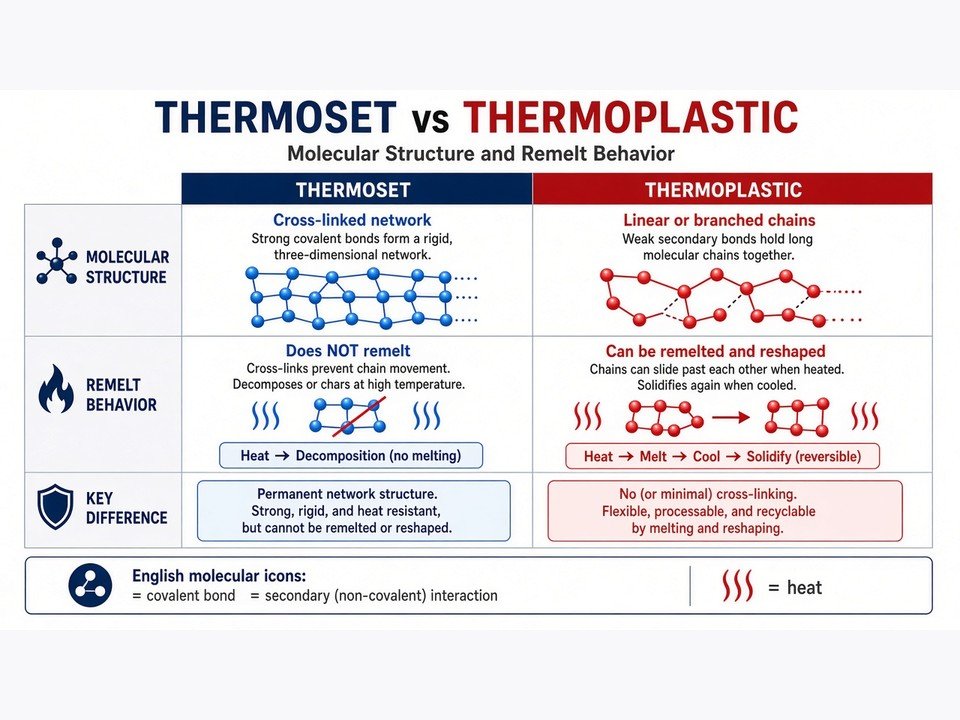
Cross-linked thermoset networks versus discrete, re-meltable thermoplastic chains.
What Are Thermosets?
Thermosets are polymers that cure — irreversibly — through a chemical cross-linking reaction. Two reactive components (a resin and a hardener, or a resin activated by heat, moisture, or a catalyst) link into a three-dimensional molecular network. Once that network forms, the material cannot be melted and re-formed. Heat it far enough and it will char and degrade rather than flow.
That permanent network is why thermosets hold their shape under load and temperature. The cross-links lock the chains in place, so the part resists creep, resists solvents, and keeps tight dimensional stability even in hot, chemically aggressive environments. The trade-off is equally permanent: you cannot re-melt a cured thermoset, which limits recycling to grinding it into filler or burning it for energy recovery.
Why It Matters
A thermoset's cure is a one-way reaction. That is a strength when you need heat resistance and dimensional stability, and a constraint when you need the part to be recyclable or reworked.
What Are Thermoplastics?
Thermoplastics are polymers held together by weaker intermolecular forces rather than chemical cross-links. Heat them and the chains slide past one another and the material softens into a melt; cool them and it solidifies again. This heating and cooling cycle is reversible and can be repeated many times — the foundation of injection molding, extrusion, and thermoforming.
Because they can be re-melted, thermoplastics are highly recyclable and easy to process at high volume. The same property that makes them convenient also makes them more sensitive to heat: above their glass transition or melting temperature, they lose stiffness and can creep under sustained load.
How Do Thermosets and Thermoplastics React to Heat?
This is the single most important behavioral difference, and it drives most material selection decisions.
A thermoplastic softens gradually as it approaches its glass transition temperature, then melts into a flowable liquid at its melting point. A thermoset does neither — it has no melting point. It holds its rigidity up to a degradation threshold, then begins to break down chemically. In practice, that means a thermoset can often tolerate higher continuous service temperatures, while a thermoplastic offers a predictable, repeatable softening window that makes it ideal for molding.
Practical Implication
If a part must hold a tight tolerance near a heat source, a thermoset is often the safer bet. If a part must be molded in high volume and possibly recycled, a thermoplastic almost always wins.
Key Differences Between Thermoset and Thermoplastic
Beyond heat behavior, the two families diverge across durability, impact resistance, aesthetics, corrosion resistance, and cost efficiency. Here is how they compare on the factors that matter most during design review.
Thermal Behavior
Thermosets resist high continuous temperatures without softening; thermoplastics soften near their glass transition and melt at a defined point.
Durability & Creep
Cross-links give thermosets excellent dimensional stability under sustained load; thermoplastics can creep when loaded hot over long periods.
Impact Resistance
Many thermoplastics — especially engineering grades — absorb impact well. Thermosets tend to be stiffer and more brittle unless reinforced.
Aesthetics & Finish
Thermoplastics mold to fine detail with consistent surface finish; thermosets are typically used where function outweighs cosmetic detail.
Corrosion Resistance
Both resist corrosion, but cured thermosets often outperform in aggressive chemical and solvent exposure thanks to their dense network.
Cost Efficiency
Thermoplastics favor high-volume, low-cycle-time molding; thermosets suit lower volumes, composites, and demanding environments.
Quick-Reference Property Comparison Table
Use this table as a first-pass filter during material selection.
| Property | Thermoset | Thermoplastic |
|---|---|---|
| Melting point | None — degrades instead of melting | Defined melting point |
| Recyclability | Very limited | High — re-meltable |
| Heat resistance | High continuous service temperature | Lower; softens with heat |
| Strength & stiffness | Rigid, dimensionally stable | Varies; engineering grades strong |
| Processing | Casting, compression, RTM | Injection molding, extrusion |
Pros and Cons of Thermosets
Advantages
- High heat resistance. Holds properties at elevated service temperatures.
- Dimensional stability. Cross-links resist creep under load.
- Chemical resistance. Dense networks resist solvents and corrosion.
Limitations
- Not recyclable. Cannot be re-melted or re-formed.
- Brittle tendency. Lower impact toughness unless reinforced.
- Harder to process. Cure cycles are slower than molding.
Pros and Cons of Thermoplastics
Advantages
- Recyclable. Re-meltable and repeatedly re-formable.
- Easy to process. Fast cycle times and high-volume molding.
- Wide property range. From commodity to high-performance grades.
Limitations
- Lower heat resistance. Soften and lose stiffness when hot.
- Creep under load. Sustained hot loads can cause deformation.
- Solvent sensitivity. Some grades are attacked by chemicals.
Examples of Thermoset and Thermoplastic Materials
When engineers ask us to name real materials, these are the ones that come up most often in quoting and design reviews.
Five Examples of Thermosetting Plastics
- 1Epoxy. Adhesives, composite laminates, and electrical encapsulation.
- 2Phenolic (Bakelite). Handles, electrical insulators, and heat-resistant components.
- 3Polyester resin. Fiberglass composites such as boat hulls and panels.
- 4Polyurethane. Rigid foams and durable coatings.
- 5Melamine. Heat-resistant tableware and laminates.
Example of a Thermoplastic and a Thermosetting Plastic
A familiar thermoplastic example is polypropylene (PP) — used in containers, living hinges, and automotive trim because it can be re-melted and re-molded. A familiar thermosetting example is epoxy — used in composites and encapsulation, where its cured network delivers heat resistance and structural integrity that a thermoplastic cannot match.
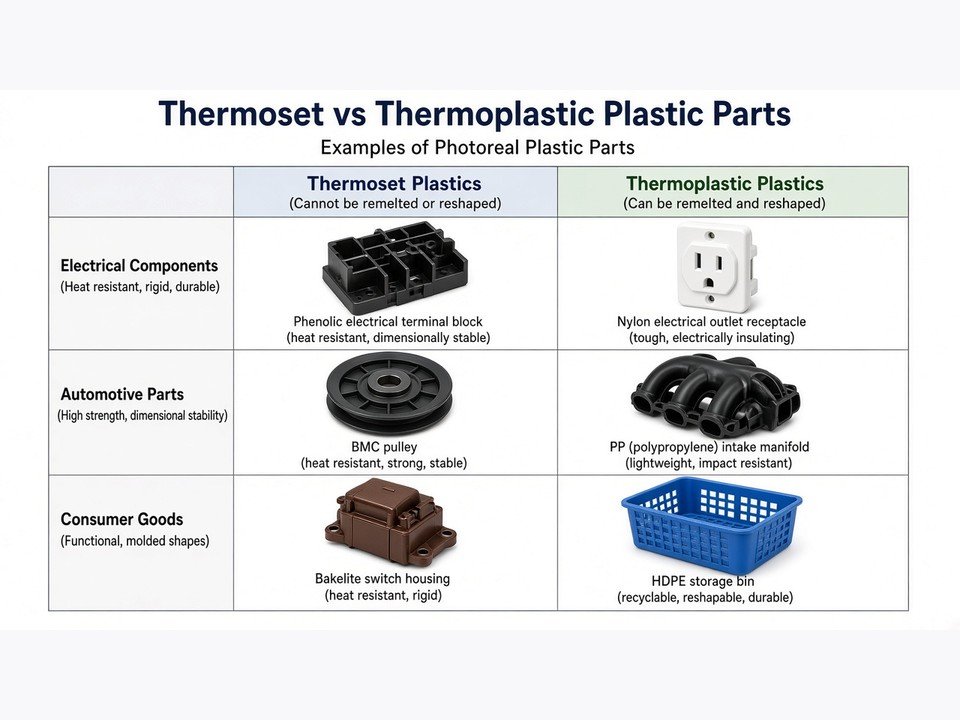
Molded thermoplastic parts and cured thermoset composite parts.
Is PVC Thermoplastic or Thermosetting?
PVC is a thermoplastic. It softens when heated and can be re-melted, which is why PVC is extruded into pipes, profiles, and cable insulation and molded into fittings. Its behavior changes with additives — rigid PVC (uPVC) is used for pipes and window frames, while plasticized PVC is flexible for cable jackets and hoses — but in both cases the base polymer remains melt-processable and therefore thermoplastic.
Common Applications Across Industries
In the projects we quote, the choice usually follows the environment the part operates in.
Automotive
Thermoplastics dominate interior trim, bumpers, and under-hood housings where molding volume and recyclability matter. Thermosets appear in composites, brake components, and heat-shielded parts.
Aerospace
Thermoset composites are standard for structural airframe and interior components that must resist heat and load. High-performance thermoplastics are increasingly used where toughness and re-formability are priorities.
Electronics
Thermosets serve as encapsulation and potting compounds for heat and electrical insulation. Thermoplastics form connectors, housings, and enclosures that are molded in high volume.
Medical
Thermoplastics are common in disposable devices, tubing, and housings. Thermosets appear in durable components and adhesives where a permanent, stable bond is required.
Construction
PVC piping and profiles are thermoplastic. Thermoset resins and composites are used in panels, coatings, and structural bonding where durability and heat resistance dominate.
Packaging
Thermoplastics — PET, PP, PE — dominate packaging because they are fast to mold, lightweight, and recyclable. Thermosets are rarely used here.
Sustainability and Environmental Impact
Recyclability is where the two families diverge most sharply. Thermoplastics can be re-melted and re-formed, feeding mechanical recycling streams for PET, PP, and PE. Thermosets, once cured, cannot be re-melted — end-of-life options are largely limited to grinding into filler or energy recovery.
Circular-economy momentum is pushing both sides forward. Thermoplastic recycling infrastructure continues to expand, and new thermoset chemistries aim to make cross-linked networks easier to break down at end of life. For most projects, the practical takeaway is simple: if recyclability is a stated requirement, a thermoplastic is the safer choice.
Thermoset vs Thermoplastic: Which Should You Choose?
At PartsMake, material selection starts with the application, not the material. We review the drawing, the environment, and the production quantity before recommending anything. Here is the decision sequence we walk through with customers.
- 1Assess heat exposure. Continuous high temperature favors a thermoset.
- 2Confirm production volume. High volume favors thermoplastic molding.
- 3Check recyclability needs. A stated recycling goal points to thermoplastic.
- 4Weigh aesthetics. Fine cosmetic detail favors thermoplastic molding.
- 5Balance budget and cycle time. Match the material to volume and tooling cost.
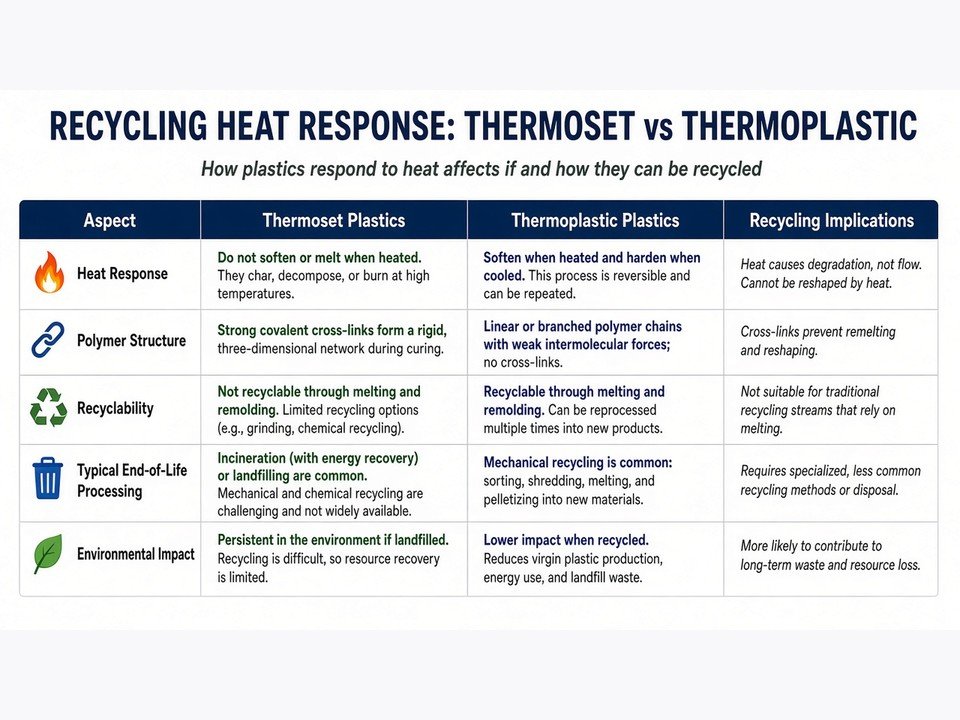
Material selection is reviewed against the drawing and application before production.
Frequently Asked Questions
What is the difference between thermoplastics and thermosets?
Thermoplastics soften and melt when heated and can be re-formed repeatedly. Thermosets cure into a permanent cross-linked network and cannot be re-melted or re-formed once set.
Which is stronger, thermoset or thermoplastic?
It depends on the grade and reinforcement. Thermosets are typically stiffer and more dimensionally stable at high temperature, while many engineering thermoplastics offer higher impact toughness. Neither wins universally.
Which is harder, thermoset or thermoplastic?
Cured thermosets generally present higher hardness and rigidity because of their cross-linked structure, though filled or reinforced thermoplastics can approach similar surface hardness.
Can thermosets be recycled?
Only in limited ways. Because they cannot be re-melted, thermosets are usually ground into filler or recovered for energy rather than mechanically recycled like thermoplastics.
Is PVC a thermoplastic or a thermoset?
PVC is a thermoplastic. It softens on heating and can be re-melted, which is why it is extruded and molded into pipes, profiles, and cable insulation.
Start Your Project
Not sure which polymer fits your part?
Send us your drawing or CAD file and tell us how the part will be used. Our engineering team reviews materials, tolerances, heat exposure, and production volume before quoting — so you commit to tooling with the right material, not a guess. From prototype through repeat production, we support CNC machining, injection molding, sheet metal fabrication, 3D printing, finishing, and inspection through one partner.
Get a Quote