
Manufacturing guide
Types of CNC Machines: Complete Guide to Varieties and Uses
We explain the main types of CNC machines, how each process works, where it is used, and how to select equipment for material, geometry, tolerance, volume, and budget requirements.
The right CNC process is determined by the part, not by the machine name alone. Material, geometry, tolerance, quantity, and required surface finish should guide the decision from the beginning.
What Is a CNC Machine?
A CNC machine is manufacturing equipment controlled by computer numerical control. Instead of relying only on manual handwheels or operator judgment, the machine follows programmed instructions that define tool movement, spindle speed, feed rate, cutting path, and other operating parameters.
A typical workflow starts with a CAD model or engineering drawing. CAM software converts the design into toolpaths, a postprocessor creates machine-specific code, and the controller interprets that code to move the cutting tool or workpiece. The machine then removes material, forms it, cuts it, bends it, or finishes its surface according to the programmed sequence.
Repeatable production
Once a process has been proven, the same program can produce consistent parts across prototype, pilot, and repeat production runs.
Controlled complexity
CNC equipment can coordinate multiple movements to create pockets, holes, threads, contours, tapers, and complex surfaces that are difficult to make manually.
Why it matters
CNC is essential in modern manufacturing because it connects digital product data with controlled physical production. However, programming alone does not guarantee a good part. Fixturing, tooling, material behavior, inspection, and design-for-manufacturing decisions remain equally important.
CNC Milling Machines
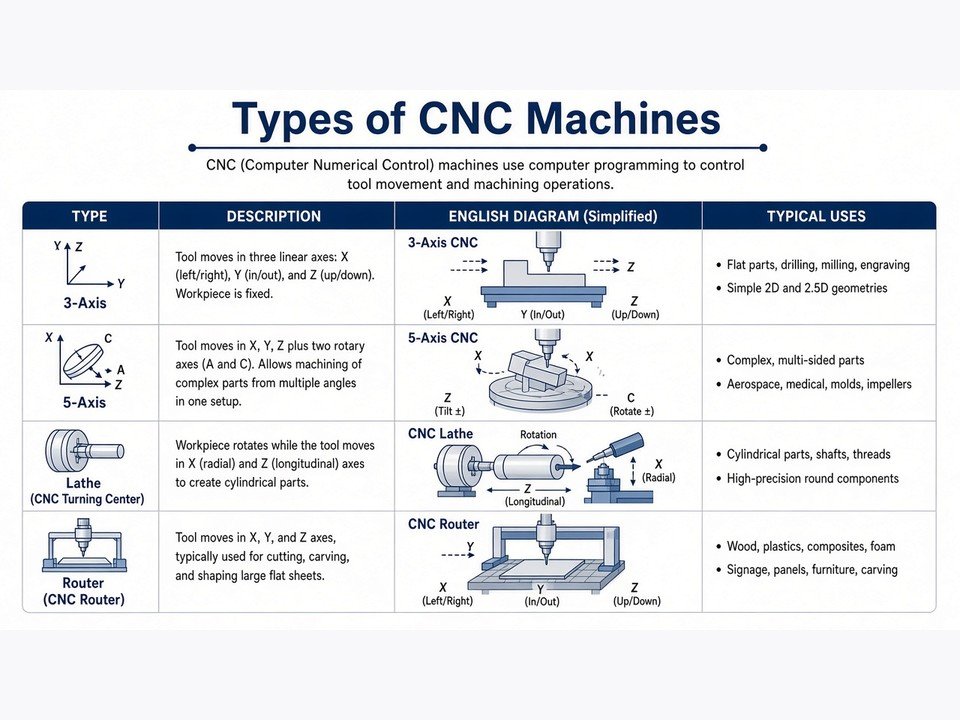
CNC mills remove material with rotating cutting tools. The workpiece is secured on a table while the tool and/or table move along controlled axes. Milling is one of the most versatile CNC processes because it can create flat faces, slots, pockets, contours, holes, and three-dimensional surfaces in metals, plastics, and other machinable materials.
Vertical and horizontal machining centers
Vertical machining centers have a spindle oriented vertically. They are widely used for plates, brackets, housings, fixtures, and general-purpose components because setup and workholding are comparatively straightforward. Horizontal machining centers use a horizontally oriented spindle and can provide advantages for parts requiring access to multiple sides, efficient chip evacuation, or high-volume production with palletized setups.
A three-axis mill is often sufficient when the tool approaches the part from one primary direction. Additional rotary axes can reduce repositioning and improve access to angled or multi-face features. At PartsMake, our CNC milling range includes 3-axis, 4-axis, and 5-axis machining for different part geometries and production requirements.
Milling applications
Prismatic components: housings, plates, brackets, fixtures, and structural parts with planar or pocketed features.
Complex surfaces: contoured components that benefit from 4-axis or 5-axis access and coordinated toolpaths.
Engineering development: prototypes and low-volume parts where dimensional control and design changes are important.
CNC Lathes and Turning Machines
CNC lathes and turning machines rotate the workpiece while a cutting tool travels along controlled axes. This makes them especially effective for cylindrical, conical, threaded, and rotationally symmetrical components.
Turning centers
A basic CNC lathe may perform external turning, facing, boring, grooving, and threading. A turning center can add features such as driven tooling, automatic tool changes, or additional axes, allowing some milling operations to be completed without transferring the part to a separate machine. Mill-turn machining combines turning and milling in one setup for more complex cylindrical components.
Turning use cases
Common turned parts include shafts, pins, bushings, sleeves, spacers, threaded parts, and rotational housings. Turning is often selected when the main geometry is centered around a rotational axis and the production process can benefit from efficient chip removal and repeatable tool motion.
Engineering note
For small precision components, Swiss machining can support parts up to Ø32 mm within our manufacturing capabilities. The best choice still depends on the part length-to-diameter ratio, features, tolerance requirements, and quantity.
CNC Routers
CNC routers use a rapidly rotating cutter, usually moving across a large table, to cut and shape sheet or panel materials. They are strongly associated with woodworking, but they can also machine plastics, foam, laminates, and selected composite materials. Some routers can process softer non-ferrous materials, although the machine design and tooling must be appropriate for the material.
Routers are useful when the part is relatively large, sheet-based, or flat compared with a typical machined metal component. Typical industries include furniture and cabinetry, signage, interior and exhibition fabrication, marine components, packaging, and composite panel production.
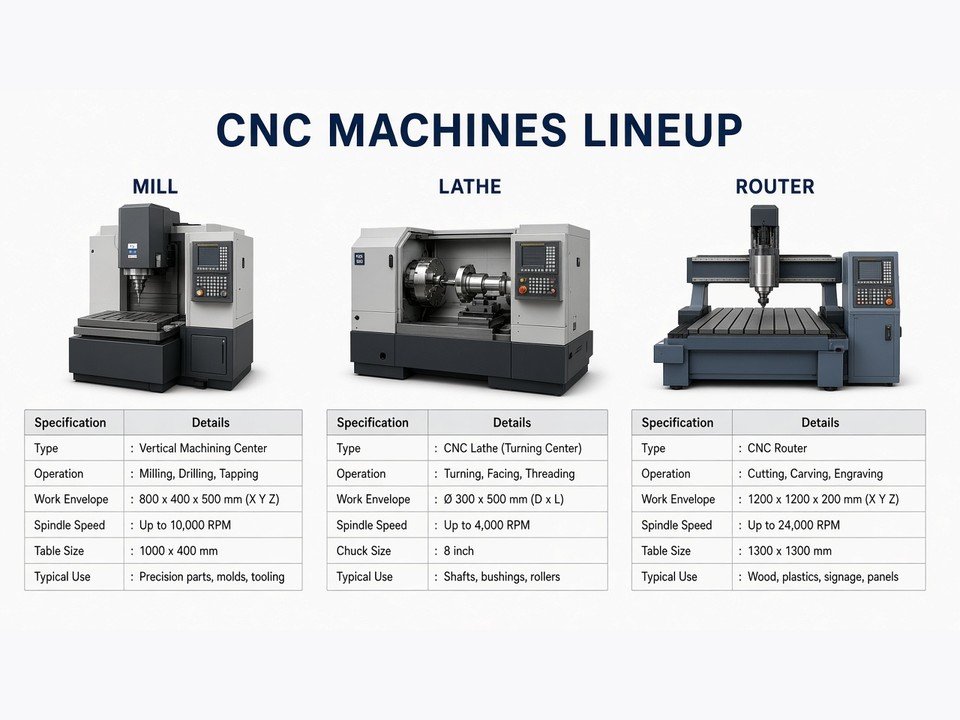
Compared with a metal-cutting machining center, a router is not automatically the better choice for tight-tolerance metal parts. We evaluate rigidity, spindle capability, material, workholding, edge quality, and required accuracy before recommending a routing process.
CNC Plasma, Laser, and Waterjet Cutters
CNC cutting machines move an energy source or cutting head along a programmed path. Plasma and laser cutting are thermal processes; waterjet cutting is primarily non-thermal. The correct technology depends on material, thickness, edge requirements, heat sensitivity, speed, and the precision expected from the cut.
| Technology | Typical strengths | Important considerations |
|---|---|---|
| Plasma | Efficient cutting of electrically conductive metal sheet and plate. | Creates a heat-affected zone and is generally selected where extreme fine-detail precision is not the primary requirement. |
| Laser | Fine profiles, narrow kerfs, and precise cutting of suitable metals and non-metal materials. | Material type, thickness, reflectivity, heat input, and machine capability affect the result. |
| Waterjet | Cold cutting of many metals, stone, glass, composites, and heat-sensitive materials. | Cut speed, abrasive use, taper, and edge condition must be considered for production planning. |
These technologies are often used for blanks, panels, brackets, enclosures, and sheet metal components before bending, welding, machining, or finishing. Cutting precision should be discussed alongside the downstream process because a cut profile may be intentionally left with machining allowance.
CNC EDM and Grinding Machines
EDM, or electrical discharge machining, removes electrically conductive material through controlled electrical discharges. The process does not cut by direct mechanical contact. It is valuable for hardened materials, intricate profiles, narrow slots, and features that would be difficult to produce with conventional cutting tools.
Wire EDM
A continuously moving wire cuts through conductive workpieces to create precise profiles, slots, and fine internal contours. It is commonly considered when the part is hardened or when a complex through-profile is required.
Sinker EDM
A shaped electrode creates a cavity or detailed feature in the workpiece. It is useful for molds, dies, and blind geometries that cannot be reached efficiently by a rotating cutter.
Grinding machines use an abrasive wheel to achieve controlled material removal and refined surface condition. Precision grinding can improve dimensional accuracy, flatness, roundness, and the quality of mating or wear surfaces. At PartsMake, precision grinding supports surface, cylindrical, and centerless grinding requirements.
Selection reminder
EDM requires electrical conductivity, while grinding is often used after another process has established the basic shape. We review the complete process chain rather than treating EDM or grinding as interchangeable with ordinary milling.
Multi-Axis CNC Machines
The number of CNC axes describes how many directions or rotary movements the machine can control. More axes do not automatically mean a better process. They become valuable when they improve tool access, reduce setups, protect datum relationships, or make complex surfaces practical to machine.
Understanding axis configurations
3-axis: controls movement along X, Y, and Z. It is suitable for many plates, brackets, pockets, holes, and straightforward contoured parts.
4-axis: adds a rotary axis, allowing the workpiece or tool to index around another direction. This can expose multiple faces with fewer manual setups.
5-axis: coordinates three linear and two rotary axes. It is useful for complex surfaces, angled features, impellers, medical components, aerospace forms, and parts requiring access to several faces.
Higher configurations: additional axes or mill-turn arrangements combine operations and may reduce handling for specialized parts.
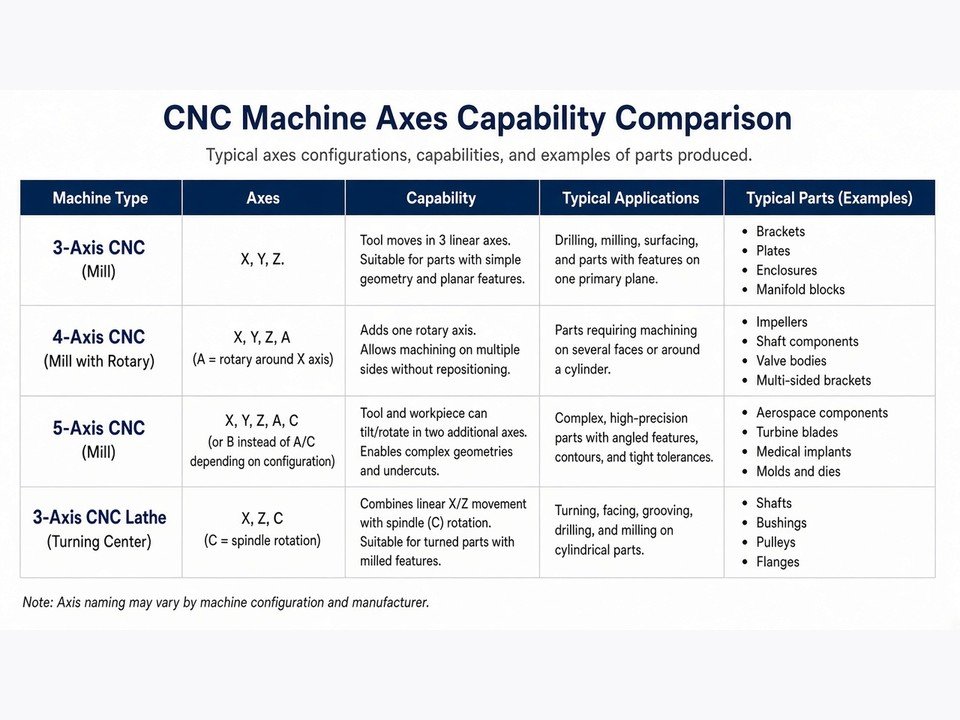
We usually recommend 5-axis machining when the geometry or datum strategy justifies it—not simply because the machine has more capability. A simpler machine can be more economical and easier to control when the component is prismatic and accessible.
Other CNC Machine Types
The main categories above cover many subtractive and cutting operations, but CNC control is also used in several other manufacturing systems:
CNC drilling machines
Designed primarily for accurate, repeatable hole-making, including drilling, reaming, tapping, and related operations.
CNC 3D printers
Use programmed paths to build parts layer by layer rather than remove material. PartsMake supports SLA, SLS, MJF, FDM, and metal printing for prototypes and low-volume parts.
CNC press brakes
Control sheet metal bending force, back gauge position, and bend sequence to produce repeatable panels, brackets, and enclosures.
CNC punch machines
Use programmed punches and dies to create holes, slots, louvers, and formed features in sheet metal.
How to Choose the Right CNC Machine
Choosing among the types of CNC machines is an engineering decision. Start with the part and the required result, then select the process that can achieve it reliably.
Material type and behavior
Identify whether the material is metal, plastic, composite, wood, electrically conductive, heat-sensitive, abrasive, or difficult to machine.
Part complexity and access
Review pockets, undercuts, angled faces, deep cavities, thin walls, rotational features, and the number of sides that require machining.
Production volume and repeatability
Prototype quantities may favor flexible milling or additive processes, while repeat production may justify automation, dedicated fixtures, turning, or combined mill-turn operations.
Precision and surface requirements
Define critical dimensions, fits, flatness, roundness, surface finish, cosmetic areas, and inspection expectations before selecting the process.
Work envelope and budget
Consider part size, stock size, workholding, tooling, setup count, secondary operations, and total process cost rather than machine purchase price alone.
At PartsMake, our engineering review considers drawings, CAD files, materials, tolerances, critical dimensions, surface requirements, and production quantities before production begins. That helps us identify manufacturing risks before material or tooling is committed.
Which CNC Machine Is Best for Beginners?
For beginners, a 3-axis CNC mill or a CNC router is usually the most accessible starting point. Both introduce the core concepts of CAD, CAM, workholding, tool selection, feeds and speeds, coordinate systems, and inspection without immediately requiring advanced multi-axis programming.
A router is a practical entry point for wood, plastics, foam, and some composites, particularly when the work is sheet-based or relatively large. A 3-axis mill is more appropriate for users working with metal or seeking tighter control over small prismatic components. The choice should follow the material and part requirements rather than the apparent simplicity of the machine.
Beginner checklist
Start with simple geometries, establish safe workholding, verify toolpaths before cutting, measure the first part, and record changes. These habits transfer directly to 4-axis, 5-axis, turning, EDM, and production environments.
What Are the 5 Most Common Types of CNC Machines?
Across general manufacturing, engineering development, and fabrication, the five most frequently encountered CNC machine categories are:
- 01
CNC milling machines for holes, pockets, faces, slots, contours, and complex solid parts.
- 02
CNC lathes and turning centers for shafts, pins, bushings, sleeves, and other rotational parts.
- 03
CNC routers for wood, plastics, composites, foam, panels, and larger sheet-based work.
- 04
CNC laser, plasma, and waterjet cutters for programmed profiles in sheet, plate, and other suitable materials.
- 05
CNC grinders and EDM machines for precision finishing, hardened conductive materials, intricate profiles, and specialized features.
What Is the Most Common CNC Machine?
The CNC milling machine is generally the most common and broadly useful CNC machine type in general manufacturing. Its popularity comes from its ability to produce a wide range of part shapes, work with many metals and plastics, support prototype and production quantities, and adapt to different levels of complexity.
That does not make milling the correct answer for every component. A shaft is normally more naturally produced by turning, a thin sheet profile may be better cut by laser or waterjet, and a hardened intricate cavity may require EDM. The most common machine is not necessarily the most efficient machine for a specific design.
FAQ
What are the top 3 manufacturers of CNC machines?
The answer depends on region, machine category, application, and how “top” is measured. Mazak, DMG MORI, and Okuma are three widely recognized global manufacturers, while other established companies may be preferred for specific milling, turning, grinding, EDM, or fabrication requirements. Buyers should compare machine suitability, service support, controller familiarity, accuracy, work envelope, and lifecycle cost rather than brand name alone.
Which CNC machine is best for complex parts?
A 5-axis machining center or mill-turn machine may be suitable when a part has complex surfaces, angled features, or several critical faces. EDM may be better for hardened conductive material or narrow intricate profiles. The best option depends on the actual geometry, datum scheme, material, tolerance, and required finish.
Is CNC machining better than 3D printing?
Neither is universally better. CNC machining is often selected for precise subtractive production in metal and engineering plastics, while 3D printing is useful for rapid prototypes, complex additive geometries, and low-volume parts. PartsMake supports both, so we can evaluate the design and recommend a process or combination of processes.
How should I choose a CNC process for production?
Begin with material, annual or batch quantity, geometry, critical tolerances, surface requirements, inspection needs, and target cost. Then compare setup count, tooling, cycle time, secondary operations, finishing, and quality control. A manufacturing review before production can reveal risks that are not visible from the CAD model alone.
Choose the Process That Fits the Part
At PartsMake, we support projects from prototype through repeat production with CNC milling, 5-axis machining, CNC turning, mill-turn machining, Swiss machining, EDM, precision grinding, injection molding, sheet metal fabrication, 3D printing, finishing, and inspection.
Send us your CAD files or drawings and we will review the material, tolerances, critical dimensions, surface requirements, quantity, and intended application before recommending a practical manufacturing route.
Discuss your CNC project