
Manufacturing guide
Types of Machining Operations: Processes, Tools & Modern Applications
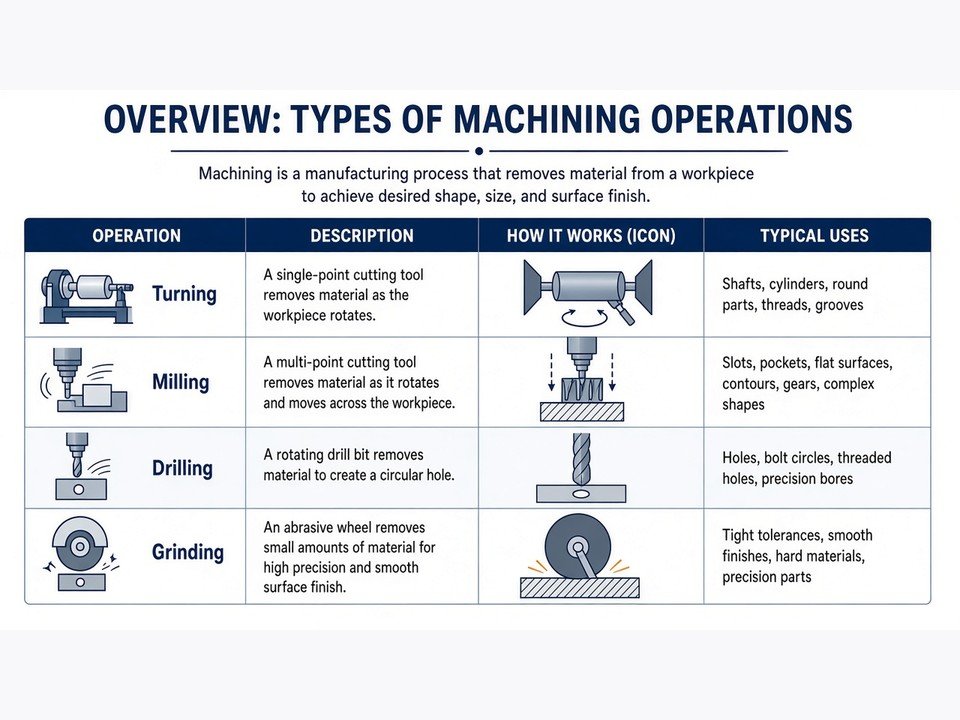
Machining converts raw material into accurate, functional components through controlled material removal. In this guide, I explain the main types of machining operations, how conventional and non-conventional processes differ, and how CNC, cutting tools, and sustainable practices shape modern production.
The right machining process is determined by the part’s geometry, material, tolerance, surface requirement, quantity, and intended use—not by the machine name alone.
What Is Machining and Why It Matters
Machining is a subtractive manufacturing process. A cutting tool, abrasive, electrical discharge, fluid jet, or concentrated energy source removes material from a workpiece until the desired shape and dimensions are achieved. The removed material may form chips, particles, or melted and eroded material, depending on the process.
This makes machining essential for parts that need controlled fits, accurate holes, flat mounting surfaces, threads, sealing features, or complex three-dimensional profiles. A machined component may be made from aluminum, steel, stainless steel, titanium, engineering plastic, or another material selected for the application.
From raw stock to functional part
A billet, bar, plate, tube, or casting can be machined into a housing, shaft, bracket, fixture, or structural component. The process removes only the material needed to create the required geometry.
Why process choice matters
Process selection influences achievable tolerance, surface finish, cycle time, tool life, setup complexity, and total production risk. Reviewing these factors early helps avoid redesign and rework.
What Are Different Types of Machining Operations?
The broadest distinction is between conventional machining, where a tool makes direct mechanical contact with the workpiece, and non-conventional machining, where material is removed through electrical, thermal, chemical, abrasive, or fluid-based energy. Within those groups are operations designed for rotating parts, prismatic parts, holes, profiles, surfaces, and difficult materials.
In practice, one component may use several operations. For example, a turned shaft can receive milled flats, drilled cross-holes, ground bearing surfaces, and a final inspection. At PartsMake, our engineering review considers the complete drawing and application before selecting the process sequence.
Conventional Machining Processes
Conventional operations use a cutting edge or abrasive grain to shear, scrape, or grind material away. Turning, milling, drilling, boring, reaming, tapping, and grinding are common examples.
Turning: the workpiece rotates while a single-point tool creates cylindrical diameters, shoulders, tapers, grooves, or threads.
Milling: a rotating multi-point cutter travels through or around a stationary workpiece to create pockets, slots, contours, and planar surfaces.
Drilling: a rotating drill creates a hole, which may then be enlarged, finished, threaded, or counterbored.
Non-Conventional Machining Processes
Non-conventional methods are useful when ordinary cutting forces would damage the part, when the material is extremely hard, or when the geometry is difficult to reach with a physical tool.
| Process | How material is removed | Typical value |
|---|---|---|
| Laser machining | A concentrated laser beam melts or vaporizes material. | Fine cutting, marking, and detail work with limited tool contact. |
| Waterjet machining | A high-pressure water stream, sometimes carrying abrasive, cuts the workpiece. | Cold cutting of sheet, plate, composites, and heat-sensitive materials. |
| EDM | Controlled electrical discharges erode conductive material. | Hardened materials, narrow features, deep cavities, and complex profiles. |
| Ultrasonic machining | High-frequency tool vibration and abrasive slurry remove material. | Brittle, hard, or non-conductive materials that are difficult to cut conventionally. |
The 3 Core Machining Processes
Turning, milling, and drilling form the foundation of most machining workshops. They can be performed manually for one-off work or programmed on CNC equipment for repeatable production. Many additional operations are variations or finishing stages built around these three principles.
Turning Operations
In turning, a lathe rotates the workpiece around its centerline while a single-point cutting tool moves along or across the part. The tool can remove material from the outside diameter, inside diameter, end face, or a defined contour.
Common lathe operations include facing, straight turning, taper turning, boring, grooving, parting, threading, and knurling. Typical applications include shafts, pins, bushings, sleeves, spacers, and threaded cylindrical components. CNC turning and mill-turn machining can combine rotational work with live-tool milling features in one coordinated setup.
Engineering note
For a turned part, specify the functional diameters, concentricity relationships, thread requirements, and bearing or sealing surfaces clearly. These details determine the setup, tooling, and inspection approach.
Milling Operations
Milling uses a rotating cutter with multiple teeth. The cutter and workpiece move relative to one another along controlled axes, allowing material to be removed from a flat block, plate, casting, or partially machined component.
Face milling creates broad planar surfaces; end milling produces pockets, slots, steps, and contours; shoulder milling forms perpendicular walls; and profile milling follows an external or internal outline. Three-axis machining is effective for many prismatic parts, while four-axis and five-axis machining can reach multiple faces or complex surfaces with fewer setups.
Where milling is commonly used
CNC milling is well suited to housings, brackets, plates, fixtures, structural components, manifolds, and tooling. A part’s deep pockets, thin walls, internal corners, and clamping surfaces should be reviewed before machining begins.
Drilling Operations
Drilling creates round holes with a rotating drill bit. A hole may be a simple clearance feature, a locating feature, a passage for a cable or fluid, or the starting point for a fastener thread.
Different drill geometries and tool materials are selected for the workpiece. After drilling, reaming can improve hole size and finish, boring can correct or enlarge a hole, and tapping can create internal threads. Countersinking and counterboring prepare holes for specific fastener heads.
Position
Confirm the hole location from functional datums.
Depth
Define blind-hole depth, breakthrough, and chip evacuation needs.
Finish
State whether drilling alone, reaming, boring, or grinding is required.
What Are the 7 Basic Types of Machine Tools?
The following seven machine-tool categories cover the core equipment used to shape, finish, and prepare engineered components. Modern CNC equipment may combine several categories in one machine, but the underlying operations remain recognizable.
- 1
Lathe: rotates the workpiece for turning, facing, boring, grooving, and threading.
- 2
Milling machine: rotates a multi-point cutter to create surfaces, pockets, slots, and profiles.
- 3
Drill press: provides controlled spindle rotation and feed for hole-making.
- 4
Grinding machine: uses abrasive wheels to achieve accurate dimensions and refined surfaces.
- 5
Broaching machine: pulls or pushes a toothed tool through a part to form repeated internal or external profiles.
- 6
Sawing machine: separates stock or produces rough blanks with a continuous toothed blade.
- 7
EDM machine: uses electrical discharges for precise erosion of conductive materials, including hardened workpieces.
Differences Between Conventional and Non-Conventional Machining
Neither category is universally better. Conventional machining is often efficient and flexible for standard materials and accessible geometries. Non-conventional machining becomes valuable when hardness, brittleness, miniature features, thermal sensitivity, or geometric access limits ordinary cutting.
| Consideration | Conventional machining | Non-conventional machining |
|---|---|---|
| Material compatibility | Broad range of metals and plastics, depending on tool and machine. | Useful for hardened, brittle, heat-sensitive, or difficult-to-cut materials; EDM requires electrical conductivity. |
| Surface finish | Can range from rough removal to fine finishing with suitable tooling. | Can produce specialized finishes, but the result depends strongly on energy settings and process control. |
| Speed | Often productive for stock removal and common geometries. | May be preferred for challenging features even when removal rates are lower. |
| Accuracy | Strong repeatability when machine condition, setup, and tools are controlled. | Can reach intricate profiles with limited mechanical cutting force. |
| Tool requirements | Uses cutting tools, holders, fixtures, and abrasives. | Uses electrodes, nozzles, lasers, abrasive media, or vibrating tools. |
Role of CNC in Modern Machining Operations
Computer numerical control, or CNC, directs machine movement through programmed instructions. Instead of relying on manual handwheels for every motion, the machine follows coordinated axes, spindle speeds, feeds, tool changes, and machining paths.
CNC does not replace engineering judgment. It improves the repeatability of a well-designed process. The programmer and machinist still need to select workholding, tools, cutting conditions, datums, toolpaths, and inspection points appropriate to the part.
Automation and repeatability
A validated CNC program can repeat the same sequence across prototype, pilot, low-volume, and repeat production while reducing manual variation.
Complex geometry
Multi-axis machining supports features on several faces and complex surfaces that would require multiple setups on simpler equipment.
At PartsMake, CNC milling, CNC turning, five-axis machining, mill-turn machining, and Swiss machining are evaluated according to the component’s geometry and production stage. We can also coordinate machining with grinding, EDM, finishing, inspection, molding, sheet metal fabrication, or 3D printing when a project needs more than one process.
Cutting Tools and Selection Criteria
Tool selection connects the part drawing to the machining strategy. Single-point tools are common in turning, while multi-point tools are used in milling, drilling, broaching, and sawing. Abrasive tools are selected for grinding and precision finishing.
The tool material, coating, geometry, diameter, number of flutes, nose radius, and edge preparation all affect cutting performance. The correct choice depends on the workpiece material, feature size, rigidity, depth of cut, required finish, and available coolant or lubrication method.
Selection checklist
Material: match tool hardness, toughness, and geometry to the workpiece.
Speeds and feeds: balance spindle speed, feed rate, chip load, and depth of cut.
Rigidity: control tool overhang, workholding, and vibration before increasing cutting conditions.
Feature access: choose a tool that reaches the feature without excessive deflection or collision risk.
Inspection: connect critical features to a practical measurement method before production.
Current Trends and Environmentally Friendly Techniques
Modern machining is moving toward better process visibility, reduced waste, and more deliberate use of energy and cutting fluids. Sustainability is not limited to one machine setting; it also includes choosing a suitable process, reducing unnecessary setups, and making parts right the first time.
Dry and minimum-fluid machining
Where material, tool life, heat, and surface requirements permit, dry machining or reduced-fluid strategies can limit coolant use and associated handling. The approach must be validated for the specific material and operation.
Digital and multi-axis production
Improved CAM programming, simulation, probing, and multi-axis equipment help reduce setup count and improve control of complex features.
Hybrid manufacturing decisions
A prototype may be produced by 3D printing and then machined at critical interfaces, while a production component may combine molding, machining, sheet metal, finishing, and inspection.
For each project, we look at the full lifecycle: prototype, engineering samples, pilot production, low-volume production, and repeat production. A process that is practical for one prototype may not be the best choice for consistent repeat manufacturing.
FAQ
What are different types of machining operations?
Common operations include turning, milling, drilling, boring, reaming, tapping, threading, grinding, broaching, sawing, EDM, laser machining, waterjet cutting, and ultrasonic machining. They can be grouped into conventional and non-conventional processes.
What are the different types of milling operations?
Face milling creates broad flat surfaces; end milling produces pockets and slots; shoulder milling forms steps and walls; slot milling cuts channels; and profile or contour milling follows internal or external shapes. Multi-axis milling extends access to multiple faces and complex surfaces.
What are the 7 basic types of machine tools?
The seven basic categories are lathes, milling machines, drill presses, grinding machines, broaching machines, sawing machines, and EDM machines. CNC systems may combine or automate several of these functions.
What are the 6 types of manufacturing processes?
A common high-level classification includes subtractive manufacturing, additive manufacturing, formative manufacturing, casting, joining, and finishing or surface treatment. Machining belongs primarily to subtractive manufacturing, although real projects often combine several process families.
Plan your next component
Need help choosing the right machining process?
Send PartsMake your drawing or CAD data. We will review the material, geometry, tolerances, surface requirements, quantity, and application before recommending a practical manufacturing route.
Contact PartsMake