
Materials Engineering Guide
12 Common Types of Sheet Metal: A Comprehensive Material Guide
Choosing the right material for your project? We explain the properties, trade-offs, and practical applications of the most common types of sheet metal, from steel and aluminum to copper, brass, titanium, and specialty coated materials.
Introduction: What is Sheet Metal?
Sheet metal is metal formed into thin, flat pieces through an industrial rolling or forming process. It can be cut, bent, punched, folded, welded, and finished to produce parts such as enclosures, panels, brackets, frames, guards, and structural components.
The phrase types of sheet metals covers much more than a list of alloys. The material’s grade, temper, surface condition, thickness, coating, and manufacturing route all affect the final part. Selecting correctly at the beginning helps us control fabrication risks, achieve the required durability, and avoid paying for performance the application does not need.
Key takeaway
The best sheet metal is not automatically the strongest or most expensive option. It is the material whose mechanical, environmental, aesthetic, and fabrication characteristics match the part’s real operating conditions.
Why Material Selection Matters in Fabrication
Material choice affects nearly every stage of production. A strong material may increase weight or require more forming force. A lightweight alloy may reduce mass but require different tooling, bend allowances, or joining methods. A corrosion-resistant grade may cost more initially while reducing the need for protective finishing and replacement later.
We evaluate the end-use environment before recommending a material. An indoor electronics enclosure has different requirements from an outdoor frame, a food-contact component, a decorative architectural panel, or a structural bracket. Temperature, humidity, chemicals, wear, vibration, appearance, and cleaning methods can all change the appropriate choice.
Mechanical trade-offs
Compare tensile strength, stiffness, formability, weight, and resistance to impact or wear. A material that performs well in one category may require compromises in another.
Environmental and budget trade-offs
Indoor and outdoor service, exposure to moisture or chemicals, required appearance, material availability, finishing, and production quantity all influence total cost—not just the sheet price.
Common Types of Steel Sheet Metal
Steel remains one of the most widely used sheet materials because it offers a practical balance of strength, availability, formability, and cost. The processing route and alloy content determine how a steel sheet behaves during cutting, bending, welding, finishing, and service.
Cold-Rolled Steel
Cold-rolled steel is processed at lower temperatures after initial rolling. This produces a smoother surface, more consistent thickness, and tighter dimensional control than many hot-rolled products. Its clean appearance also makes it suitable when the part will be painted or used where surface quality matters.
We commonly consider it for precision brackets, panels, housings, machine covers, and formed parts that require predictable dimensions. It is often a strong option for indoor fabricated components, provided the final environment does not demand additional corrosion protection.
Hot-Rolled Steel
Hot-rolled steel is shaped at high temperatures, which makes it economical for producing larger sections and general-purpose sheet. Its surface is typically rougher and may carry mill scale, and its dimensional tolerances are generally less precise than cold-rolled material.
That trade-off is often worthwhile for structural supports, frames, base plates, brackets, and industrial components where strength and cost matter more than a smooth cosmetic finish.
Stainless Steel
Stainless steel contains alloying elements that improve resistance to corrosion and staining. Grade 304 is a common general-purpose choice, while grade 316 offers improved resistance in more demanding environments, including exposure to salts and certain chemicals.
Stainless sheet is used for equipment panels, food-related applications, laboratory equipment, enclosures, architectural components, and parts where cleanability and appearance are important. The grade should be selected with the actual environment in mind rather than relying on the word “stainless” alone.
Galvanized Steel
Galvanized steel has a protective zinc coating applied to the steel surface. The coating helps isolate the underlying steel from moisture and provides sacrificial protection when the surface is exposed to minor damage.
It is frequently used for outdoor brackets, ducts, panels, cabinets, roofing-related components, and utility structures. During fabrication, we account for the coating when cutting, bending, welding, and planning any exposed edges or post-processing.
Carbon Steel
Carbon steel is valued for its high strength-to-weight ratio, broad industrial utility, and availability in many forms. Its performance depends on carbon content and grade, while its untreated surface generally requires paint, plating, coating, or another protective approach when corrosion is a concern.
It is a practical choice for frames, machinery components, supports, brackets, guards, and general fabricated parts. For cost-sensitive projects, carbon steel is often one of the first materials we compare against alternatives.
Lightweight and Non-Ferrous Sheet Metals
Non-ferrous metals do not use iron as their primary element. They are often selected for low weight, electrical or thermal conductivity, corrosion resistance, appearance, or specialized performance. Their forming and joining behavior can differ substantially from steel, so design details should be reviewed before production.
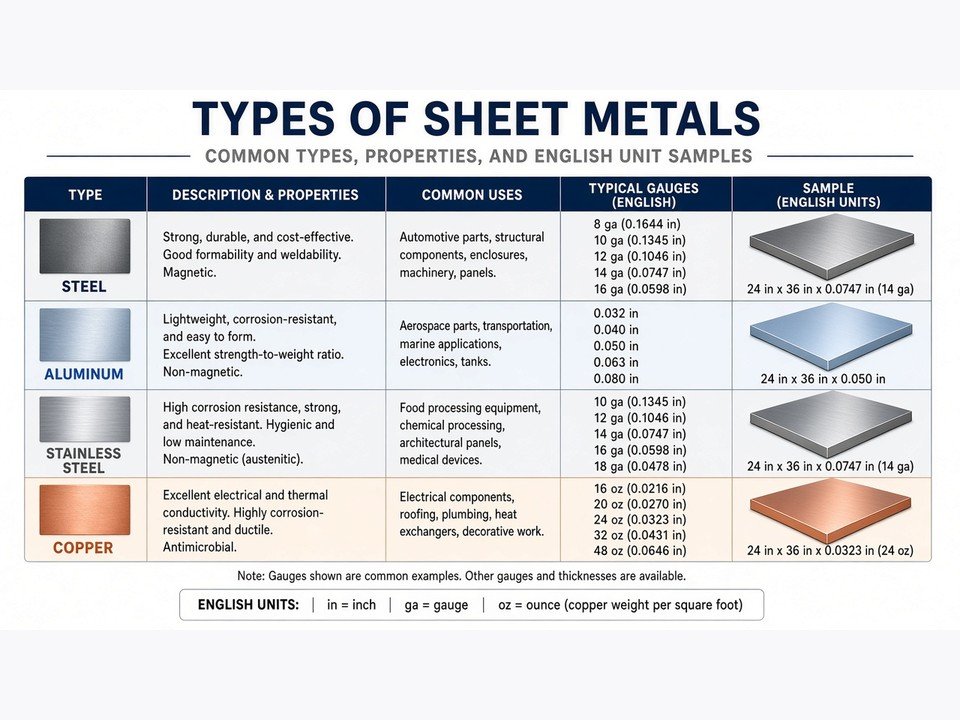
Material selection should connect the alloy to the part’s function, forming method, surface requirements, and service environment.
Aluminum
Aluminum is lightweight and offers an excellent strength-to-weight ratio. It also provides useful corrosion resistance and can be formed into panels, covers, brackets, housings, and transportation components without the mass associated with many steel alternatives.
Alloy selection matters. Aluminum 5052 is commonly considered for formed sheet parts because of its formability, while 6061 is often selected when higher structural performance and machining compatibility are important. We also review bend direction, radius, temper, and finishing requirements before fabrication.
Copper
Copper is known for very high electrical and thermal conductivity. That makes copper sheet valuable for electrical components, busbars, grounding elements, heat-transfer applications, and selected thermal management designs.
Its warm color and distinctive surface also give it architectural and decorative appeal. Copper is relatively soft, so handling, forming, surface protection, and cosmetic expectations should be discussed early.
Brass
Brass is a copper-zinc alloy with a recognizable gold-like appearance. It offers good machinability, low friction in suitable applications, and useful resistance to corrosion, making it attractive for hardware, fittings, electrical components, decorative panels, and architectural details.
The exact balance of color, strength, formability, and machinability depends on the brass grade. We recommend confirming the required finish and functional performance rather than specifying brass only by appearance.
Titanium
Titanium delivers exceptional strength at relatively low weight and offers strong corrosion resistance. These advantages make it a high-performance option for aerospace, medical, chemical, and other demanding applications where material performance justifies additional cost and fabrication complexity.
Because titanium can require careful process control, tool selection, and joining practices, it should be evaluated as part of the complete manufacturing plan—not treated as a simple substitute for aluminum or steel.
Specialty and High-Performance Sheet Metals
Some sheet products are engineered around a specific environment or production objective. Coatings may improve heat or corrosion resistance, pre-finished surfaces may reduce downstream work, and layered materials may combine properties that are difficult to obtain from one alloy.
Aluminized Steel
Aluminized steel uses an aluminum-silicon coating over a steel substrate. The steel provides a useful structural base, while the coating improves resistance to heat and oxidation in appropriate service conditions.
This material can be considered for heat shields, exhaust-related components, appliances, ducts, and other parts where temperature exposure is more important than a standard untreated steel surface.
Pre-Plated Steel
Pre-plated steel arrives with a finished protective or functional coating already applied. Depending on the product, this may reduce the need for a separate plating or finishing cycle after fabrication.
The advantage is a potentially shorter production sequence, but forming and cutting can affect the coating at edges, bends, and pierced features. We review the part design and required appearance before deciding whether a pre-finished sheet is appropriate.
Composite Sheet Metals
Composite sheet metals use multiple layers or material combinations to deliver a tailored balance of stiffness, weight, corrosion resistance, heat performance, sound control, or appearance. These modern constructions can be useful when a single alloy cannot satisfy all design requirements.
They also introduce considerations such as edge treatment, layer compatibility, joining, and forming behavior. The manufacturing process should therefore be selected together with the material system.
How to Choose the Right Sheet Metal for Your Project
We recommend treating material selection as a structured engineering decision. Start with the part’s load and environment, then confirm that the material can be formed, joined, finished, inspected, and sourced within the project’s budget and schedule.
Define mechanical requirements
Identify tensile strength, stiffness, impact resistance, weight limits, fatigue exposure, and wear conditions.
Evaluate the environment
Consider moisture, salt, chemicals, temperature, cleaning, outdoor exposure, and whether corrosion protection is required.
Check fabrication behavior
Confirm weldability, bendability, springback, cutting method, joining approach, surface sensitivity, and finishing compatibility.
Balance performance and cost
Compare material cost, processing time, finishing, inspection, expected service life, and production quantity—not material price alone.
| Material | Key characteristics | Best-use examples |
|---|---|---|
| Cold-rolled steel | Smooth surface, tight tolerances | Precision panels, brackets, housings |
| Hot-rolled steel | Economical, strong, rougher surface | Structural frames, supports, base plates |
| Stainless steel | Corrosion resistance, cleanable surface | Food, laboratory, outdoor, architectural parts |
| Galvanized steel | Zinc-coated corrosion protection | Outdoor panels, ducts, utility components |
| Aluminum | Low weight, good strength-to-weight ratio | Lightweight housings, brackets, transportation parts |
| Copper | High electrical and thermal conductivity | Electrical, thermal, and decorative applications |
| Brass | Low friction, machinability, decorative appearance | Hardware, fittings, electrical and architectural parts |
| Titanium | High performance, low weight, corrosion resistance | Aerospace, medical, and demanding environments |
Fabrication note
At PartsMake, our engineering review considers drawings, CAD files, tolerances, critical dimensions, surface requirements, production quantities, material, and intended application before production begins. That review helps identify material and process risks early.
Frequently Asked Questions
What are the 8 most common sheet metals used in the industry?
The eight commonly used categories are cold-rolled steel, hot-rolled steel, stainless steel, galvanized steel, aluminum, copper, brass, and carbon steel. The right choice among them depends on strength, corrosion resistance, weight, appearance, fabrication needs, and budget.
What is the strongest type of sheet metal?
High-strength carbon steel can provide very high strength at a comparatively practical cost. Titanium offers an exceptional combination of strength and low weight, but it is a high-performance material with different fabrication and cost considerations. “Strongest” should therefore be defined against the application, weight limit, environment, and manufacturing method.
What is the cheapest type of sheet metal?
Hot-rolled steel and general carbon steel are typically among the most budget-friendly options because of their broad industrial availability and straightforward processing. The final part cost still depends on thickness, quantity, cutting, bending, welding, finishing, inspection, and any corrosion protection required.
How do I choose between aluminum and stainless steel?
Choose aluminum when low weight and a strong strength-to-weight ratio are priorities. Choose stainless steel when corrosion resistance, cleanability, surface durability, or a more robust material feel is more important. We also compare the required forming, joining, finishing, and service environment before making a final recommendation.
What is the most common sheet metal for DIY projects?
Cold-rolled steel is a common choice for indoor DIY projects because it has a relatively smooth, consistent surface and is easy to paint or finish. Galvanized steel is useful when additional resistance to moisture is needed. The best option still depends on the available tools, thickness, required bends, and intended environment.
Conclusion: Optimizing Your Fabrication Results
There is no universally best sheet metal. Cold-rolled and hot-rolled steels can offer practical strength and value, stainless and galvanized products can address corrosion concerns, aluminum can reduce weight, copper and brass can provide conductivity or visual appeal, and titanium can solve demanding performance problems.
Before finalizing your material, evaluate the part’s mechanical loads, environmental exposure, appearance, fabrication route, finishing requirements, production quantity, and total budget. A thoughtful material decision at the design stage helps us reduce rework and deliver parts that are ready for assembly and use.
PartsMake supports projects from prototype and engineering samples through pilot production, low-volume production, and repeat manufacturing. Our capabilities include sheet metal fabrication, CNC machining, injection molding, 3D printing, surface finishing, and inspection, coordinated through one engineering and project management team.
Discuss your material and fabrication plan
Need help selecting sheet metal for a real part?
Share your drawing, CAD file, material preferences, tolerances, surface requirements, quantity, and intended application. We will review the manufacturing risks and help identify a practical path from prototype to production.